
How To Clean Case Fans: A Step-by-Step Walkthrough
Dusty case fans are one of those problems you hear before you see. The whine gets louder, temperatures creep up a few degrees under load, and one day you.

We independently review everything we recommend. When you buy through our links, we may earn a commission. As an Amazon Associate we earn from qualifying purchases. Learn more ›
Keep your processor running at optimal temperatures with the best CPU coolers available today. From air coolers to liquid cooling solutions, explore top options designed for performance, efficiency, and quiet operation.
Dusty case fans are one of those problems you hear before you see. The whine gets louder, temperatures creep up a few degrees under load, and one day you.
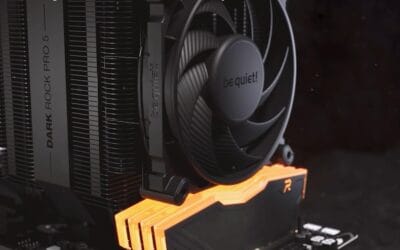
Two dual-tower air coolers, two very different philosophies. The Noctua NH-D15 chromax.Black runs about $119.95 and carries a 4.2 rating, while the be quiet!.

Ask this question in any build thread and you'll get twenty confident answers, half of them wrong.

If you've ever opened your motherboard's fan settings and seen a dropdown labeled "PWM" next to another one labeled "DC," you're not alone in wondering what.

Your PC has a quiet superpower it uses every second it's on: it decides, moment by moment, how fast the fans should spin. That decision isn't random.
A fan curve is the rule that tells your fans how fast to spin at any given temperature, and setting one up yourself is the difference between a PC that roars.

An Intel Core i9 is a lot of chip. Under a heavy render or a long gaming session, a top-end i9 can push past 250 watts, and that heat has to go somewhere.

The Ryzen 7 9800X3D is a strange beast to cool. It's AMD's flagship gaming chip, built on the second-generation 3D V-Cache design, and it runs hot in short.

Case fans are the quiet workhorses of any build. They pull cool air across your components, push hot air out the back and top, and keep temperatures low.

Small cases punish big coolers. A tower heatsink that clears 160mm in a full ATX build turns into a physical wall inside a slim HTPC or a compact office box.