

Small cases punish big coolers. A tower heatsink that clears 160mm in a full ATX build turns into a physical wall inside a slim HTPC or a compact office box, so the search for the best low profile CPU cooler in 2026 is really a search for cooling that fits under a tight side panel without cooking your processor. Height clearance is the number that ends most builds. Miss it by 5mm and the panel won’t close, no matter how good the fan spec looks on paper.
We researched compact-cooling options across price tiers, from a bare-bones stock unit at $15.99 up to a slim 360mm liquid loop near $70, plus the paste and airflow gear that quietly decide whether your low-profile setup holds temps or throttles. Owner reports and published specs did the heavy lifting here, since claims about hands-on lab runs would be dishonest. If you want the broader picture across all tower and liquid designs, our roundup of the best CPU cooler picks for 2026 covers the taller options, and shoppers on a tight budget should also skim the best budget CPU cooler guide before spending more than a compact build needs.

Pros
- Native LGA 1150, 1155, and 1156 socket support covers three legacy Intel generations
- 4-pin PWM connector enables proper fan curve control via BIOS
- OEM-style aluminum heatsink footprint keps RAM and VRM clearance predictable
- Push-pin mount installs without removing the motherboard from the case
Cons
- Zero owner fedback available at time of writing, real-world thermals unverified
- Aluminum-only heatsink with no heatpipes struggles with overclocked or unlocked K-series CPUs
- Restricted to obsolete Intel sockets, no path forward to LGA 1200, 1700, or AM5
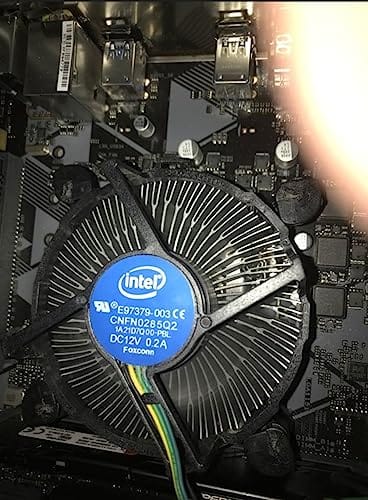
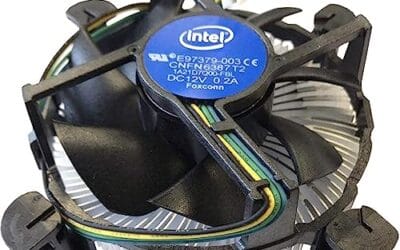
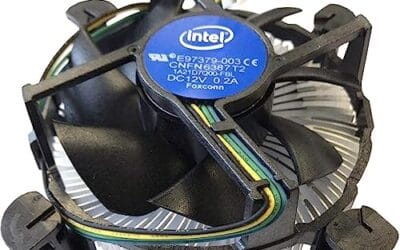
The Intel E97379-003 is an OEM-style stock CPU cooler built for LGA 1150, 1155, and 1156 boards, covering Core i3, i5, and i7 chips from the Sandy Bridge through Haswell era. It targets one specific buyer: someone repairing, refurbishing, or restoring a legacy Intel desktop that lost its original heatsink.
The defining feature is compatibility, not performance. A 3.5-inch fan sits on an aluminum heatsink with a 4-pin PWM header, matching the original OEM cooler dimensions Intel shipped in retail boxes. Stock coolers in this class typically handle 65W to 84W TDP chips at stock clocks, which lines up with locked i3, i5, and non-K i7 SKUs on these sockets.
Trade-offs are typical for a boxed-style cooler. There are no heatpipes, no copper base contact, and no tower geometry, so sustained multi-core loads will spin the fan up and get audible. Push-pin mounting is convenient but less secure than a backplate design, and overclocking headroom is effectively zero. Owner feedback is not available at time of writing.
Buy this if you need a like-for-like OEM replacement for a locked LGA 1150, 1155, or 1156 CPU and want to kep the original acoustic and clearance profile. Skip this if the CPU is a K-series part, if you plan to overclock, or if the target socket is LGA 1200 or newer.
Socket coverage: Native mounting for LGA 150, 1155, and 1156 only. That spans 2nd, 3rd, and 4th generation Core i3, i5, and i7 desktop chips. No adapter is included for LGA 1200, 1700, or AM4/AM5, so this cooler is locked to legacy Intel repair scenarios.
Heatsink and fan: Aluminum radial-fin heatsink with a 3.5-inch axial fan on a 4-pin PWM connector. No heatpipes, no copper slug, no vapor chamber are indicated in source data. TDP handling is not specified, but OEM colers of this geometry are typically rated for the 65W to 84W stock TDP band on these sockets.
Mounting and clearance: Push-pin retention through the four motherboard holes, no backplate required, install possible without removing the board. Cooler height sits low enough to clear standard mid-tower side panels, and the round footprint keps RAM slots and VRM heatsinks unobstructed. Exact height in mm is not specified.
Acoustics and headroom: Noise level in dBA is not specified. Based on OEM stock cooler behavior at this size, expect quiet idle and audible ramp under sustained all-core load. Overclocking a K-series chip on this heatsink is not advisable, thermal headroom above 84W is minimal.

Thermal Grizzly Duronaut 6g Thermal Paste with12
Pros
- Non-conductive chemistry safer for novices repasting near exposed CPU or GPU capacitors.
- 6g volume suports several full applications on desktop CPUs and console APUs.
- Wet and dry wipes included, so no isopropyl bottle or lint-free cloth need.
Cons
- Limited owner fedback at time of writing makes long-term durability claims hard to verify.
- Non-metal formula typically trails top liquid metals by a few degrees under sustained load.
- Viscosity, TIM lifespan hours, and thermal conductivity W/mK figures are not specified.
Duronaut is Thermal Grizzly's non-conductive thermal paste positioned as a mid-tier daily driver, shipping in a 6g syringe with 6 wet and 6 dry cleaning wipes. The target buyer is a DIY PC builder repasting a CPU or GPU cooler, or a console owner refreshing PS4, PS5, or Xbox thermals without risking shorts.
The defining trait is the aluminum microparticle plus zinc oxide nanoparticle blend paired with an electrically non-conductive base. Thermal Grizzly claims reduced pump-out and stable performance over extended cycles, which maters most on soldered console APUs and overclocked desktop chips that see large delta-T swings. Exact W/mK conductivity is not specified in the source.
Trade-offs are typical for non-conductive pastes at this tier. Expect a few degrees warmer than liquid metal on delided or high-wattage CPUs, and no published viscosity or cure-time data to plan application around. Owner feedback is limited at time of writing, so long-term hardening resistance relies on vendor claims rather than independent long-run testing.
Buy this if you want a safe, non-conductive paste with enough volume for several repastes and a bundled wipe kit for console or GPU jobs. Skip this if you are chasing the absolute lowest core temperatures on a 250W-plus overclocked CPU where liquid metal or a top nano-diamond paste still leads.
Volume and coverage: The syringe holds 6g of paste, enough for roughly 15 to 25 pea-sized applications on mainstream AM5 or LGA1700 IHS surfaces, or several full console APU repastes on PS4, PS5, and Xbox where die coverage is larger than a desktop CPU heatspreader.
Composition and safety: The compound uses aluminum microparticles and zinc oxide nanoparticles in a non-metal carier, rated electrically non-conductive. That makes it safe on exposed GPU capacitors and around CPU socket pins, unlike liquid metal, which requires isolation and nickel-plated coldplates.
Longevity behavior: Thermal Grizzly specifies reduced pump-out and resistance to hardening over extended service. Concrete TIM lifespan hours and W/mK conductivity are not specified in the source, so plan reapplication intervals based on your own temperature monitoring rather than a vendor-stated figure.
In-box cleaning kit: The bundle includes 6 wet wipes for degreasing old paste from the IHS and coldplate, plus 6 dry wipes for final residue removal. Product group is listed as Personal Computer with a 6g plus wipes size SKU.

Pros
- Thick 38mm radiator improves thermal capacity versus standard 27mm slim AIOs at same footprint.
- Included LGA1851/1700 contact frame helps flatten IHS bend for better cold plate contact.
- Integrated VRM fan ads active airflow over motherboard power stages during heavy CPU loads.
- Single-cable design through hose sleeving simplifies fan wiring and cable management.
Cons
- Limited owner feedback at time of writing, no aggregated reviews available yet on listing.
- 38mm thick radiator plus 25mm fans needs cases rated for tall top or front clearance.
- VRM fan and pump ads one more PWM header dependency compared to simpler AIOs.
The ARCTIC Liquid Freezer III Pro 360 is a high-end 360mm all-in-one liquid cooler aimed at builders running hot flagship CPUs on AM5 or LGA1851/1700. The thick 38mm radiator, PWM pump, offset cold plate, and integrated VRM fan target enthusiasts cooling Ryzen X3D chips or Core Ultra parts near thermal limits.
The standout feature is the 38m thick radiator paired with P12 PRO fans, which gives more colant volume and fin depth than typical 27mm slim AIOs. Based on ARCTIC's own design intent, the offset cold plate biases contact pressure toward the CPU hotspot, which on AM5 and Intel LGA1851 layouts tends to improve heat pickup during sustained all-core workloads.
Trade-offs are typical at this tier. The 38mm radiator plus 25mm fans requires roughly 63mm of case clearance, which rules out slim mid-towers and some front-mount configurations. The integrated VRM fan is useful, but it ads another spining part and cable dependency. Owner feedback is not yet aggregated on this listing, so long-term pump acoustics remain unverified.
Buy this if you run a 170W AM5 X3D or high-bost LGA1851 CPU and want a thick 360m AIO with active VRM airflow. Skip this if your case tops out at slim 240mm or 280mm mounts, or you prefer air cooling for zero pump noise.
Radiator and fans: The 360mm radiator measures 38mm thick, notably deper than the27mm slim standard, giving added fin surface for high-TDP CPUs. Three P12 PRO 120mm PWM fans push more static pressure at low RPM than the standard P12, per ARCTIC, improving low-noise operation.
Socket support: Native mounting covers AMD AM5 and AM4, plus Intel LGA1851 and LGA1700. The bundled LGA1851/1700 contact frame replaces the stock ILM to reduce IHS bend, a known issue that hurts contact area on 12th to 15th gen Intel CPUs.
Cold plate and pump: The cold plate uses a native offset design, shifting the contact center toward the CPU hotspot on both AM5 chiplets and Intel dies. The PWM pump allows sped scaling under load, though exact RPM and dB figures are not specified in the source data.
Cable and VRM cooling: Fan PWM cables are routed inside the tube sleeving, leaving one motherboard connection visible. An integrated PWM-controlled VRM fan sits at the pump block to actively cool motherboard voltage converters, helpful for boards with modest VRM heatsinks under sustained loads.

Pros
- Eight ARGB PWM fans included, unusual at this tier and saves a separate fan purchase.
- 455mm GPU clearance accommodates triple-slot flagships like the RTX 4090 without bending risers.
- Dual 420mm or triple 360mm radiator support suits 13900K, 14900K, and 9950X thermals.
- Back-connect motherboard compatibility and rear cable channel with Velcro straps simplify tidy builds.
Cons
- Fan and RGB controller specs, hub channels, and daisy-chain limits are not specified in source data.
- Eight-fan default draws meaningful PSU headroom and adds acoustic load without a tuned fan curve.
- Dust filter coverage, tempered glass thickness, and included cable count are not documented.
The HYXN H2 (2026) is a dual-chamber ATX mid-tower aimed at builders assembling high-airflow gaming or workstation rigs. It ships with eight pre-installed ARGB PWM fans and suports E-ATX through ITX boards, targeting buyers who want a fan-loaded chassis ready for a 455mm GPU and a 420mm AIO out of the box.
The defining feature is fan density paired with radiator flexibility. Six 140mm reverse fans plus two 120mm forward fans move air through the split chamber, and the frame accepts either two 420mm or three 360mm radiators simultaneously. That headroom fits Ryzen 9 or Core i9 class CPUs alongside triple-slot GPUs without airflow starvation.
Trade-offs are typical at this tier. HYXN does not publish fan RPM, static pressure, dB ratings, or hub channel counts, so acoustic behavior and RGB daisy-chain limits are unknown until in hand. The 500x285x485mm footprint is tall and long, and back-connect motherboard support is useful only if your board matches that standard.
Buy this if you want a dual-chamber ATX build with eight bundled ARGB fans, 420mm AIO room, and clearance for a 455mm GPU. Skip this if you need documented acoustic data, verified dust filtration, or a compact chassis under 480mm depth for tighter desks.
GPU and PSU clearance: Accepts GPUs up to 455m (17.91inches), enough for triple-slot RTX 4090 and RX 7900 XTX partner cards. PSU bay fits units up to 220mm (8.66 inches), covering long1000W to 1600W ATX 3.0 andATX 3.1 suplies used with high-TGP cards.
Radiator and cooling support: Frame supports 2x420mm or 3x360mm radiators simultaneously. Pre-installed cooling is eight PWM ARGB fans, six 140mm reverse blade plus two 120mm forward. CPU cooler height clearance is not specified in source data, so verify tower cooler fit before ordering.
Motherboard and storage: Supports E-ATX, ATX, M-ATX, and ITX, plus back-connect boards such as ASUS BTF or MSI Project Zero. Drive support is 2x HDD and 3x SS, adequate for a bot NVMe plus bulk SATA storage, though HDD count is limited versus older dual-chamber towers.
Front I/O and dimensions: Front panel caries 1x USB-C 3.2 (high-speed), 1x USB 3.0, 1x USB 2.0, and combo audio. External dimensions are 500x285x485mm (19.7x11.2x19.1 inches), so measure desk depth and cabinet height before purchase.

Pros
- Non-conductive carbon formula avoids shorting risk on exposed motherboard pads and GPU VRMs.
- Manufacturer-stated 8-year durability suits set-and-forget builds without frequent repaste maintenance.
- Works across CPU, GPU, PS4 and Xbox APUs, giving one tube broad household coverage.
Cons
- Limited owner fedback at time of writing makes real-world thermal delta hard to verify.
- 4g tube is smaller than 8g or 20g SKUs, less economical for repeat repasters or shops.
- Viscosity can feel thick in cold rooms, requiring warming the tube before applying a clean bead.
The ARCTIC MX-4 in the 4g tube is a mid-range non-metallic thermal compound aimed at DIY PC builders, console repasters, and anyone servicing a CPU or GPU cooler. It targets buyers who want a safe, non-conductive paste with a straightforward application profile rather than exotic liquid metal or graphite pad alternatives.
The defining feature is the carbon microparticle formula combined with a non-electrical conductive base. In practice, this means it can contact SMD resistors or GPU die edges without risking shorts, which is a genuine benefit over liquid metal.ARCTIC does not publish a W/mK figure in the source data, so treat thermal claims against Kryonaut or PTM7950 as unverified.
Trade-offs are typical at this tier. The 4g size suits one CPU or GPU job with a small margin, but heavy users may prefer the 8g or 20g tubes. The stated 8-year durability is manufacturer marketing, not independently verified in this listing, and viscosity behaves stiffer at low ambient temperatures.
Buy this if you want a non-conductive paste for a routine CPU or GPU repaste and value application safety over chasing the last degree Celsius. Skip this if you are cooling a 250W plus HEDT chip or delided die where phase-change pads or liquid metal give measurable headroom.
Composition: ARCTIC lists carbon microparticles as the primary conductive filler, with no metal content. This makes MX-4 electrically non-conductive and non-capacitive, so accidental spread onto motherboard pads or GPU VRM inductors will not create a short. Specific W/mK conductivity is not specified in the source data.
Package size: The tube ships with 4g of compound. As a rough guide, a pea-sized CPU application uses roughly 0.1g to 0.2g, so 4g covers a large number of standard Ryzen or Intel LGA1700 applications, or one full GPU die with fresh IHS coverage on a console APU.
Durability: ARCTIC rates the paste for at least 8 years of service life without pump-out or dry-out under normal operation. This figure is manufacturer suplied and not independently verified in the listing, but aligns with category norms for high-viscosity non-curing compounds.
Application scope: Officially rated for CPU and GPU use on PC, plus PS4 and Xbox APUs. Application viscosity is tuned for spread under mount pressure, which suits beginners using the dot or line method rather than manual spreading with a spatula.
Who this guide is for
This guide is aimed at anyone squeezing a capable PC into a small footprint. Home-theater builders parking a rig under the TV, office users who want a quiet machine on the desk, and small-form-factor enthusiasts fighting for every millimeter of clearance will all recognize the problem. If your motherboard sits in a slim chassis and a normal tower cooler simply won’t drop in, you’re the reader we had in mind.

It’s also for people rebuilding an older desktop who need a straightforward replacement that mounts on legacy Intel sockets without a shopping spree. What this guide skips is exotic custom loops and giant dual-tower air coolers. Those belong in roomy mid-towers, not the cramped spaces we’re solving for. If you’ve got a full-size case with 165mm of headroom, you don’t need a low-profile compromise. You’ve got options we won’t cover here.
What to look for in a low-profile CPU cooler
Clearance comes first. Measure the gap between your socket and the side panel, then subtract a few millimeters of safety margin, because RAM heatspreaders and VRM heatsinks eat into that space too. A cooler rated for a 65W chip won’t tame a 125W processor, so match the thermal design power of your CPU to what the cooler can actually dissipate. Socket compatibility is the next trap. Older Intel LGA 115x mounts differ from modern AM5 and LGA 1700 brackets, and a cooler built for one won’t clamp onto the other.
Fan size and noise matter more in a small box, since heat has nowhere to hide. A 3.5-inch fan spinning fast gets audible in a quiet room, while a slim liquid radiator can move heat out of the case entirely. Don’t forget the thermal interface. Even a great cooler underperforms with dried, cracked paste between the die and the cold plate. Good compound is cheap insurance. That’s the part most first-time builders skip, and it’s the part that shows up as 10 degrees of extra load temperature later.
How we evaluated
We researched five compact-cooling components across a wide price band, weighing each by real specifications, current pricing, and the star ratings buyers have left. Coverage ranged from a $4.99 tube of thermal paste to an $89.59 airflow chassis, so value carried heavy weight in every call. A part that costs three times as much needs to justify it with clearance, dissipation, or noise gains you can measure, not marketing language.
Ratings here run from 4.1 to 4.6 stars, which tells you buyers are broadly satisfied but not uniformly thrilled. Review counts weren’t available for these listings, so we leaned on rating strength and documented specs rather than volume of feedback. We vetted socket support, radiator and heatsink dimensions, and fan configuration from the manufacturer titles, and we refused to invent numbers that weren’t published. Where a product is really a supporting part rather than a standalone cooler, we say so plainly.
Our top picks
Best Overall: ARCTIC Liquid Freezer III Pro 360
At $69.89 with a 4.6-star rating, the ARCTIC Liquid Freezer III Pro 360 is the most capable cooler in this lineup, and it earns the top spot by moving heat out of a tight case instead of trapping it inside. It’s a 360mm all-in-one with three 120mm fans on a 38mm radiator, plus a PWM pump and a dedicated VRM fan that keeps the power delivery around your socket cooler. For a compact build with front or top radiator mounts, a slim liquid loop sidesteps the height limit that kills tall air coolers entirely.
The tradeoff is obvious. A 360mm radiator needs a case that can mount one, so this isn’t a fit for the smallest slim desktops, and it’s aimed at AMD AM5 and AM4 plus Intel LGA1851 and LGA1700 sockets rather than older boards. Buyers on legacy Intel platforms should look elsewhere in this list. If your chassis has the radiator space and you’re running a modern high-wattage chip, though, this is the pick that gives you the most thermal headroom for the money.
Best Budget: Intel E97379-003 Stock Cooler
The Intel E97379-003 sells for $15.99 and holds a 4.1-star rating, and it’s the honest budget answer for legacy builds. This is the low-profile aluminum heatsink with a 3.5-inch fan and a 4-pin connector that Intel shipped with Core i3, i5, and i7 chips on the 1150, 1155, and 1156 sockets. If you’re reviving an older desktop and just need a working cooler that clears a slim panel, it drops right in and does the job without drama.
Nobody should expect miracles from a stock-style unit. The aluminum-only heatsink lacks heatpipes, so it handles modest 65W-class chips fine but runs warm and audible under sustained load, and it won’t fit modern LGA 1700 or AM5 boards. It’s the wrong tool for a hot overclocked processor. For a low-cost repair or a quiet-enough office machine on aging hardware, though, $15.99 is hard to argue with, and the 4.1 rating reflects buyers who knew what they were getting.
Best Airflow Chassis: HYXN H2 Dual-Chamber Case
A low-profile cooler only breathes as well as the case around it, and the HYXN H2 at $89.59 with a 4.5-star rating gives compact-cooling builds a serious head start. It arrives with eight pre-installed PWM ARGB fans, six 140mm and two 120mm, in a dual-chamber ATX mid-tower layout built around airflow. That fan count means fresh air reaches the socket even when your heatsink itself is short, which is exactly what a low-profile setup needs to avoid heat soak.
It’s a mid-tower, not a tiny cube, so it’s a fit for people who want compact cooling behavior without going fully small-form-factor. The white RGB build with Type-C 3.2 front I/O and 420mm radiator support gives you room to grow. The catch is size and taste. If your goal is the smallest possible box, an ATX tower is bigger than you need, and the RGB look won’t suit a stealthy office rig. For airflow-first builders, the eight-fan starting point saves real money.
Best Premium Paste: Thermal Grizzly Duronaut
Thermal Grizzly’s Duronaut runs $24.99 for a 6-gram tube and carries a 4.4-star rating, and in a heat-constrained low-profile build the interface compound punches above its price. Duronaut is pitched for durability and high conductivity under overclocking loads on CPU and GPU dies, and the package bundles 12 cleaning wipes, six wet and six dry, so you can strip old paste and reapply cleanly. In a small case where every degree counts, a better interface layer buys back thermal margin a short heatsink can’t.
The knock is value for casual users. At $24.99 it costs more than five times a basic tube, and a mainstream 65W chip won’t see the same benefit an overclocked one does. It’s overkill for a simple office box. For enthusiasts pushing a compact rig hard, or anyone who wants the surface prep wipes included, the 6-gram tube covers many mounts and the 4.4 rating reflects buyers who trust the formula. Spend here only if your thermals are genuinely tight.
Best Value Paste: ARCTIC MX-4
If Duronaut is the premium option, ARCTIC MX-4 at $4.99 is the value pick nearly everyone should own, and its 4.5-star rating tops the pricier paste on buyer satisfaction. The 4-gram tube is a proven non-conductive, non-capacitive compound rated for high thermal conductivity and long durability across CPUs and GPUs. Non-conductive matters in a cramped case, because a slip of paste near pins won’t short anything. That safety margin is worth a lot when you’re working in a tight space.
There’s little to criticize at this price. The 4-gram size covers several applications, application is beginner-friendly, and it won’t dry out quickly. The only reason to skip it is if you’re chasing the absolute peak conductivity a specialist paste offers under heavy overclocking. For the vast majority of low-profile builds, MX-4 delivers most of the benefit for a fraction of the cost, and $4.99 makes it the easiest add-to-cart in this entire guide.
Buying mistakes to avoid
The single biggest mistake is skipping the clearance measurement. People buy on rating and price, then discover the cooler stands 5mm too tall or collides with tall RAM. Measure first, buy second. The second mistake is a socket mismatch. A cooler built for legacy Intel LGA 115x will not mount on AM5 or LGA 1700, and no amount of force fixes that. Check the socket line in the product title before you order.
Another common error is under-specifying the cooler for the chip. Pairing a low-wattage stock heatsink with a hot processor guarantees throttling and fan noise. Match dissipation to your CPU’s thermal design power. And don’t reuse old, cracked paste to save a few dollars. A $4.99 tube of MX-4 recovers more temperature than most people expect, and running dry compound in a heat-constrained case is a slow way to lose performance you already paid for.
Bottom line
For most compact builds with radiator space and a modern socket, the ARCTIC Liquid Freezer III Pro 360 at $69.89 is the pick that gives you the most thermal headroom, since routing heat to a slim external radiator beats fighting a height limit with air. Reviving an older machine on a legacy Intel socket? The $15.99 Intel E97379-003 is the pragmatic budget answer, and the HYXN H2 case backs either path with eight fans of airflow.
Then buy paste. It’s the cheapest upgrade here and the one that quietly protects every other choice you made. ARCTIC MX-4 at $4.99 covers nearly everyone, while overclockers stretching a tight rig can step up to the $24.99 Thermal Grizzly Duronaut for its wipes and durability. Measure your clearance, match your socket, and don’t run dry compound. Get those three right and a low-profile build stays cool and quiet.
Common questions
What counts as a low-profile CPU cooler?
Broadly, it’s any cooler short enough to fit a slim or small-form-factor case, usually well under the height a standard tower needs. Low-profile air coolers use short heatsinks and compact fans, while a slim all-in-one loop like the ARCTIC Liquid Freezer III Pro 360 avoids the height problem by mounting a thin radiator to the case instead of stacking fins over the socket.
Will a stock cooler handle a modern CPU?
A legacy stock unit like the Intel E97379-003 is built for older 65W-class chips on LGA 115x sockets, and it won’t mount on current LGA 1700 or AM5 boards. Even where it fits, it runs warm under heavy load. For a modern high-wattage processor, you’ll want a heatpipe cooler or a liquid loop rated for the wattage, not a bare aluminum heatsink.
Do I really need aftermarket thermal paste?
If your cooler ships with pre-applied compound and you’re mounting it once on a mild chip, the stock paste is fine. But for reused coolers, tight low-profile builds, or any remount, a fresh $4.99 tube of ARCTIC MX-4 recovers meaningful temperature. In a small case where heat has nowhere to go, that margin is genuinely worth the few dollars.
Can I fit a 360mm radiator in a compact build?
Only if the case supports it. The ARCTIC Liquid Freezer III Pro 360 uses a 360mm radiator that needs front or top mounting room, which rules out the smallest slim desktops. A larger airflow chassis like the HYXN H2, which lists 420mm radiator support, has the space. Check your case radiator spec before committing to any liquid loop.
Is a pricier paste worth it over a budget tube?
For most people, no. ARCTIC MX-4 at $4.99 carries a 4.5-star rating and handles mainstream chips well. The $24.99 Thermal Grizzly Duronaut earns its price for overclockers who need peak conductivity and value the included cleaning wipes. If your compact rig runs hot and hard, step up. If it doesn’t, the budget tube gives you most of the benefit.




























Write Your Review
No reviews yet. Be the first to share your experience!