

The wired-versus-wireless headset debate is older than most of the gear fighting it, and it keeps going because both sides have a real case. Wired means zero battery worry and, historically, the lowest latency. Wireless means freedom to move and a tidy desk, with modern 2.4GHz connections closing the lag gap to a few milliseconds. The twist worth knowing up front is that many of today’s best “wireless” headsets, including both picks below, also run wired, so the choice is often about which mode you’ll live in rather than which product to own.
We researched how the two connection types actually differ for gaming and where your money goes at each tier. If you’ve already decided wireless is your lane, our roundups of the best wireless gaming headsets and the best wireless options for competitive play narrow the field further. Here, we’ll settle which approach earns your dollars.
Matchup at a glance
Frame it as freedom versus simplicity. Wireless headsets cut the cord using 2.4GHz dongles or Bluetooth, letting you lean back, walk to grab a drink, and keep a clean desk, at the cost of charging and a higher price for equivalent sound. Wired headsets plug straight in, never need charging, and often cost less for the same audio quality, but they tether you to the desk and can snag on your chair.
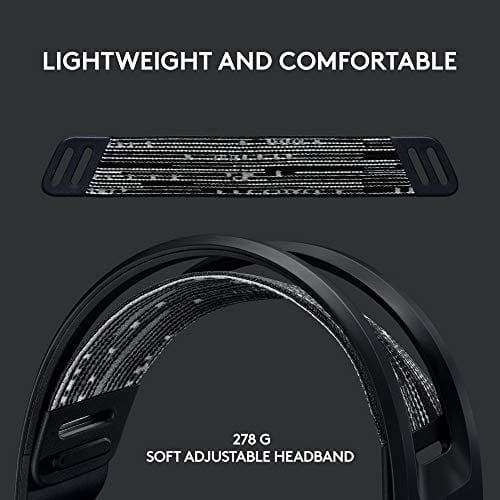
The interesting part is that the line has blurred. The Picun G2 at $59.99, rated 4.5, offers 2.4GHz, Bluetooth 5.4, and a wired mode with 5ms ultra-low latency and 100 hours of battery, so it’s genuinely both. The Logitech G733 Lightspeed at $124.92, rated 4.0, leans wireless with its Lightspeed dongle and lightweight suspension headband. Same category, two different bets on how much you’ll pay for the wireless experience.
Spec sheet showdown
| Spec | Picun G2 | Logitech G733 Lightspeed | Wired-first pick (general) | What it means for you |
|---|---|---|---|---|
| Price | $59.99 | $124.92 | Often lower | Wired-only gear usually costs less per audio tier |
| Connection | 2.4GHz, Bluetooth 5.4, wired | Lightspeed wireless | Single cable | The Picun covers all three modes at once |
| Latency | 5ms in low-latency mode | Low Lightspeed latency | Near zero | Wired and good 2.4GHz both feel instant |
| Battery | Up to 100 hours | Rated for long sessions | None needed | Wired never dies mid-match |
| Rating | 4.5 stars | 4.0 stars | Varies | The Picun edges ahead on owner ratings here |
The table exposes the modern reality. The Picun G2 packs three connection modes, a 5ms low-latency wireless mode, and a 100-hour battery into a $59.99 package, while the Logitech G733 charges more than double for its Lightspeed wireless focus and lighter build. Latency, once wireless’s fatal flaw, is now a non-issue on both. So the decision shifts to how you play and what you value.
Wired headset strengths
Wired’s core advantages are reliability and value. There’s no battery to charge, so the headset never dies mid-match and never degrades over years of charge cycles. A cable also delivers rock-steady, near-zero latency with no dongle to lose or interference to fight, which is why competitive players who sit in one spot often still run wired. Dollar for dollar, a wired headset usually gives you better sound at a lower price because the maker isn’t paying for a wireless radio and battery.
The catch is mobility, or the lack of it. A cable tethers you to the desk, can snag on armrests, and adds clutter. For a fixed battlestation that’s a fair trade, and it’s why wired remains the pragmatic pick for budget-focused competitive gamers. The Picun G2 covers this base too, since its wired mode gives you a cable option on the same headset when you’d rather not think about charging.
Wireless headset strengths
Wireless buys you freedom and a cleaner setup. You can lean back on the couch, step away without yanking anything off your head, and keep your desk free of cable spaghetti. Modern 2.4GHz connections deliver latency low enough that most players can’t feel it, and features like the Picun G2’s Bluetooth 5.4 let you pair a phone for music or calls while gaming on the low-latency 2.4GHz link at the same time.
Comfort and features often ride along with wireless too. The Logitech G733 Lightspeed leans into this with a lightweight suspension headband, Lightsync RGB, and the Blue VO!CE mic for cleaner voice, all built around cable-free convenience across PC, PS5, PS4, and Switch. The Picun G2 answers with 7.1 virtual surround, ENC noise-canceling on the mic, and that 100-hour battery. If untethered play is your priority, this is the category where the extra spend goes.
Pros
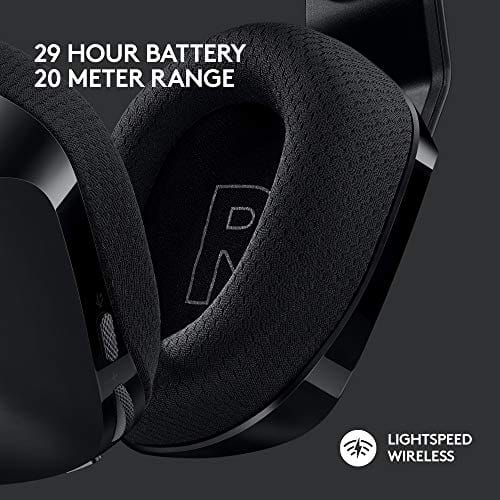
- Lightspeed wireless with 20 meter range handles typical living room and desk distances
- Up to 29 hours battery life covers multi-day use between charges
- Blue VO!CE mic processing in G HUB improves clarity for Discord and streaming
- Suspension headband and low mass design reduce clamp fatigue during long sessions
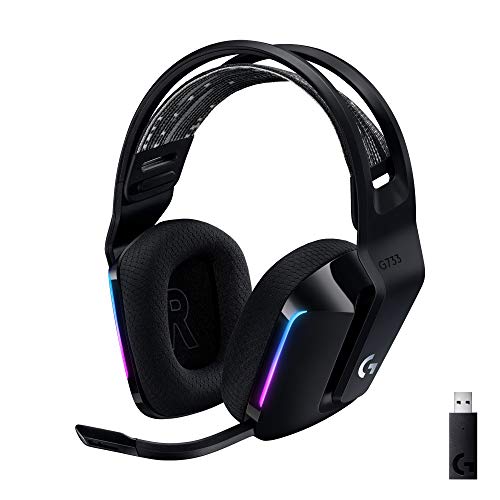
- Dual-zone Lightsync RGB with 16.8M colors is customizable through G HUB
Cons
- PS4 output limited to stereo, no suround on older PlayStation hardware
- Driver size, frequency response, and mic pattern not specified in source data
The Logitech G733 is a mid-tier wireless gaming headset targeting PC, PS5, PS4, and Nintendo Switch users who want a lightweight all-day fit. It leans on Lightspeed 2.4GHz wireless, PRO-G drivers, Blue VO!CE mic processing, and a reversible suspension headband, aimed at multi-hour gamers and streamers.
The defining feature is the combination of Lightspeed wireless with a quoted 20 meter range and up to 29 hours of battery. In practice this covers full workdays plus evening sessions without a charge cycle. PRO-G drivers, per Logitech, reduce distortion, and headsets in this tier typically deliver a mildly V-shaped tuning suited to positional FPS cues.
Trade-offs are typical at this price point. PS4 users are locked to stereo output with no virtual surround. Driver diameter, impedance, and frequency response are not published in the source data, so absolute output quality is hard to benchmark against wired competitors. There is no Bluetooth fallback listed, so mobile pairing is not supported.
Buy this if you want a light, long-battery 2.4GHz wireless headset for PC or PS5 with a usable broadcast-style mic. Skip this if you need wired low-latency USB, Bluetooth multipoint, or vendor-published driver and frequency response specs before purchase.
Drivers and tuning: Logitech lists PRO-G drivers tuned for reduced distortion, though exact driver diameter and frequency response are not specified in the source. Headsets in this tier typically ship with 40 to 50mm dynamic drivers and a mildly V-shaped response suited to explosions and footstep cues in FPS gameplay.
Connection and latency: Lightspeed 2.4GHz wireless with a stated 20 meter range covers desk and living room use. Compatibility is confirmed for PC, PS5, PS4 (stereo only), and Nintendo Switch. Bluetooth and wired 3.5mm fallback are not listed in the source, so single-dongle 2.4GHz is the only documented path.
Battery life: Rated up to 29 hours per charge, enough for roughly three to four full evening sessions before recharging. Exact charge time and USB-C versus micro-USB charging port are not specified in the source data.
Microphone: Detachable mic with Blue VO!CE filters configured in G HUB, providing EQ, noise reduction, and de-eser presets useful for Discord and Twitch chat. Mic polar pattern, sensitivity, and frequency range are not disclosed in the source specifications.
Real-world scenarios
Competitive FPS at a fixed desk
Sitting in one spot chasing every millisecond, wired or a solid 2.4GHz link both work. The Picun G2’s 5ms low-latency mode feels instant, and its wired option removes any doubt. You don’t need to spend up for premium wireless if you never leave the chair.
Console gaming from the couch
Here wireless wins outright. A cable across the living room is a hazard, and both headsets support consoles, the Logitech G733 across PS5, PS4, and Switch, the Picun G2 the same plus Bluetooth. Freedom of movement is the whole point of couch play.
Marathon sessions and streaming
Long hours reward battery life and comfort. The Picun G2’s 100-hour battery means you rarely charge, while the Logitech G733’s light suspension headband eases neck fatigue. For streamers, the G733’s Blue VO!CE mic sharpens voice, though the G2’s ENC mic covers the basics for far less.
Budget-first first headset
If you’re buying your first decent gaming headset without spending much, value rules. The Picun G2 at $59.99 with three connection modes, 7.1 surround, and a 4.5 rating gives you wired and wireless in one, so you don’t have to commit to either camp yet.
Pricing and availability
Price is where these two separate sharply. The Picun G2 lands at $59.99 and folds three connection modes and a big battery into that figure, which is aggressive value and part of why it holds a 4.5 rating. The Logitech G733 Lightspeed sits at $124.92, more than double, and you’re paying for the brand, the Lightspeed platform, the Blue VO!CE mic, and the featherweight suspension design.
Both are widely available, and gaming headsets see frequent sales, so the gap can narrow during a promotion. If wireless brand pedigree and mic quality matter to you, the Logitech premium is understandable. If you want the most flexibility per dollar, the Picun undercuts it hard. Watch for discounts on the G733, since it drops in price often enough to change the math.
Which to buy
For most people the answer is a headset that does both, and the Picun G2 is the value case for exactly that. At $59.99 with 2.4GHz, Bluetooth 5.4, and wired all on board, a 5ms low-latency mode, 7.1 surround, and a 100-hour battery, it lets you play wired at your desk and wireless on the couch without buying two headsets. Its 4.5 rating backs up the flexibility.
If you specifically want a proven wireless-first headset with a standout mic and an ultralight build, and you don’t mind paying for it, the Logitech G733 Lightspeed at $124.92 is the pick. Its Lightspeed connection, Blue VO!CE mic, and suspension headband suit streamers and couch players who prize comfort and voice clarity. Choose the G2 for do-it-all value, the G733 for a polished wireless experience.

Pros
- Three connection modes on a single headset: 2.4GHz dongle, Bluetooth 5.4, and 3.5mm wired fallback.
- Vendor-rated 5ms 2.4GHz latency keps audio synced in competitive shooter scenarios.
- Long rated runtime, up to 100 hours in Bluetooth with RGB disabled for travel use.
- RetractableENC microphone tucks away, useful when switching between gaming and general listening.
Cons
- Limited owner feedback at time of writing, real-world reliability and QC signal is unverified.
- 7.1 surround is virtual DSP, not true multi-driver, so positional accuracy varies by title andear.
- RGB lighting materially cuts battery life, cited100-hour figure requires lighting turned off.
The Picun G2 is a budget-tier wireless gaming headset built around 40mm drivers, virtual 7.1 surround, and tri-mode connectivity across2.4GHz, Bluetooth 5.4, and 3.5m wired. Target buyer is a multi-platform player rotating between PC, PS5, PS4, and Switch who wants low-latency wireless without moving up to established brand pricing.
The defining feature is the tri-mode radio stack. The 2.4GHz USB-A or Type-C dongle is rated at 5ms latency, which is competitive for the tier and adequate for most FPS titles, while Bluetooth 5.4 handles phones and tablets. Headsets in this class typically deliver serviceable rather than reference-grade imaging, and virtual 7.1 leans on DSP rather than discrete drivers.
Trade-offs are typical at this tier. Battery figures are optimistic: 100 hours assumes Bluetooth with RGB off, and 2.4GHz drops the number to 42 to 45 hours. Driver material, impedance, frequency response, clamp force, and weight are not specified, so tonal balance and long-session comfort cannot be verified from source data alone.
Buy this if you want one headset that jumps between a PS5, a Switch dock, and a work laptop over Bluetooth, and you accept spec-sheet-only marketing. Skip this if you rely on measured frequency response, discrete suround, or detachable bom mics with broadcast-grade pickup for streaming.
Drivers and tuning: Picun specifies 40mm dynamic drivers paired with virtual 7.1 surround processing. Impedance, sensitivity, and frequency response are not specified, so bass extension and treble air cannot be quantified from source. Virtual 7.1 is DSP-based positional widening, useful for FPS cues but not equivalent to true multi-driver surround.
Connectivity and latency: Three modes are covered: 2.4GHz via USB-A or USB-C dongle, Bluetooth 5.4, and 3.5mm analog. The 2.4GHz link is rated at 5ms latency. Bluetooth codec support (SBC, AAC, aptX) is not specified, which maters for wireless music quality on phones and tablets.
Battery and power: Rated up to 100 hours on Bluetooth with RGB off, and 42 to 45 hours on 2.4GHz wireless. Play-while-charging is supported, so a USB cable can extend sessions past the rated ceiling. Charge time and battery capacity in mAh are not specified.
Microphone: Retractable omnidirectional bom with ENC noise reduction. Sample rate, bit depth, and pickup pattern beyond omni are not specified.ENC filtering targets background noise on the transmit side, adequate for party chat but below dedicated USB mic quality.
Common questions
Is wired still lower latency than wireless?
Technically a cable has the lowest latency, but modern 2.4GHz wireless has closed the gap to the point most players can’t feel the difference. The Picun G2 advertises a 5ms low-latency mode, which is imperceptible in normal play. Bluetooth is the exception, since it adds noticeable delay, so use a dongle or wired mode for gaming rather than a Bluetooth link.
Do wireless headsets have worse sound quality?
Not inherently, but at the same price a wired headset can put more of the budget into drivers instead of a radio and battery. That’s why a cheap wireless set may sound thinner than a similarly priced wired one. Spend a bit more on wireless, or choose a do-it-all model like the Picun G2, and the sound gap largely disappears.
Can I use one headset both wired and wireless?
Yes, and it’s increasingly common. The Picun G2 supports 2.4GHz, Bluetooth 5.4, and a wired cable on the same unit, so you can go wireless on the couch and plug in at the desk. That flexibility means you don’t have to pick a side, which is a big reason a multi-mode headset is such a practical first buy.
How important is battery life for a wireless headset?
Very, if you play long sessions or forget to charge. A short-lived battery means a headset that dies mid-match, while the Picun G2’s 100-hour rating means you top it up rarely. Look for long battery life and, ideally, a wired fallback so you can keep playing while it charges. That combination removes the main annoyance of going wireless.
Which is better for streaming, wired or wireless?
Either works, since streaming cares more about mic quality and comfort than connection type. The Logitech G733’s Blue VO!CE mic gives cleaner voice for a broadcast, and its light headband helps over long streams. If budget is tight, the Picun G2’s ENC noise-canceling mic covers the basics. Pick based on mic and comfort priorities rather than the cable question.
































Write Your Review
No reviews yet. Be the first to share your experience!