

An SFF build, short for Small Form Factor, is a PC packed into a compact case that takes up a fraction of the space of a normal tower. Think shoebox-sized boxes that still house a real graphics card and a full desktop CPU. The appeal is obvious: a powerful machine that fits on a desk, slides into an entertainment center, or travels to a friend’s place without hauling a mid-tower. The short version is that an SFF build trades interior space and easy assembly for a smaller footprint, and it demands more careful part selection to fit and cool everything.
This explainer covers what an SFF build actually is, why people choose one, and what to watch out for. If you’d rather buy a ready-made compact system than build one, our guides to the best budget prebuilt PC in 2026 and the best budget prebuilt PC for an HTPC are useful starting points. Let’s define the term clearly first.
The short answer
An SFF build is a computer built in a small case, usually Mini-ITX or Micro-ATX based, that minimizes volume while keeping desktop-class performance. Instead of a large ATX tower, you use a compact motherboard, often a smaller power supply like an SFX unit, and carefully chosen parts that physically fit the tighter space. The goal is a full-power PC in a much smaller box, whether that’s for a clean desk, a living-room media machine, or a portable gaming rig you can carry.
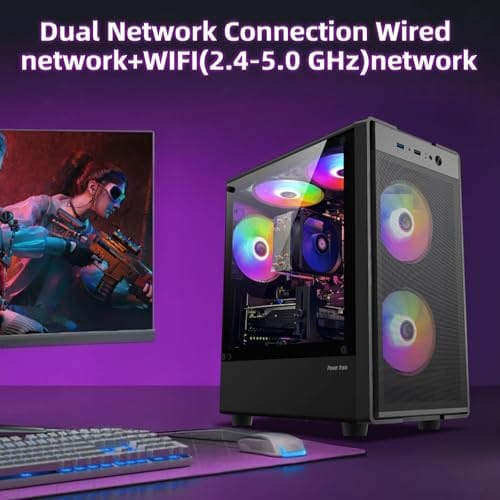
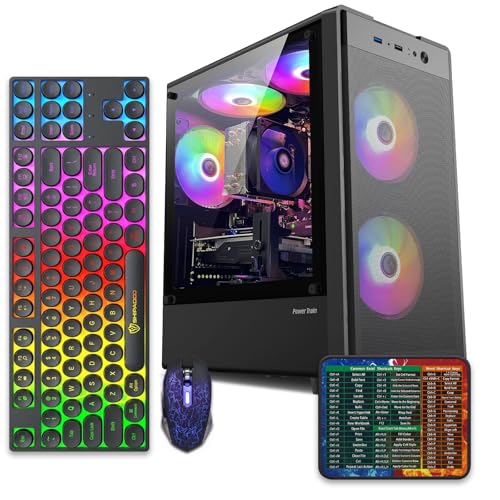
Prebuilt makers sell compact-leaning desktops too, though be aware many budget “small” prebuilts are actually standard towers. A system like the abytespark Intel Core i7 desktop at $499.99, rated 4.4, is a wallet-friendly starting point, even if it’s a conventional tower rather than a true Mini-ITX SFF box.
Pros
- 512GB SSD bot drive avoids the HDD bottleneck common in budget prebuilts
- RX 590 8GB VRAM buffer handles 1080p textures better than 4GB budget cards
- Complete bundle with RGB peripherals means no extra spend to start using
- Genuine Windows 11 Home 64-bit preinstalled, no activation hassle out of box
Cons
- Limited owner feedback at time of writing, verify seller reputation before purchase
- Core i7-4770 is Haswell era LGA150, no upgrade path and weak IPC versus modern CPUs
- Windows 11 on 4th-gen Intel is unsupported by Microsoft and may miss feature updates
- No CD/DVD-ROM support and RAM/GPU generation limits future workload headroom
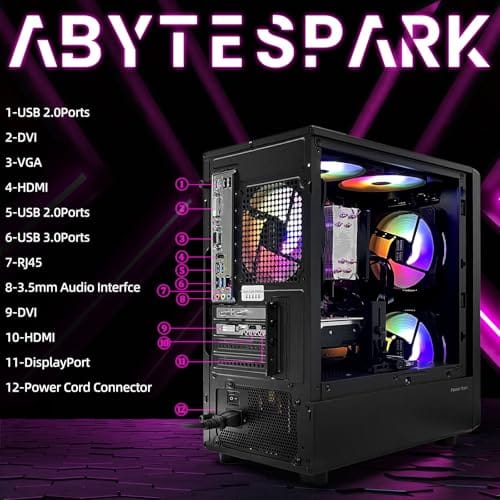
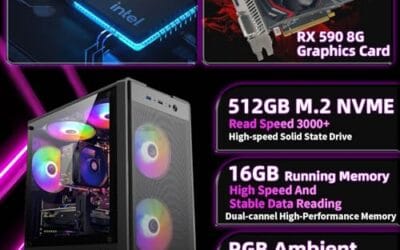
This is an entry-tier prebuilt tower built around an Intel Core i7-4770 Haswell CPU, 16GB RAM, a 512GB SSD, and an AMD Radeon RX 590 8GB GDDR5 GPU. It targets budget buyers who need a working office and light gaming PC with peripherals bundled, not enthusiasts chasing current-gen performance.
The defining feature is the RX 590 8GB paired with a 512GB SSD, an uncommon combo at this price band. Cards in this class typically handle 1080p esports titles at 60+ FPS on medium to high, matching the vendor claim for CS:GO, League of Legends, Apex, and Overwatch. Newer AA titles will need lowered settings.
Trade-offs are significant. The i7-4770 launched in 2013, so IPC, single-thread performance, and platform features like NVMe bot, PCIe Gen4, and modern USB are limited. Windows 11 runs here but sits outside Microsoft's official supported CPU list. There is no realistic CPU or socket upgrade path on LGA1150.
Buy this if you need a plug-and-play 1080p esports and office tower with keyboard, mouse, and RGB included at a low outlay. Skip this if you want current-gen platform support, sustained AA 1440p gaming, or a build with a meaningful upgrade runway.
GPU class: The AMD Radeon RX 590 8GB GDDR5 is a Polaris-refresh card roughly equivalent to a GTX 1060 6GB tier. Expect 1080p 60+ FPS in esports titles like CS:GO, Overwatch, Apex, League, and Fortnite on medium settings, matching the listing's claims.
AAA and modern titles: The vendor lists GTA V, Warzone, Hogwarts Legacy, and The Division 2. Realistically, these run at 1080p low to medium with FSR upscaling where suported.Ray tracing is unsupported on RX 590. No DLSS, no frame gen, no AV1 encode.
CPU bottleneck: The Core i7-4770 quad-core with 8threads at up to 3.9GHz will bottleneck the RX 590 in CPU-heavy titles like Warzone and Escape from Tarkov. Expect frame time inconsistency in large team fights even when average FPS looks aceptable.
Storage and RAM fit: 512GB SSD holds Windows plus 3 to 5 modern game installs before space pressure. 16GB DR3-era RAM is adequate for current esports but leaves no headroom for heavy streaming, browser tabs, and OBS NVENC alongside a game session.
The longer explanation
SFF builds come in a range of sizes. At the small end are Mini-ITX systems in cases under 15 liters, some as tiny as a thick hardcover book, that still fit a full-length GPU and an SFX power supply. A step up are Micro-ATX builds, which give you a bit more room for cooling and extra slots while staying far smaller than a mid-tower. The common thread is intentional space savings, achieved by using compact components and accepting that every part has to earn its place inside.
What you don’t sacrifice is raw power. A well-planned SFF build can run the same CPU and graphics card as a big tower, so gaming performance is identical. The difference is in the building: cable routing is tighter, airflow needs planning, and part clearances matter down to the millimeter. It’s a more deliberate build, rewarding people who enjoy the puzzle of fitting a high-end system into a tiny enclosure. The performance is full-size even when the box isn’t.
Sizing terms help here. Builders talk in liters of case volume, and it’s a useful shorthand. Anything under roughly 20 liters is genuinely small-form-factor, the sub-10-liter builds are the tiny showpieces, and cases in the 20-to-40-liter range are compact but roomier and far more forgiving for a first attempt. Knowing where a case falls on that scale tells you how hard the build will be before you buy a single other part. Smaller means more impressive and more finicky, larger means easier and still much tidier than a tower.
How we got here
Small PCs aren’t new, but capable ones are. For years, shrinking a computer meant weak laptop-grade parts. Two things changed that. First, Mini-ITX motherboards matured, offering full features on a tiny board. Second, graphics cards and power supplies got shorter and denser, and SFX power supplies made it possible to feed a strong GPU from a compact unit. Case designers responded with clever layouts that pack a full build into a box you can hold in two hands.
The result is that SFF went from a niche experiment to a mainstream option. Enthusiasts drove early designs, and now there’s a healthy market of compact cases, low-profile coolers, and SFX power supplies built specifically for these systems. What was once a difficult, custom-only endeavor is now something a careful builder can pull off with off-the-shelf parts, which is why compact rigs have surged in popularity.
Why it works this way
SFF builds work because desktop components became efficient enough to pack tightly without overheating, provided you plan cooling. Modern CPUs and GPUs draw less power for the same performance than older parts, so a small case can dissipate their heat with the right fans and airflow path. SFX power supplies deliver the same wattage as larger units in a smaller shell, removing a major space constraint. Every piece of the ecosystem shrank in step, making a true small-yet-powerful build feasible.
The constraint that remains is thermal and spatial planning. In a tight case, hot air has fewer places to go, so component choice and fan layout matter more than in a roomy tower. That’s the core tradeoff of the form factor. You get a compact machine, but you accept tighter tolerances and more careful cooling design. Done right, an SFF rig runs cool and quiet. Done carelessly, it can run hot, which is why planning is central to the whole approach.
When you’d want this
Choose an SFF build if desk space is precious, if you want a living-room gaming PC that hides in an entertainment center, or if you carry your rig to LAN events and want something luggable. It’s also for people who simply love the aesthetic of a tiny, tidy machine. If none of that applies and you have room for a tower, a standard build is easier and often cheaper, so the SFF path is about specific space or portability goals rather than performance gains.
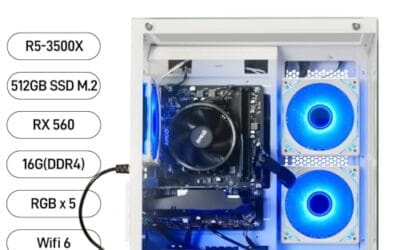
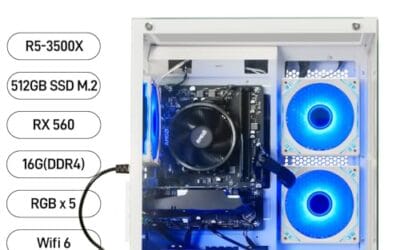
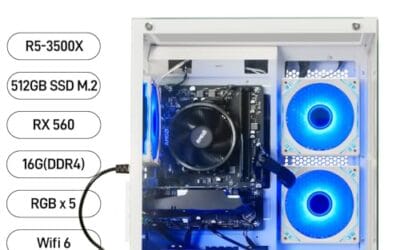
If building isn’t your thing, a compact prebuilt is the shortcut, though again, check the actual dimensions before assuming it’s small. The WIWB Ryzen 5 desktop at $569.99, rated 4.7, with an RX 560, 16GB of DDR4, a 512GB SSD, and Wi-Fi 6, is a budget prebuilt for home, office, and casual gaming. It’s a tower design, so it’s not a true SFF box, but it shows the kind of entry-level ready-made system a space-conscious buyer might weigh against a hand-built compact rig.

Pros
- Ryzen 5 3500X 6-core CPU bosts to 4.1GHz for smooth 1080p esports CPU load.
- Discrete RX 560 4GB handles DirectX 12 and Vulkan esports titles better than integrated graphics.
- 512GB SSD as bot drive keps Windows load times and app launches snappy out of box.
Cons
- Limited owner feedback at time of writing, no verified reviews to validate build quality.
- RX 560 is a legacy entry-tier GPU, skip if you want modern AAA at 1080p high.
- Ryzen 5 3500X sits on aging AM4, upgrade path is caped at Zen 3 with a BIOS update.
The WIWB is a budget prebuilt tower built around a Ryzen 5 3500X, RX 560 4GB, 16GB DDR4, and a 512GB SSD. It targets students, home office users, and casual gamers who want a plug-and-play box for esports at 1080p rather than a rig for current AAA titles.
The defining pairing here is the 3500X and RX 560. The 6-core, 6-thread CPU bosting to 4.1GHz is still competent for League, CS2, Valorant, and Overwatch, and typically pushes well above 100FPS at 1080p low-to-medium when paired with this GPU class. The RX 560 4GB is the bottleneck for anything heavier.
Trade-offs are typical at this tier. The RX 560 predates FSR frame generation and struggles with modern UE5 titles even at 1080p low. AM4 with a 3500X caps future CPU upgrades at Zen 3, and the case, PSU wattage, VRM phases, and included cooler are not specified, so headroom for a stronger GPU later is unclear.
Buy this if you need a cheap, pre-assembled Windows tower for schoolwork, browsing, and light esports at 1080p. Skip this if you plan to play current AAA releases, stream at 1080p60, or want a platform with a real multi-year upgrade path.
CPU workload: The Ryzen 5 3500X is a 6-core, 6-thread Zen 2 part with a 3.6GHz base and 4.1GHz boost. It stays viable for 1080p esports and light productivity like image editing and IDE work, but lacks SMT, which hurts streaming and modern CPU-bound AA titles.
GPU class and resolution fit: The RX 560 4GB GDDR5 is an entry esports card. Expect high frame rates in CS2, League, and Overwatch at 1080p low-to-medium, and playable frame rates in older AAA titles at 1080p low. 1440p and modern AA at medium are outside its envelope.
Memory and storage: 16GB DDR4 is the current baseline for gaming and multitasking, and the 512GB SSD covers Windows plus roughly 3 to 5 modern game installs. Exact DDR4 speed, dual-channel status, and SSD interface (SATA vs NVMe) are not specified.
Connectivity and upgrade path: WiFi 6 is included, and the board exposes an M.2 slot plus spare DDR4 slots for later expansion. PSU wattage, connector layout, case clearance, and waranty length beyond the stated 1-year coverage are not specified, so plan GPU upgrades cautiously.
What to look for in an SFF build
If you build one, start with the case, since its volume and clearances dictate every other choice. Check the maximum GPU length, CPU cooler height, and power supply type it accepts. Pick a Mini-ITX or Micro-ATX motherboard to match, an SFX or SFX-L power supply for compact power, and a graphics card that fits the length limit. Prioritize cooling with a low-profile air cooler or a compatible AIO, and plan airflow so intake and exhaust actually move heat out. Measure twice, buy once.
Common misconceptions
The biggest misconception is that small means weak. A modern SFF build runs the same top-tier CPU and GPU as a full tower, so gaming performance is equal. Another myth is that every compact-looking prebuilt is a true SFF machine, when many budget “small” desktops are ordinary towers, as our examples show. Finally, people assume SFF is always cheaper because it’s smaller, but compact cases and SFX power supplies often cost a premium, so you pay for the size savings rather than saving money.
Frequently asked
Is an SFF build weaker than a full tower?
No. A well-built SFF system uses the same desktop CPU and graphics card as a tower, so gaming and productivity performance match. The only real differences are interior space, cooling headroom, and build difficulty. Plan the thermals well and a compact rig performs identically to its full-size counterpart in day-to-day use.
Are SFF builds harder to assemble?
Generally yes. Tight clearances make cable routing and part installation fussier than in a roomy tower, and order of assembly matters more. It’s a rewarding puzzle for hobbyists but can frustrate a first-time builder. If you want a small machine without the challenge, a compact prebuilt sidesteps the assembly entirely.
Do SFF builds run hotter?
They can, since a small case gives heat fewer places to escape. Good component choice and a planned airflow path keep temperatures in check, and modern efficient parts help a lot. A carefully designed SFF rig runs cool and quiet, but a careless one can overheat, so cooling planning is the most important part of the build.
Is an SFF build cheaper than a regular PC?
Usually not. Compact cases, SFX power supplies, and low-profile coolers often carry a premium over standard ATX parts. You’re paying for the smaller footprint, not saving money. If budget is the top concern and space isn’t, a conventional tower build or a standard prebuilt typically costs less for the same performance.
Can I use a normal graphics card in an SFF build?
Often yes, as long as it fits the case’s length and width limits. Many compact cases accept full-length GPUs, while the smallest require shorter cards. Always check the case’s maximum GPU clearance against your chosen card’s dimensions before buying, since a card that’s a few millimeters too long simply won’t fit.





























Write Your Review
No reviews yet. Be the first to share your experience!