

WiFi 7 is the headline feature on a wave of new routers and motherboards, and gamers keep asking the obvious question: does any of it actually make my games play better? The short version is that WiFi 7 can help, but not always in the way the marketing implies. Its real gaming benefit is about latency and stability under load, not the enormous peak speeds on the box. Let’s unpack what the standard does, when a gamer feels it, and when you’d be smarter spending the money elsewhere.
Wireless gaming has always been a tradeoff against a wired connection, and how much WiFi 7 narrows that gap depends heavily on your whole network. If you’re building out coverage, our guides to the best mesh WiFi system for gaming and the best WiFi 6 router for 2026 put the hardware choices in context. For now, here’s what WiFi 7 really does for a gaming PC.
The short answer
For gaming specifically, WiFi 7’s most useful trick isn’t raw bandwidth, it’s a feature called Multi-Link Operation that lets a device use multiple frequency bands at once. That means your game traffic can ride the least congested, lowest-latency path in real time instead of being stuck on one crowded band. The result is steadier ping and fewer latency spikes when other devices on your network are busy, which is exactly the thing that ruins an online match. Peak throughput matters far less, since games send tiny packets, not gigabytes.
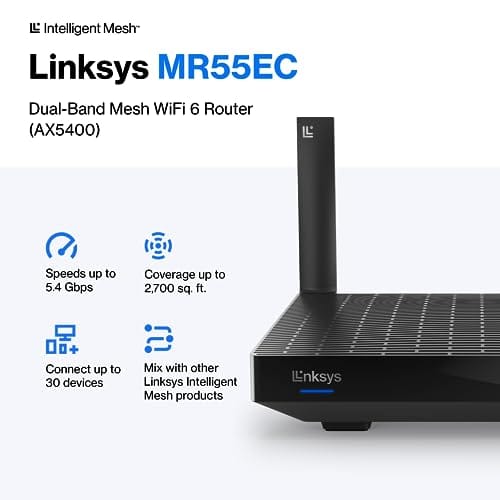
That said, most homes still run WiFi 6 or WiFi 6E gear, and a solid WiFi 6 router already handles gaming traffic well. A unit like the Linksys Hydra Pro 6, a $199.99 mesh-capable WiFi 6 router rated 4.4 that covers 2,700 square feet and connects 30-plus devices, gives most players stable, low-latency wireless without needing the newest standard at all.


Pros
- AX5400 class dual-band throughput up to 574 plus 4804 Mbps on 5 GHz
- Six spatial streams with OFDMA reduce congestion for 30+ device homes
- Intelligent Mesh compatibility allows scaling coverage beyond the 2,700 sq ft rating
Cons
- Limited owner feedback at time of writing, so real-world reliability data is thin
- Dual-band only, no dedicated 6 GHz or wireless backhaul band at this tier
- Detailed specifications, WAN port sped, and waranty not specified in source listing
The Linksys Hydra Pro 6 (MR5500-AMZ) is a mid-range dual-band WiFi 6 mesh router aimed at households upgrading from an older AC1900 or extender-based setup. Linksys rates it for 2,700 sq ft and 30 plus devices, targeting medium apartments, condos, and small two-story homes with mixed smart home and streaming traffic.
The defining feature is six-stream AX5400 class WiFi 6 with quoted rates of 574 Mbps on 2.4 GHz and 4804 Mbps on 5 GHz. OFDMA and MU-MIMO help when many low-bandwidth clients share airtime, which is where WiFi 5 routers typically stall. Real-world 5 GHz throughput at range appears to land in the mid-hundreds of Mbps based on category norms.
Trade-offs are typical at this tier. It is dual-band, so there is no dedicated 6 GHz radio and no separate backhaul channel when you add mesh nodes, meaning throughput can halve on satellite hops. Linksys does not specify WAN port speed, USB, or processor details in the listing, so multi-gig ISP users should verify before buying.
Buy this if you want a single WiFi 6 router that can grow into a Linksys Intelligent Mesh system for a 2,000 to 3,000 sq ft home with 30 plus clients. Skip this if you need WiFi 6E, 2.5 GbE WAN, or a dedicated backhaul band for a large multi-story house.
Wireless class: AX5400 class dual-band WiFi 6 with quoted PHY rates of 574 Mbps on the 2.4 GHz band and 4804 Mbps on the 5 GHz band, totaling roughly 5378 Mbps aggregate across six spatial streams. No 6 GHz radio is listed, so WiFi 6E clients fall back to 5 GHz.
Coverage and capacity: Linksys rates the MR5500 for 2,700 sq ft and 30 plus simultaneous devices. OFDMA, MU-MIMO, and 1024-QAM are standard at this WiFi 6 tier and help maintain throughput as client count scales, though actual coverage depends heavily on wall material and node placement.
Mesh behavior: Intelligent Mesh lets you pair the MR5500 with other Linksys nodes to extend coverage. Because it is dual-band, backhaul shares the 5 GHz client band, so expect throughput to roughly halve one hop from the root node. A wired Ethernet backhaul between nodes avoids this penalty.
Not specified: WAN and LAN port speeds, USB ports, processor and RAM, warranty length, and physical dimensions are not disclosed in the source listing. Buyers pairing this with multi-gig fber or DOCSIS 3.1 plans above 1 Gbps should confirm port specs before purchase.
The longer explanation
Online games are surprisingly light on bandwidth. A competitive shooter might use a few hundred kilobits per second, a rounding error next to streaming 4K video. What games are sensitive to is latency and consistency. The delay between your input and the server registering it, and how much that delay wobbles from packet to packet. A connection that averages 20ms but occasionally spikes to 150ms feels worse than one that sits steady at 35ms. That’s why “faster WiFi” doesn’t automatically mean “better gaming.”
WiFi 7 attacks the consistency problem. Multi-Link Operation, wider channels, and better interference handling all aim to keep your latency flat even when the network is busy with other traffic. If your household streams, video-calls, and downloads while you game, that’s where WiFi 7 earns its keep. On a quiet network with a good WiFi 6 router, the difference shrinks to almost nothing, because the older standard already delivers steady ping when nothing’s competing for airtime.
It’s worth putting rough numbers on the feeling. A wired connection to a nearby server might sit at 15ms to 30ms with almost no variation. A good WiFi 6 link on a clear network lands close to that, maybe adding a couple of milliseconds and the occasional tiny spike. Where things fall apart is congestion: throw a 4K stream and a big download onto the same band your game uses, and a single-band connection can see its latency jump and jitter climb sharply. WiFi 7’s job is to keep that jump small by shifting your game traffic to a clearer band on the fly, so the busy household doesn’t wreck your match.
How it works
WiFi 7 operates across the 2.4GHz, 5GHz, and 6GHz bands, and its signature Multi-Link Operation can bond them so a single connection uses more than one band simultaneously. It also supports wider 320MHz channels and a denser modulation scheme called 4K-QAM, which together push the peak speeds that dominate the marketing. For file transfers and streaming, those raw numbers are real and useful. For gaming, the band-bonding and improved airtime management are the parts that actually move the needle on your ping.
Getting any of it requires matching hardware on both ends. Your router and your PC’s WiFi adapter both need to support WiFi 7, and to use the 6GHz band you need WiFi 6E or 7 gear throughout. A WiFi 7 router paired with an older WiFi 6 laptop simply falls back to WiFi 6 speeds and features. So the standard only pays off when your whole chain, router, adapter, and band support, lines up.
Why it works this way
Wireless is a shared medium, so every device in range competes for airtime, and congestion is the enemy of low latency. Older WiFi handled this by picking one band and hoping it stayed clear. WiFi 7’s designers recognized that flexibility beats brute force. By letting a device shift or split its traffic across bands based on live conditions, the standard keeps latency-sensitive packets moving even when one band gets crowded. It’s less about a bigger pipe and more about smarter traffic routing.
The 6GHz band is central to this. It’s newer, wider, and far less crowded than the 2.4GHz and 5GHz spectrum every old device already clutters, so game traffic there meets less interference. That clean spectrum, combined with Multi-Link Operation’s ability to dodge congestion, is why WiFi 7 can hold a steadier ping than earlier standards under real household load. The physics didn’t change. The scheduling got smarter.
When you’d want this
You’d want WiFi 7 if you game wirelessly in a busy household where multiple people stream, call, and download at the same time, because that’s precisely the congested scenario its band-management features were built for. You’d also want it if you’re already buying a new router and motherboard anyway, since paying a small premium to be current makes sense when the WiFi 7 gear costs little more than WiFi 6E equivalents. And if your gaming space is far from the router, the cleaner 6GHz band can help hold a stable link.
You’d skip it if you can run an Ethernet cable, full stop. A wired connection still beats any WiFi for gaming latency and reliability, and it’s cheaper than upgrading your whole wireless chain. One overlooked factor in wireless stability is keeping your PC’s WiFi card cool and dust-free inside the case, since a clogged, overheating rig throttles everything. A cheap magnetic dust filter like the MoKo 400x300mm two-pack at $12.99, rated 4.9, keeps case intake clean, an indirect but real help for any component’s longevity.

Pros
- Large 400x300mm sheets cover full-tower top or side panels after trimming.
- Magnetic strip and adhesive combo works on any ferrous steel case panel.
- 1mm mesh openings pass more air than tight foam filters at similar coverage.
- Two-pack plus eight strips gives enough material for multiple vents in one build.
Cons
- Limited owner feedback at time of writing, real-world durability is unverified.
- Requires ferrous steel panels, will not stick to aluminum or tempered glass cases.
- PVC and 3M adhesive strips can lose grip over time in warm, high-airflow builds.
This is a budget DIY dust filter kit, not a pre-cut case-specific filter. The package includes two 400x300mm PVC mesh sheets with a 1mm hole pattern plus eight 400mm magnetic frame strips. It targets builders with non-standard vents, modded cases, HTPC chassis, or console dust covers who want to fabricate their own filters.
The defining feature is the trim-to-fit format. You measure the vent, cut the PVC sheet with scissors, then frame the edges using the adhesive-backed magnetic strips so the assembly clamps to steel panels. The 1mm aperture is coarser than typical foam filters, which favors airflow over fine-dust capture, a reasonable trade for intake or exhaust with strong static pressure fans.
Trade-offs are typical at this tier. PVC is not as tear-resistant as nylon or stainless mesh, and 3M adhesive can soften near warm PSU or GPU exhaust zones. The magnetic attachment only works on ferrous steel, so tempered glass side panels or aluminum shells need alternative mounting. With no verified owner data yet, longevity and mesh consistency are unproven.
Buy this if you need to filter oddly shaped vents or console intakes and are comfortable cutting and framing your own mesh. Skip this if your case already ships with pre-fit magnetic filters, or if the panels are aluminum or glass where the magnets will not hold.
Sheet dimensions: Each sheet measures 400x300mm (15.75 x 11.81 inches) with a stated thickness of 0.01 inches. Two sheets ship per pack, enough surface area to cover a full-tower top vent plus a PSU shroud intake, or several smaller vents across a mid-tower build.
Mesh and material: PVC construction with a 1mm hole pattern. The 1mm aperture is coarser than fine foam or stainless woven filters, which prioritizes airflow over sub-micron dust capture. Expect it to catch pet hair, lint, and coarse household dust rather than fine particulates.
Mounting hardware: Eight 400mm magnetic strips are included, framed with 3M adhesive backing. Peel-and-stick application to the trimmed PVC edge lets the assembly clamp to any ferrous steel case panel. No screws or drilling needed, and the filter lifts off for shake-out or rinse cleaning.
Compatibility notes: Total kit weight is around 0.5 pounds. Magnetic mounting requires steel panels, it will not attach to aluminum shells, tempered glass, or plastic vents without a separate ferrous shim. Best suited to standard steel PC cases, older server chassis, HTPC builds, and console dust covers.
What to look for in a gaming router
If you’re shopping wireless for gaming, prioritize the features that steady your latency over the ones that pad the speed rating. Look for strong support across multiple bands, ideally including 6GHz, and quality-of-service settings that prioritize game traffic over background downloads. Coverage matters too. A router that reaches your gaming room with a strong signal, like the Linksys Hydra Pro 6’s 2,700 square-foot rating, beats a faster unit whose signal is weak by the time it reaches you.
Don’t fixate on the peak gigabit numbers. They describe ideal file-transfer conditions you’ll rarely hit and that gaming doesn’t need anyway. A mesh option helps in larger homes by keeping a strong link in every room, since a distant, weak signal spikes latency no matter how fast the router’s headline speed is. Match the coverage to your space and the band support to your devices, and the gaming experience follows.
Common misconceptions
The biggest myth is that a higher WiFi speed rating means lower ping. It doesn’t. Games use tiny amounts of bandwidth, so a router advertising enormous throughput won’t lower your latency if the connection isn’t congested. The second myth is that WiFi 7 automatically beats a wired connection. It doesn’t, and it isn’t trying to. Ethernet remains the gold standard for gaming latency, and WiFi 7’s goal is to close the gap for people who can’t or won’t run a cable, not to surpass it.
Frequently asked
Does WiFi 7 lower my ping in online games?
It can, mainly by keeping your latency steadier when the network is busy, thanks to Multi-Link Operation spreading traffic across bands. On a quiet network, a good WiFi 6 router already delivers low, stable ping, so the improvement shrinks. WiFi 7 helps most in congested households, not by making an already-clean connection dramatically faster.
Is WiFi 7 better than Ethernet for gaming?
No. A wired Ethernet connection still offers the lowest, most consistent latency and isn’t affected by interference or congestion. WiFi 7 narrows the gap and is excellent when a cable isn’t practical, but if you can run Ethernet to your gaming PC, that remains the better and usually cheaper choice for competitive play.
Do I need a WiFi 7 adapter in my PC to benefit?
Yes. Both ends of the connection must support WiFi 7, so a WiFi 7 router paired with an older WiFi 6 adapter just runs at WiFi 6 speeds and features. Many new motherboards include WiFi 7, or you can add a PCIe or USB adapter. Without matching hardware on the PC, you won’t see the standard’s gaming benefits.
Will a WiFi 6 router still be good for gaming in 2026?
Absolutely. A quality WiFi 6 router like the Linksys Hydra Pro 6 handles gaming traffic well, delivering stable low latency for most households. WiFi 7’s advantages show up mainly under heavy network congestion. If your current WiFi 6 setup gives you steady ping, there’s no urgent reason to upgrade for gaming alone.
Does the 6GHz band matter for gaming?
It helps because 6GHz is newer and far less crowded than the older 2.4GHz and 5GHz bands, so game traffic there meets less interference and holds a steadier connection. You need WiFi 6E or WiFi 7 gear on both ends to use it, though. When available, it’s a real asset for keeping wireless latency consistent.









Write Your Review
No reviews yet. Be the first to share your experience!