

Here’s the number that starts most of these arguments: the GEEKOM A5 mini PC lists at $399, while the Skytech Gaming Crystal full tower sits at $1,199.99. That’s a 3x price gap, and it maps almost perfectly onto the question every space-conscious builder asks. Do you want something that tucks behind a monitor and sips power, or a real gaming rig with a discrete graphics card? Both run Windows 11. Only one has an RTX 5060 inside. If you’re cross-shopping these against a custom build, our guides to the best AMD prebuilt gaming PC and the best budget prebuilt PC in 2026 add useful context, but this matchup is about form factor.
Matchup at a glance
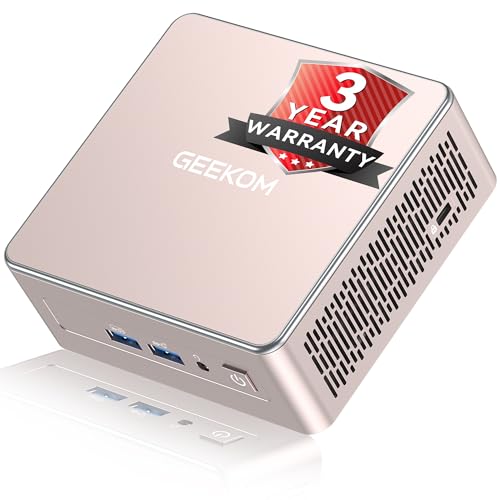
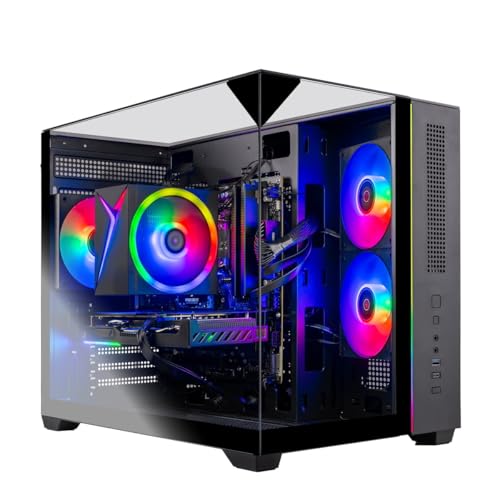
The Skytech Gaming Crystal is a full desktop tower built for one job: playing games at high frame rates. It pairs an AMD Ryzen 7 5700 running at 3.7GHz with an NVIDIA RTX 5060, 32GB of DDR4-3200 memory, a 1TB NVMe SSD, and a 650W Gold-rated power supply. It holds a 4.4 rating. The GEEKOM A5 2026 Edition is a different animal entirely. It’s a compact mini PC with an AMD Ryzen 5 7430U mobile-class chip, 16GB of RAM upgradable to 64GB, a 512GB M.2 NVMe SSD, six USB ports, 8K output, and a 3-year coverage plan. It rates 4.2.

So the framing writes itself. The Skytech leans on a dedicated GPU and a desktop platform. The GEEKOM leans on integrated graphics, tiny footprint, and a low price. One of these can push modern titles at 1080p and stretch to 1440p. The other is a home-office box that can dabble in light gaming. Knowing which bucket you fall into settles most of the decision before you read another word.

Spec sheet showdown
| Spec | Skytech Crystal (Full Desktop) | GEEKOM A5 (Mini PC) | Gaming Edge |
|---|---|---|---|
| Price | $1,199.99 | $399 | GEEKOM (cost) |
| Graphics | NVIDIA RTX 5060 discrete | Integrated Radeon (7430U) | Skytech |
| CPU | Ryzen 7 5700 @ 3.7GHz | Ryzen 5 7430U mobile | Skytech |
| Memory | 32GB DDR4-3200 | 16GB (to 64GB) | Skytech |
| Storage | 1TB NVMe SSD | 512GB M.2 NVMe SSD | Skytech |
| PSU / power | 650W Gold | External adapter, low draw | GEEKOM (efficiency) |
| Rating | 4.4 | 4.2 | Skytech |
The table makes the split obvious. The Skytech wins nearly every gaming-relevant row because it’s a purpose-built tower with a card that draws real wattage. The GEEKOM wins on price and power efficiency, which are the exact reasons people buy a mini PC in the first place. Neither result is a surprise. What matters is how much each spec gap costs you in actual play.
Full desktop strengths
The RTX 5060 is the whole story here. A discrete GPU with its own memory and cooling is what separates a gaming machine from a productivity box, and the Crystal has one. That card is comfortable at 1080p in current titles and can reach into 1440p with sensible settings, which is why prebuilts like this keep showing up in our best budget prebuilt PC for 1080p gaming shortlist. The Ryzen 7 5700’s eight cores feed that GPU without choking, and 32GB of DDR4-3200 means you won’t be closing background apps to keep a game stable.
The tower form factor pays off later, too. A 650W Gold PSU leaves headroom for a bigger card down the road, the case has physical slots for more storage, and DDR4 sticks are cheap to add. That upgrade path is worth real money over a few years. The tradeoffs are the usual desktop ones. It’s large, it’s heavier, it pulls more power under load, and at $1,199.99 it costs three GEEKOMs. Owner reports at the 4.4 rating skew positive on build quality and airflow, with the occasional gripe about stock cable management. For a gaming-first buyer, none of that outweighs having a genuine graphics card.
Mini PC strengths
The GEEKOM A5 plays a completely different game, and it plays it well. For $399 you get a Ryzen 5 7430U, 16GB of RAM that climbs to 64GB, a 512GB NVMe drive, six USB ports, and 8K display output from a box you can mount behind a monitor. It sips power, runs quiet, and ships with a 3-year coverage plan that most towers can’t match. For a living-room setup, a second desk, or a dorm, that footprint is the selling point. It’s the same logic behind our best budget prebuilt PC for HTPC picks.
On gaming, be honest with yourself. The 7430U leans on integrated graphics, so this handles esports titles, older games, and cloud streaming rather than the latest AAA releases at high settings. Drop the resolution and expectations and it’s genuinely capable for the money. The 4.2 rating reflects that: buyers love the size, the quiet operation, and the value, while the ones expecting console-beating frame rates walk away disappointed. If your gaming is light and your desk is small, it fits.
Pros
- Ryzen 5 7430U 6-core Zen 3 refresh chip covers everyday productivity and light creative loads
- User-serviceable DDR4 and NVMe unlike soldered LPDR mini PCs, easier long-term upgrades
- Four display outputs including 8K capable USB Type-C fits multi-monitor office setups
Cons
- Limited owner feedback at time of writing, real-world reliability data is thin
- DR4 and Vega 7 platform is a Zen 3 refresh, not competitive with newer Zen 4 mini PCs
- No 2.5GbE or Thunderbolt listed, networking and dock options trail current mid-range mini PCs
The GEEKOM A5 2026 Edition is a compact mid-range mini PC built around the AMD Ryzen 5 7430U, a 6-core Zen 3 refresh APU paired with Radeon Vega 7 graphics. With 16GB DDR4, a 512GB NVMe SSD, and Windows 11 Pro preinstalled, it targets home office users and small business deployments needing a tidy behind-monitor box.
The defining feature is upgradability in a 4.6 by 4.4 inch chassis. Dual DR4 SO-DIMM slots scale to 64GB, and storage stacks across an M.2 NVMe slot, an M.2 2242 slot, and a 2.5 inch bay for up to 10TB per GEKOM. Vega 7 iGPUs in this class typically drive 4K desktop work and light 1080p esports, not modern AA titles.
Trade-offs are typical at this tier. The 7430U is a rebadged Zen 3 part on DDR4, so IPC and iGPU throughput trail current Ryzen 7040and8040 mini PCs on DDR5. Source data does not specify LAN speed, Thunderbolt, or sustained TDP, so heavy sustained multithread loads may throttle in the smallABS and metal shell.
Buy this if you want a serviceable Windows 11 Pro mini PC for spreadsheets, browser tabs, Teams cals, and multi-monitor office work with room to add RAM and storage later. Skip this if you need Zen 4 IPC, DDR5 bandwidth, discrete GPU performance, or 2.5GbE networking for NAS and creative workflows.
CPU and iGPU: The Ryzen 5 7430U is a 6-core, 12-thread Zen 3 refresh APU with Radeon Vega 7 graphics. This class of chip is a clear step up from the 500U, 4300U, and 3500U GEEKOM calls out, and it comfortably handles Office, browser-heavy workflows, 4K video playback, and 1080p video calls.
Memory and storage: Two DDR4 SO-DIMM slots scale to 64GB, giving headroom for large Excel models, Chrome tab sprawl, and Adobe Lightroom catalogs. The PCIe NVMe bot drive is upgradable to 4TB, with an additional M.2 242 slot and 2.5 inch SATA bay pushing total capacity to a stated 10TB.
Display output: Four simultaneous displays are supported via 2 HDMI and 2 USB 3.2Gen 2 Type-C outputs, with 8K signaling over Type-C. For office multitasking this covers dual 4K monitors plus a laptop-style secondary panel without a dock.
Connectivity: WiFi 6 and Bluetooth 5.2 handle wireless peripherals and cloud sync, and the unit ships with 6 USB ports per the listing. Wired LAN speed, Thunderbolt support, and exact port breakdown are not specified in the source.
Real-world scenarios
You want to play current AAA games
This one isn’t close. The Skytech’s RTX 5060 and Ryzen 7 5700 will run modern titles at 1080p smoothly and push 1440p with tuned settings. The GEEKOM’s integrated graphics can’t keep pace here. If newer releases are the plan, the tower is the answer.
You want a tiny, quiet media and light-gaming box
Now the GEEKOM shines. It’s near-silent, draws little power, and disappears behind a TV or monitor. For streaming, emulation, older libraries, and the odd esports session, $399 gets a clean, capable machine. The 8K output and six USB ports make it a tidy hub.
You care about upgrading later
The tower’s 650W Gold PSU and open slots let you swap the GPU or add drives as your budget grows. The GEEKOM upgrades RAM to 64GB and swaps the M.2 SSD, but the soldered mobile CPU and integrated graphics are fixed. For long-term gaming headroom, the Skytech has the room.
You’re tight on both budget and space
If $399 is the ceiling and the desk is small, the mini PC is the pragmatic pick. You give up AAA performance, but you gain a machine that does real work, boots fast off NVMe, and won’t dominate the room. That’s a fair trade for a lot of people.
Pricing and availability
The price story is the cleanest part of this comparison. The GEEKOM A5 lists at $399 and the Skytech Crystal at $1,199.99, so the tower costs roughly three times as much. But you’re not paying 3x for nothing. That premium buys a discrete RTX 5060, double the RAM, double the storage, a desktop-class eight-core CPU, and a real upgrade path. Both machines are current Windows 11 systems, and both carry solid ratings at 4.4 and 4.2 respectively.
Availability tends to favor the mini PC for impulse buys since it’s a single small box with a 3-year coverage plan baked in. The tower is a bigger shipping item and a bigger commitment. If you’re weighing resolution targets, our rundown of the best budget prebuilt PC for 1440p gaming can help you decide whether the Skytech’s headroom is worth it for your monitor.
Which to buy
For gaming, the recommendation is straightforward. If playing modern games at decent frame rates is the point of the purchase, buy the Skytech Gaming Crystal. The RTX 5060, eight-core Ryzen 7 5700, 32GB of DDR4, and 650W Gold PSU make it a real gaming desktop, and the tower gives you somewhere to grow. Yes, it’s $1,199.99 and it takes up space. That’s the cost of a discrete GPU and a proper platform, and there’s no shortcut around it.
Buy the GEEKOM A5 if gaming is a side dish rather than the main course. At $399, upgradable to 64GB, near-silent, and tiny, it’s a superb home-office and media machine that handles light and older titles without complaint. Don’t ask it to run the newest AAA release at high settings. It wasn’t built for that, and it doesn’t pretend to be. Match the machine to how you actually play and you’ll be happy either way.
Pros
- 8-core, 16-thread Ryzen 7 5700 avoids CPU bottleneck for RTX 5060 at 1080p ultra
- 32GB DDR4-3200 exceeds the 16GB gaming baseline for streaming and heavy multitasking
- Triple tempered glass Crystal case with ARGB airflow fans suports thermals under sustained load
Cons
- Zero owner reviews at time of writing, so long-term reliability data is unavailable
- AM4 socket is end-of-life, capping future CPU upgrades at the Ryzen 5000 series
- 650W PSU and 8GB VRAM leave limited headroom for upgrading to higher-TGP GPUs later
The Skytech Crystal is a mid-range prebuilt gaming PC pairing an 8-core AMD Ryzen 7 5700 on AM4 with an NVIDIA RTX 5060 8GB GDR7, 32GB DDR4-3200, and a 1TB NVMe SSD. It targets 1080p high-refresh esports players and AAA gamers who want a plug-and-play tower with a warranty.
The RTX 5060 8GB GDDR7 is the defining component and sits in the 1080p ultra bracket, with GPUs at this tier typically hitting 60+ FPS in modern AAA titles and well above 144 FPS in Valorant, CS2, and Overwatch 2. DLSS 4 and frame generation extend usable headroom into 1440p.
Trade-offs are real at this tier. AM4 is a dead-end socket, so future CPU upgrades stop at the 5000 series. DDR4-3200 lags the DDR5-6000 sweet spot on AM5 builds, and the 8GB VRAM buffer will pressure ray tracing at 1440p in heavier titles. The 650W PSU also limits future GPU upgrades.
Buy this if you want a 1080p ultra or 1440p DLSS-assisted gaming PC with zero build time and a one year parts warranty. Skip this if you plan to upgrade to an RTX 5070 Ti class GPU or move to DDR5, since the AM4 board and 650W PSU will bottleneck that path.
1080p Ultra: The RTX 5060 8GB GDDR7 is a 1080p-first card. Expect 60+ FPS ultra in Baldur's Gate 3, Black Myth Wukong, and ELDEN RING at native resolution, and 240+ FPS in Valorant, CS2, and Overwatch 2 paired with a high-refresh 1080p monitor.
1440p and DLSS 4: 8GB VRAM is the ceiling. 1440p is playable with DLSS Quality and frame generation in most AA titles, but path-traced or heavy ray tracing loads at 1440p can saturate the VRAM buffer in games like Alan Wake 2 and Cyberpunk 2077 Overdrive.
CPU pairing: The Ryzen 7 5700 is an 8-core, 16-thread AM4 chip at 3.7GHz base and 4.6GHz boost. It feeds the RTX 5060 without meaningful bottleneck at 1080p ultra or 1440p, and handles OBS NVENC streaming since encode load lives on the GPU.
Memory and storage: 32GB DDR4-3200 with heat spreaders is above the 16GB gaming baseline and covers moded Minecraft, Escape from Tarkov, and Chrome-heavy multitasking. The 1TB NVMe M.2 SSD stores roughly six to eight modern AAA installs before Call of Duty class titles force selective uninstalls.
Common questions
Can the GEEKOM A5 mini PC play modern games?
It can play esports titles, older games, and cloud-streamed sessions at lower resolutions, but its Ryzen 5 7430U relies on integrated graphics. For current AAA games at high settings, it isn’t the right tool. Set expectations to light gaming and it delivers.
Is a full desktop always better for gaming?
For raw performance, usually yes, because a tower like the Skytech Crystal fits a discrete RTX 5060 and a desktop CPU that a mini PC can’t. But “better” depends on your needs. If space, noise, and a $399 budget matter more than frame rates, the mini PC can be the smarter buy.
How much more powerful is the Skytech Crystal?
It’s a large jump for gaming. The discrete RTX 5060 alone puts it in a different class, and the Ryzen 7 5700’s eight cores plus 32GB of DDR4-3200 back it up. The GEEKOM’s integrated graphics simply aren’t in the same category for AAA titles.
Which one uses less power?
The GEEKOM A5, by a wide margin. Its mobile-class chip and external adapter draw far less than the Skytech’s 650W Gold PSU feeding an RTX 5060. If low power draw and quiet operation are priorities, the mini PC wins that row easily.
Can I upgrade either machine later?
Both have some room. The GEEKOM takes RAM up to 64GB and a new M.2 SSD, though its CPU and graphics are fixed. The Skytech tower is more flexible, with a 650W PSU and physical slots for a bigger GPU and extra storage down the line.



























Write Your Review
No reviews yet. Be the first to share your experience!