

SFF stands for small form factor, and an SFF build is a full-power PC squeezed into a case a fraction the size of a normal tower. Think shoebox, not filing cabinet. The idea is simple: keep real desktop performance, ditch the empty air inside a standard mid-tower, and end up with a machine you can tuck under a monitor, carry to a friend’s place, or park in a media cabinet without it dominating the room. That’s the whole pitch, and it’s a compelling one once you’ve lived with a giant tower hogging desk space.
People usually land on SFF after they realize a big box isn’t buying them much. If you’re weighing a compact machine against a conventional one, our guides to the best budget prebuilt PC 2026 and the best budget prebuilt PC for an HTPC both touch on where size matters most. This explainer covers what an SFF build actually does for your setup.
The short answer
An SFF build is a desktop PC assembled in a small case, typically under about 20 liters of internal volume, using compact components like a Mini-ITX or Micro-ATX motherboard and often a short power supply. It does the same work a normal desktop does, gaming, editing, office tasks, but in a package that takes up a quarter to a third of the space. You give up some easy expansion room. You gain portability and a much cleaner desk.

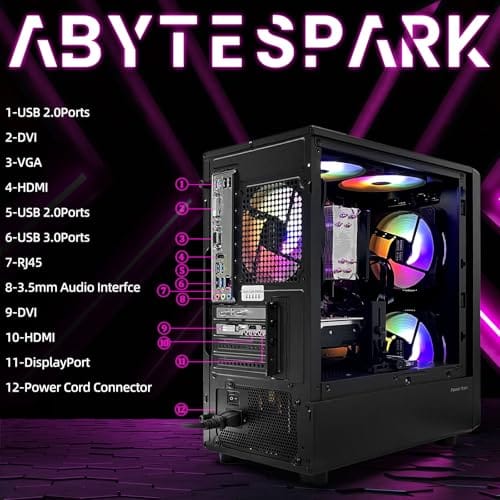
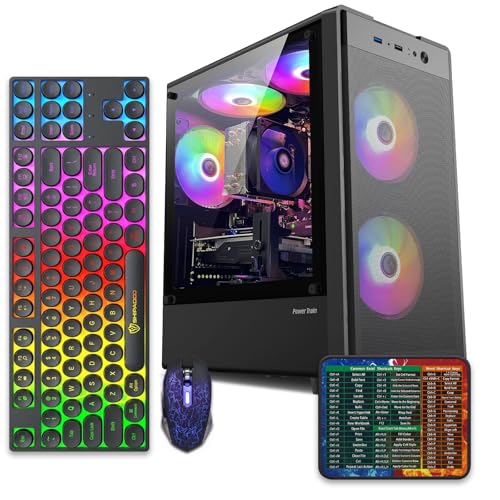
For folks who want that compact footprint without sourcing every part, a small prebuilt tower is often the easy on-ramp. The abytespark prebuilt at $499.99 with a 4.4 rating pairs an Intel Core i7 in a business-office tower, and it’s a straightforward entry point for someone who wants a tidy machine that runs everyday work and light gaming out of the box.
Pros
- 512GB SSD bot drive avoids the HDD bottleneck common in budget prebuilts
- RX 590 8GB VRAM buffer handles 1080p textures better than 4GB budget cards
- Complete bundle with RGB peripherals means no extra spend to start using
- Genuine Windows 11 Home 64-bit preinstalled, no activation hassle out of box
Cons
- Limited owner feedback at time of writing, verify seller reputation before purchase
- Core i7-4770 is Haswell era LGA150, no upgrade path and weak IPC versus modern CPUs
- Windows 11 on 4th-gen Intel is unsupported by Microsoft and may miss feature updates
- No CD/DVD-ROM support and RAM/GPU generation limits future workload headroom
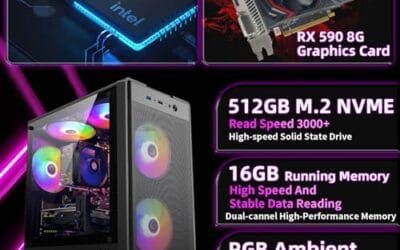
This is an entry-tier prebuilt tower built around an Intel Core i7-4770 Haswell CPU, 16GB RAM, a 512GB SSD, and an AMD Radeon RX 590 8GB GDDR5 GPU. It targets budget buyers who need a working office and light gaming PC with peripherals bundled, not enthusiasts chasing current-gen performance.
The defining feature is the RX 590 8GB paired with a 512GB SSD, an uncommon combo at this price band. Cards in this class typically handle 1080p esports titles at 60+ FPS on medium to high, matching the vendor claim for CS:GO, League of Legends, Apex, and Overwatch. Newer AA titles will need lowered settings.
Trade-offs are significant. The i7-4770 launched in 2013, so IPC, single-thread performance, and platform features like NVMe bot, PCIe Gen4, and modern USB are limited. Windows 11 runs here but sits outside Microsoft's official supported CPU list. There is no realistic CPU or socket upgrade path on LGA1150.
Buy this if you need a plug-and-play 1080p esports and office tower with keyboard, mouse, and RGB included at a low outlay. Skip this if you want current-gen platform support, sustained AA 1440p gaming, or a build with a meaningful upgrade runway.
GPU class: The AMD Radeon RX 590 8GB GDDR5 is a Polaris-refresh card roughly equivalent to a GTX 1060 6GB tier. Expect 1080p 60+ FPS in esports titles like CS:GO, Overwatch, Apex, League, and Fortnite on medium settings, matching the listing's claims.
AAA and modern titles: The vendor lists GTA V, Warzone, Hogwarts Legacy, and The Division 2. Realistically, these run at 1080p low to medium with FSR upscaling where suported.Ray tracing is unsupported on RX 590. No DLSS, no frame gen, no AV1 encode.
CPU bottleneck: The Core i7-4770 quad-core with 8threads at up to 3.9GHz will bottleneck the RX 590 in CPU-heavy titles like Warzone and Escape from Tarkov. Expect frame time inconsistency in large team fights even when average FPS looks aceptable.
Storage and RAM fit: 512GB SSD holds Windows plus 3 to 5 modern game installs before space pressure. 16GB DR3-era RAM is adequate for current esports but leaves no headroom for heavy streaming, browser tabs, and OBS NVENC alongside a game session.
The longer explanation
The magic of SFF is that modern components got small and efficient enough to not need a cavernous case. A Mini-ITX motherboard measures 6.7 inches square, yet it accepts the same CPUs, the same RAM, and often full-length graphics cards that a full tower does. Pair that with an SFX power supply, which is noticeably shorter than a standard ATX unit, and suddenly the whole system collapses into a box you can lift with one hand.
The tradeoff lives in the details. Less internal volume means less room for air to move, so thermals and cooling choices matter more than they do in a spacious tower. You’ll often see low-profile coolers, blower-style cards, or carefully planned fan layouts. Cable management gets fiddly because everything sits close together. And you usually get one PCIe slot and limited drive bays, so the endless expansion of a big case isn’t on the menu. For most people that’s fine, because they were never going to fill those slots anyway.
How it works
An SFF case is engineered around a specific volume budget. Designers decide how tall a CPU cooler can be, how long a GPU can stretch, and how the power supply tucks in, then they route airflow to keep those parts fed. Sandwich-layout cases put the motherboard and GPU on parallel planes with a riser cable between them, which is how a case the size of a console can still swallow a large graphics card.
Because the margins are tight, part selection drives everything. You check GPU length against the case’s clearance in millimeters, cooler height against its limit, and power supply type before you buy anything. Get those three right and an SFF build goes together like any other PC. Skip that homework and you’ll find a part that physically won’t fit. That planning step is the real skill of small form factor.
Why it works this way
It comes down to physics and standards. The ATX and ITX specifications fixed motherboard sizes decades ago, and component makers kept shrinking the silicon and power delivery while holding those mounting standards. That let case designers shave away the dead space that full towers carry for expansion nobody uses. A normal mid-tower might run 40 to 50 liters. A tidy SFF case can hit 10 to 15 liters and lose almost nothing that a typical gamer or creator actually needs.
The reason SFF isn’t the default for everyone is heat and flexibility. Cramming powerful parts into a small volume concentrates the heat they produce, so cooling has to be deliberate rather than brute-force. And if you like swapping in extra drives, multiple GPUs, or big custom loops, the small box fights you. SFF trades that headroom for size, and that’s a deal most desk-bound users are happy to make.
When you’d want this
SFF makes the most sense when space or portability is a real constraint. Small apartments, shared desks, dorm rooms, and living-room media setups all benefit from a machine that hides in plain sight. It’s also a favorite for people who travel to LAN events or move between two homes, since a compact tower fits in a backpack or a padded bag far more easily than a full case. If your PC never moves and your desk is enormous, the size savings matter less.
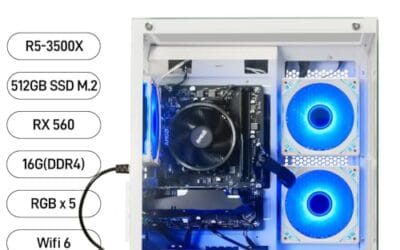
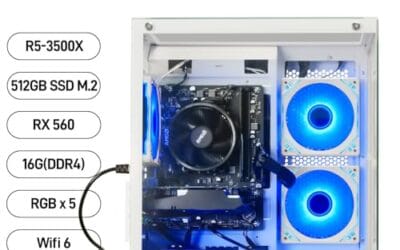
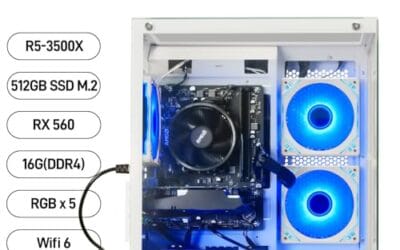
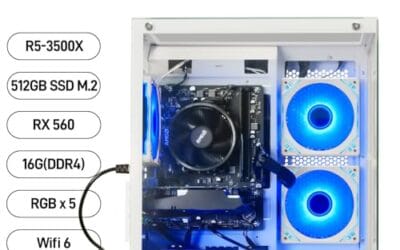
If you’d rather buy compact and skip the parts hunt, a small prebuilt does the job. The WIWB prebuilt at $569.99 with a 4.7 rating packs a Ryzen 5 running up to 4.1GHz, an RX 560 4GB graphics card, 16GB of DDR4, a 512GB SSD, and Wi-Fi 6 into a tidy white tower aimed at home office, students, and casual gaming. It’s a sensible small machine for someone who wants light gaming and everyday tasks without building from scratch.

Pros
- Ryzen 5 3500X 6-core CPU bosts to 4.1GHz for smooth 1080p esports CPU load.
- Discrete RX 560 4GB handles DirectX 12 and Vulkan esports titles better than integrated graphics.
- 512GB SSD as bot drive keps Windows load times and app launches snappy out of box.
Cons
- Limited owner feedback at time of writing, no verified reviews to validate build quality.
- RX 560 is a legacy entry-tier GPU, skip if you want modern AAA at 1080p high.
- Ryzen 5 3500X sits on aging AM4, upgrade path is caped at Zen 3 with a BIOS update.
The WIWB is a budget prebuilt tower built around a Ryzen 5 3500X, RX 560 4GB, 16GB DDR4, and a 512GB SSD. It targets students, home office users, and casual gamers who want a plug-and-play box for esports at 1080p rather than a rig for current AAA titles.
The defining pairing here is the 3500X and RX 560. The 6-core, 6-thread CPU bosting to 4.1GHz is still competent for League, CS2, Valorant, and Overwatch, and typically pushes well above 100FPS at 1080p low-to-medium when paired with this GPU class. The RX 560 4GB is the bottleneck for anything heavier.
Trade-offs are typical at this tier. The RX 560 predates FSR frame generation and struggles with modern UE5 titles even at 1080p low. AM4 with a 3500X caps future CPU upgrades at Zen 3, and the case, PSU wattage, VRM phases, and included cooler are not specified, so headroom for a stronger GPU later is unclear.
Buy this if you need a cheap, pre-assembled Windows tower for schoolwork, browsing, and light esports at 1080p. Skip this if you plan to play current AAA releases, stream at 1080p60, or want a platform with a real multi-year upgrade path.
CPU workload: The Ryzen 5 3500X is a 6-core, 6-thread Zen 2 part with a 3.6GHz base and 4.1GHz boost. It stays viable for 1080p esports and light productivity like image editing and IDE work, but lacks SMT, which hurts streaming and modern CPU-bound AA titles.
GPU class and resolution fit: The RX 560 4GB GDDR5 is an entry esports card. Expect high frame rates in CS2, League, and Overwatch at 1080p low-to-medium, and playable frame rates in older AAA titles at 1080p low. 1440p and modern AA at medium are outside its envelope.
Memory and storage: 16GB DDR4 is the current baseline for gaming and multitasking, and the 512GB SSD covers Windows plus roughly 3 to 5 modern game installs. Exact DDR4 speed, dual-channel status, and SSD interface (SATA vs NVMe) are not specified.
Connectivity and upgrade path: WiFi 6 is included, and the board exposes an M.2 slot plus spare DDR4 slots for later expansion. PSU wattage, connector layout, case clearance, and waranty length beyond the stated 1-year coverage are not specified, so plan GPU upgrades cautiously.
What to look for in an SFF build
Three numbers decide whether a small build succeeds: GPU clearance, cooler height, and power supply format. Check the case’s maximum GPU length and cooler height in millimeters against the parts you want, and confirm it takes an SFX or SFX-L supply if it doesn’t fit standard ATX. After that, look at airflow design, mesh panels and thoughtful fan mounts keep temperatures in check, and at build access, because some cases are far friendlier to work in than others. A model with a removable tray or side panels saves real frustration.
For a prebuilt route, focus on the same fundamentals you’d want anywhere: a capable CPU, enough RAM for your work, an SSD rather than a hard drive as the boot disk, and modern connectivity. Our roundup of the best budget prebuilt PC for a home server shows how compact machines can quietly handle always-on jobs too, which is another natural fit for the form factor.
Common misconceptions
The biggest myth is that SFF means weak. It doesn’t. A small case can house a top-tier CPU and a large graphics card, and plenty of compact builds match or beat mid-towers on raw performance. What’s true is that SFF demands more planning and slightly better parts discipline, not less power. Another myth is that these builds always run hot and loud. With the right cooler and fan setup, a well-designed small system stays cool and quiet. Poor planning causes the heat problems people blame on the size.
People also assume SFF is only for experts. It’s more finicky than a big tower, sure, but a first-timer who measures carefully and picks compatible parts can absolutely pull it off. And if the assembly still feels intimidating, a compact prebuilt sidesteps the whole worry while giving you the same small footprint.
Cooling is the part most first-time SFF builders underestimate. A small case traps heat fast, so component choice and fan layout matter more than in a full tower. Plan the airflow path before buying parts, not after.
Frequently asked
What does SFF actually stand for?
SFF means small form factor. In PC terms it describes a desktop built in a compact case, usually under roughly 20 liters of internal volume, using small components like a Mini-ITX board while keeping full desktop capability.
Is an SFF build more expensive than a normal one?
Often a little, yes. Compact cases, SFX power supplies, and low-profile coolers tend to cost more than their full-size counterparts. The core parts, CPU, GPU, RAM, cost the same, so the premium is mostly in the specialized enclosure and supply, typically a modest amount overall.
Can an SFF PC handle a high-end graphics card?
Many can. Plenty of SFF cases support full-length cards through a riser cable and clever internal layout. The key is checking the case’s stated GPU clearance in millimeters before buying, since that number varies widely from one small case to the next.
Do small builds run hotter?
They can, because there’s less air volume inside. Good cooler selection and a sensible fan layout keep temperatures reasonable, though. A carefully planned SFF machine runs cool and quiet; the heat complaints usually trace back to rushed part choices rather than the size itself.
Should a beginner attempt an SFF build?
A beginner can, as long as they measure clearances and confirm compatibility first. It’s tighter to work in than a big case, so patience helps. If that sounds like too much, a compact prebuilt gives you the same small footprint with none of the assembly stress.



























Write Your Review
No reviews yet. Be the first to share your experience!