

If you’ve ever stared at a motherboard box and wondered why it lists “PCIe 5.0 x16” and “PCIe 4.0 x4” like they mean something, you’re in the right place. A PCIe lane is one of the most quietly important pieces of your PC, and it decides how much bandwidth your graphics card, your NVMe drive, and your Wi-Fi module actually get. Most people never think about lanes until a second SSD slows down or a capture card refuses to run at full speed. That’s usually a lane problem.
The good news? You don’t need an electrical engineering degree to get this. We researched how lanes are allocated across current Intel and AMD platforms, and the pattern is pretty consistent once you see it. This matters most when you’re picking a board, which is why buying guides like our roundups for the best 7800X3D motherboard and the best motherboard for the i9-13900K spend so much time on slot layouts. Lanes are the reason a cheap board and an expensive board can look identical on paper and behave very differently.
The short answer
A PCIe lane is a single high-speed data path made of two wire pairs, one for sending and one for receiving. Devices use lanes in groups: a graphics card typically wants sixteen lanes (written x16), an NVMe SSD usually wants four (x4), and smaller add-in cards might use x1 or x4. Your CPU provides a fixed number of lanes directly, and your motherboard chipset provides more through a shared connection. Add them up, split them across slots, and that’s your lane budget.
Think of it like lanes on a highway. One lane moves a certain amount of traffic. Four lanes move four times as much. The PCIe generation (3.0, 4.0, 5.0) sets the speed limit on each lane, roughly doubling per generation. So a PCIe 4.0 x4 SSD slot and a PCIe 3.0 x8 slot can carry similar total bandwidth even though the lane counts differ. That combination of lane width and generation is what really defines a slot’s capability.
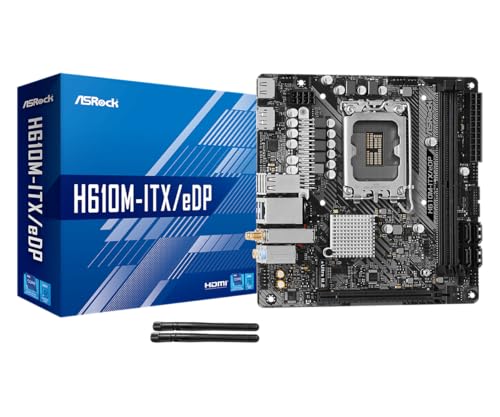
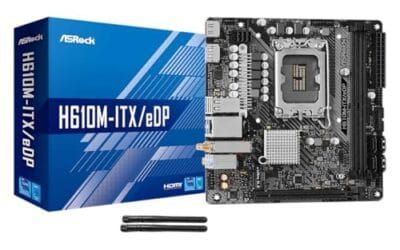
A compact board is a great way to see this budgeting in action, since space forces tradeoffs. The ASRock H610M-ITX/eDP is a good example at $89.99, an LGA1700 Mini-ITX board with PCIe 4.0 support for Intel 14th, 13th, and 12th Gen Core chips. On a small H610 board, every lane counts, and it’s a clean look at how an entry chipset spends its limited allotment.
Pros
- eDP 1.4 header is rare at this tier, ideal for custom AIO and panel builds
- Dr.MOS 50A 6-phase VRM adequate for 65W LGA1700 CPUs in SFF cases
- PCIe 4.0 x16 slot preserves GPU bandwidth despite H610 chipset limits
- Integrated WiFi 5 and Bluetooth 5.1 plus Intel Gigabit LAN cover connectivity
Cons
- Limited owner fedback available at time of writing, making reliability signal thin
- H610 blocks CPU overclocking and caps DR4 at 3200MHz with no XMP scaling
- Single M.2 slot is Gen3 x4 only, no Gen4 NVMe or secondary M.2
The ASRock H610M-ITX/eDP is a budget LGA1700 Mini-ITX board built around Intel's entry H610 chipset with DDR4 memory and a dedicated eDP 1.4 panel connector. It targets SFF builders, embedded system integrators, and digital signage projects rather than gamers chasing K-series CPUs or high-frequency RAM tuning.
The standout is the eDP 1.4 header, which lets integrators drive a laptop-style FHD 60Hz panel directly, useful for all-in-one and industrial builds. For general desktop use, HDMI 2.1 outputs 4K 60Hz and DisplayPort 1.4 handles up to 8K 60Hz, both dependent on the installed CPU's iGPU capabilities.
Trade-offs are typical at H610 tier: no CPU or memory overclocking, DDR4-3200 ceiling, a single Gen3 x4 M.2, and no rear USB-C. The 6-phase 50A Dr.MOS VRM is fine for 65W non-K chips like a Core i5-13400, but pairing with a 14700K in a hot SFF case is not the intended use.
Buy this if you need a compact LGA1700 board with eDP for a panel PC, signage kiosk, or budget SFF office build. Skip this if you want DR5, K-series overclocking headroom, Gen4 NVMe, or dual M.2 storage on a modern Intel platform.
Socket and chipset: LGA1700 with H610 chipset supports 12th, 13th, and 14th Gen Core CPUs. H610 disables CPU multiplier and memory overclocking, so pair with locked SKUs like Core i3-12100, i5-13400, or i5-14400 for best value rather than K-series parts.
Memory support: 2 DR4 DIMM slots run dual-channel up to 3200MHz with XMP 2.0 and ECC UDIMM in non-ECC mode. Confirm kits against ASRock's QVL, since Mini-ITX 2-DIMM layouts are typically friendlier to Hynix and Micron dies at 3200 CL16.
Storage and PCIe: One PCIe 4.0 x16 slot for GPU, one Ultra M.2 slot (PCIe Gen3 x4 and SATA3), and 4 SATA3ports. Only one M.2, so plan bot NVMe plus SATA SDs for bulk storage in SFF builds.
Form factor and I/O: Standard 6.7 by 6.7 inch Mini-ITX footprint fits ITX cases and thin mITX chassis. Rear I/O includes HDMI 2.1, DisplayPort 1.4, 2 USB 3.2 Gen1, 4 USB 2.0, and Gigabit LAN. Note CNVi Bluetooth shares bandwidth with one rear USB 2.0 port.
The longer explanation
Here’s where the nuance lives. Your CPU doesn’t hand out unlimited lanes. A mainstream desktop chip, whether it’s a Ryzen or a Core i-series part, provides a set number of usable lanes for expansion, typically around 20 to 28 depending on the platform. Most of those go straight to the primary x16 slot for your GPU. A handful get reserved for the first NVMe slot, so your fastest SSD talks directly to the processor with no middleman.
Everything else runs through the chipset. The chipset connects back to the CPU over a dedicated link (AMD calls it the chipset uplink, Intel uses DMI), and that single link is shared by every device hanging off the chipset: secondary M.2 slots, SATA ports, USB controllers, extra PCIe slots, and onboard networking. It’s a lot of stuff sharing one pipe. Under normal use you’ll never notice. Copy from one chipset SSD to another chipset SSD while a USB device is busy, though, and you can bump into that shared ceiling.
This is why high-end boards feel roomier. A board built for a chip like the i9-13900K, covered in our guide to the best i9-13900K motherboards, gives you more chipset lanes and smarter routing so multiple fast devices don’t fight. Compare that to a budget board where installing a second NVMe drive quietly disables a couple of SATA ports. The lanes had to come from somewhere.
How it works under the hood
Each lane is a point-to-point serial connection. That’s a fancy way of saying it’s a dedicated link between two endpoints, not a bus that everyone shares equally. When a card negotiates x16, it’s establishing sixteen of these links running in parallel. If only eight are wired or available, the card falls back to x8 and keeps working, just with less bandwidth. Modern GPUs handle this gracefully, which is why a card in an x8 slot still runs fine in most games.
Lane switching happens through hardware called a mux, or through the chipset itself. Board makers decide which slots share lanes and how they split. A common design puts the main x16 slot and the second M.2 slot on a switch, so populating the second drive drops the GPU slot to x8. On the platforms behind boards like those in our best 9800X3D motherboard lineup, the extra CPU lanes mean you can often run a GPU and a fast SSD without that penalty. The physical slot length can also lie to you. A slot can be physically x16 long but only wired for x4, which manufacturers do to fit more full-size slots on the PCB.
Why it works this way
Lanes cost money and physical space. Every lane needs traces on the board, pins on the CPU package, and controllers to manage it. Doubling lanes would mean bigger, hotter, more expensive chips, and most users don’t need it. A gamer with one GPU and one SSD is happy with 24 lanes. Someone running a GPU, three NVMe drives, a 10-gigabit network card, and a capture setup is not, and that’s exactly the crowd that pays for high-end desktop or workstation platforms with 60-plus lanes.
So the industry settled on tiers. Mainstream platforms keep lane counts modest and lean on the chipset for the extras. That keeps prices sane. The tradeoff is the shared uplink and the slot-sharing behavior we described. It’s a reasonable bargain for the vast majority of builds, and it’s why reading the manual’s slot table matters more than counting slots on the box.
When you’d want to care about lanes
You should care the moment your build has more than the basics. Multiple NVMe drives, a dedicated sound card or capture card, a high-speed network adapter, or a USB expansion card all draw from the same pool. If you’re planning any two of those alongside a GPU, check the board’s block diagram before you buy. That diagram tells you exactly which slot loses lanes when another gets filled.
Small-form-factor builders feel this most, because Mini-ITX has room for just one expansion slot and one or two M.2 slots. The Gigabyte A520I AC at $126.61 shows the AMD AM4 side of this: a Mini-ITX board with an NVMe PCIe 3.0 x4 M.2 slot, 55A DrMOS power stages, gigabit LAN, and integrated Intel Wi-Fi and Bluetooth. On a board this size, the single M.2 running full x4 to the CPU is the whole point, and it’s rated 4.3 out of 5 by owners. You’re trading slot quantity for a clean, direct lane path.

Pros
- Q-Flash Plus enables BIOS update without CPU installed, essential for Ryzen 5000 out-of-box support.
- 55A DrMOS phases are adequately rated for Ryzen 5 and Ryzen 7 non-X chips at stock settings.
- Intel WiFi AC and Bluetooth onboard saves a PCIe slot in a platform with zero spare slots.
- Three rear display interfaces (DP plus two HDMI) give APU builders real multi-monitor flexibility.
Cons
- A520 chipset lacks PCIe 4.0 and overclocking support, ruling out XFR tuning and fast NVMe Gen4 drives.
- Single M.2 slot at PCIe 3.0 x4 speeds caps sequential reads well below modern Gen4 SSDs.
- Only two DIMM slots with no OC headroom means RAM configuration and speed are locked to JEDEC or limited EXPO profiles.
The Gigabyte A520I AC is a budget-tier Mini-ITX motherboard on the AMD AM4 socket, targeting builders who need a compact, self-contained system around a Ryzen 5000 or 3000 series CPU. It is best suited for home theater PCs, small office machines, or entry-level SFF gaming rigs where size and wireless connectivity matter more than overclocking.
The standout feature is Q-Flash Plus, which allows BIOS updates from a FAT32 USB drive with no CPU or RAM installed. For buyers picking up a Ryzen 5000 CPU with an older BIOS on the shelf, this is a genuine convenience that removes the need to borrow a compatible CPU. The 55A DrMOS 6-phase VRM is adequate for Ryzen 5 5600 and Ryzen 7 5700X at stock, though sustained all-core loads on higher-TDP chips may see thermal limits without active airflow over the heatsink.
The A520 chipset is the real constraint here. There is no CPU overclocking, no PCIe 4.0 support, and the single M.2 slot runs at PCIe 3.0 x4, capping sequential reads around 3,500 MB/s. With only two DIMM slots and no XMP/EXPO tuning above JEDEC defaults on this chipset, RAM flexibility is limited. Case builders should also confirm GPU length clearance in their chosen Mini-ITX enclosure before purchasing.
Buy this if you are building a compact Ryzen 5000 system where integrated WiFi and Q-Flash convenience matter and overclocking is not on the table. Skip this if you plan to run a Ryzen 9 series chip, use a Gen4 NVMe drive at full speed, or need any meaningful CPU tuning headroom.
CPU and Socket: AM4 socket supports 3rd Gen Ryzen (Zen 2) natively and 5th Gen Ryzen 5000 (Zen 3) after a Q-Flash Plus BIOS update. A520 chipset does not support CPU overclocking or manual frequency tuning, so PBO and Curve Optimizer are off the table entirely.
RAM and Memory: Two DIMM slots support dual-channel DDR4 configurations. A520 chipset limits practical RAM tuning, so target DDR4-3200 CL16 kits for the best 1:1 FCLK ratio without pushing outside chipset support. Maximum capacity is not specified in source data; typical AM4 Mini-ITX boards support 64GB across two slots.
Storage and Expansion: One M.2 slot running PCIe 3.0 x4 delivers up to approximately 3,500 MB/s sequential read, sufficient for mid-range NVMe SSDs but incompatible with PCIe 4.0 drives at full rated speed. A single PCIe 3.0 x16 slot handles the discrete GPU, leaving no room for add-in cards in a Mini-ITX build.
Display and Wireless: Rear I/O includes one DisplayPort and two HDMI outputs for APU-based builds, supporting up to three simultaneous displays. Intel dual-band AC WiFi covers 2.4 GHz and 5 GHz bands with Bluetooth included. ALC887 audio codec is functional for basic use but below the ALC1220 found on mid-range and higher boards.
What to look for in a motherboard’s lane layout
Start with the generation of the primary slot. A PCIe 4.0 or 5.0 x16 slot future-proofs your GPU upgrade path. Next, look at how many M.2 slots run at full x4 and which generation each one uses. A board might advertise three M.2 slots while only one of them connects directly to the CPU at top speed. The rest hang off the chipset at reduced bandwidth or steal lanes from other slots.
Then read the fine print about slot sharing. Phrases like “M.2_2 shares bandwidth with SATA ports 5 and 6” tell you the real story. This is where our platform guides earn their keep. The boards in our best i7-14700K motherboard roundup and the best Ryzen 9800X3D boards selection are chosen partly for sane lane routing, so you don’t discover a disabled SATA port after the build’s done. Cheaper boards aren’t bad, they’re just honest about their limits, and you should know those limits going in.
Common misconceptions
The biggest myth? That a longer slot always means more lanes. Physical length and electrical wiring are separate things. A full-length x16 slot wired for x4 is common on budget boards. Another myth is that running a GPU at x8 instead of x16 tanks gaming performance. In practice, current cards lose only a few percent at most in typical resolutions, so it’s rarely worth stressing over.
People also assume the chipset link is a bottleneck all the time. It isn’t. It only matters when several chipset devices push data at once, which is uncommon in everyday use. And no, adding more RAM doesn’t use PCIe lanes; memory has its own dedicated channels straight to the CPU. Lanes are strictly for PCIe devices like GPUs, SSDs, and add-in cards.
Frequently asked
How many PCIe lanes does a typical desktop CPU have?
Mainstream desktop chips from AMD and Intel usually offer around 20 to 28 usable lanes for expansion. Most of those feed the main x16 GPU slot and the first NVMe slot directly. The chipset then provides additional lanes for secondary devices over a shared uplink to the processor.
Will a PCIe 4.0 card work in a PCIe 3.0 slot?
Yes. PCIe is backward and forward compatible. A 4.0 card in a 3.0 slot runs at 3.0 speeds, and a 3.0 card in a 4.0 slot runs at 3.0 speeds. You simply get the lower of the two generations. For most devices the difference is invisible, though a fast NVMe SSD will feel the cap.
Does installing a second NVMe drive really slow down my GPU?
On some boards, yes. If the second M.2 slot shares lanes with the primary x16 slot, filling it can drop the GPU to x8. Check your motherboard manual’s slot table. Many higher-end boards route the second drive through the chipset instead, so the GPU keeps its full x16.
Are more PCIe lanes worth paying extra for?
It depends on your build. A single GPU and one SSD don’t need much, so a budget board is fine. If you plan multiple fast SSDs, a capture card, or a high-speed network adapter, extra lanes and better routing genuinely pay off. Match the board tier to what you’ll actually plug in.
What’s the difference between lane width and PCIe generation?
Width (x1, x4, x8, x16) is how many lanes a device uses. Generation (3.0, 4.0, 5.0) is the speed per lane, roughly doubling each step. Total bandwidth is width times per-lane speed, so a narrow slot on a newer generation can match a wider slot on an older one.





Write Your Review
No reviews yet. Be the first to share your experience!