

The best office chair under $200 is the SIHOO M18 for most home offices. It gives you a padded seat, a mesh back and adjustable lumbar support, with room left in the budget. If your desk has a low drawer or lives in a shared room, the cheaper NEO CHAIR with flip-up arms may be an easier fit.
Five chairs, two price tiers. The picks below include two SIHOO chairs for shoppers who want more control over their seating position and three options under $100 for smaller spaces or tighter budgets. Before you choose, measure both the height and width of your desk opening. A chair can feel right when you’re sitting in it and still put your keyboard several inches out of reach.
Compare the Best Cheap Office Chairs
These were the Amazon U.S. prices for the listed finishes on November 26, 2026, before any applicable taxes or delivery charges. Prices and availability can change.
| Chair | Price checked | Seat and back | Best for | Main tradeoff |
|---|---|---|---|---|
| SIHOO M18 | $125.90 | Padded seat, mesh back | Most home offices | Arms stay in place when you park it |
| SIHOO M57 | $179.99 | Mesh seat and back | Airflow beneath the seat | Highest price here |
| SONGMICS KIME | $79.99 | Foam seat, mesh back | A headrest and adjustable lumbar under $100 | Modest tilt range |
| NEO CHAIR Flip-Up Mesh | $56.98 | Padded seat, mesh back | An office chair you can tuck away | Basic lumbar support |
| Serta Essentials | $67.98 | Padded seat, mesh back | A compact armless chair | No place to rest your elbows on the chair |
SIHOO M18 | Best Office Chair Under $200 Overall
The black M18 is the first chair I’d consider for a desk used most days. Its padded seat gives you a familiar cushion, while the mesh back leaves an open surface behind your torso. You can reposition the lumbar pad, adjust the headrest and change the seat height. SIHOO lists the chair for up to 330 pounds. Use that figure as a weight limit and assess the seat’s width and depth separately.

The lumbar adjustment is the main reason to choose the M18 over a basic task chair. Two people sharing a desk can move the pad to different heights as they switch seats. That’s also useful when your seated back position changes with the seat height or the thickness of your shoes. Start with the pad low enough to meet the curve of your lower back and add pressure gradually, if needed.
The M18 makes the most sense if you’ve already got enough desk clearance. Even when you lower its armrests, the pads still project forward and might hit a drawer front. Measure the clearance with your chair at the height you’ll actually use for typing. If your desk opening is the limiting factor, the SONGMICS and NEO models have arms you can swing out of the way. Choose the M57 if you’d prefer an open mesh seat in addition to the mesh back.
SIHOO M57 | Best Full-Mesh Office Chair Under $200
The M57 uses mesh under you as well as behind you. That open seat is the reason to spend more if your room runs warm or you’ve found that padded seats trap heat. SIHOO describes a full mesh seat in its U.S. documentation, and the black listing also specifies a 330-pound limit, a movable headrest and adjustable lumbar support. The 3D armrests let you position the pads for more than one desk task. SIHOO’s M57 design overview

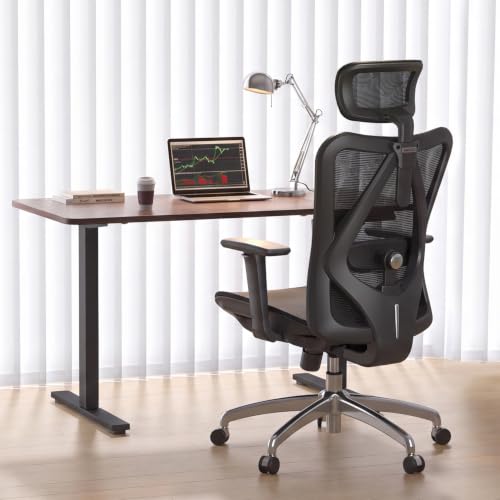
Pay attention to the perimeter of the seat. The mesh stretches across a frame, and the front edge matters if your thighs reach it or you tend to bring one leg up. Measure a chair that fits you now and compare the usable sitting area. The outer width alone gives you a poor sense of how much mesh is available between the edges.
At the checked prices, the M57 cost $54.09 more than the M18. I’d spend the difference for the mesh seat or the extra armrest positioning. If you typically sit upright with both forearms on the desk and like a padded seat, the M18 covers the features you’ll use most. The M57 also leaves about $20 beneath the price ceiling before tax, so it’s worth checking delivery charges if your budget covers the entire order.
SONGMICS KIME | Best Adjustable Office Chair Under $100
The ink-black KIME has a feature combination that makes sense in a shared workspace. Its lumbar pad is adjustable, it has a headrest, and the armrests flip up when you put the chair away. The selected model pairs a mesh back with a foam seat. SONGMICS’ product materials show a cushion about 19.7 inches wide and 3.5 inches thick. Check the width between the arms too, especially if you like to shift sideways while seated. SONGMICS product-family specifications
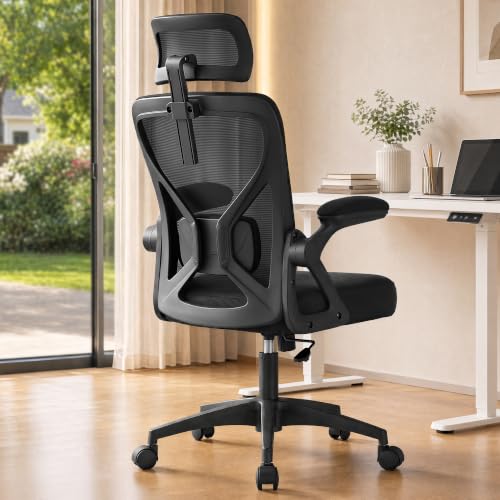
The retail listing gives a 90 to 105 degree tilt range. That’s enough for a small posture change between writing and reading. If you often lean back during long calls or prefer a more open hip angle, look at the M57’s broader recline range. Also check how much space you have behind the chair with the headrest in place, especially if a wall sits close to the desk.
The KIME sits in the middle of the under-$100 choices. I’d pick it if you want the chair to provide adjustable lower-back support while you work and still clear the desk opening when you’re finished. If you only need the swing-away arms and adjustable height, you can put the roughly $23 difference toward a footrest or keep it in the budget.
NEO CHAIR Flip-Up Mesh | Best Low-Cost Chair With Arms
The beige NEO CHAIR is the cheapest pick here. This is the mesh-back office model with flip-up arms, a height-adjustable seat and a swiveling rolling base. The listing describes built-in lumbar support. Put the arms down while you read or take a call, then swing them up to approach a crowded desk or slide the chair back into its parking spot.

Consider it for a bedroom desk, study corner or work surface that doubles as a place to sort paperwork. You can change how much space the chair’s arms take up in seconds. The wheelbase still needs room to roll in, so measure between the desk legs and look for anything at floor level, including a crossbar or a cable tray with a hanging power strip. A chair can clear the desktop and still stop short at the base.
I’d spend more for the KIME if you already know you want to move the lumbar pad around. The NEO’s selling point is clearance on a tight budget. If the desk opening is also narrow at shoulder level or you want both sides completely open for a hobby, the Serta is the cleaner fit. The NEO makes more sense when you’d miss armrests during breaks.
Serta Essentials | Best Compact Armless Office Chair
The black Essentials is a simple armless task chair with a foam cushion, a mesh back, rolling casters and adjustable height. Removing the arms from the design gives you room to approach the work surface from an angle. That can be handy when a narrow desk shares a corner with a bed, or when you turn between a computer and a nearby workbench. The short seat is worth comparing against a chair you already use comfortably if you have long thighs.

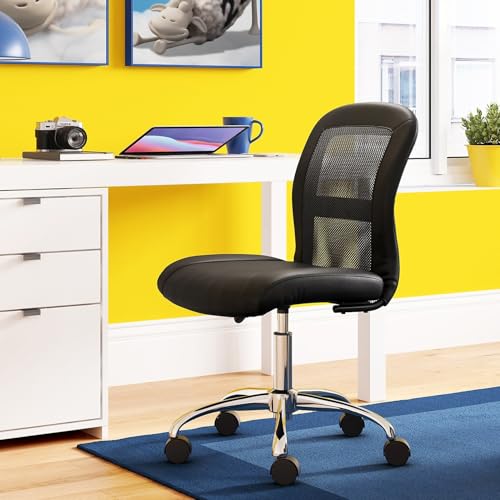
Check where you’ll support your forearms when you type. A clear desktop can do that job if your keyboard sits at a comfortable height and is close to the front edge. A high desk can leave you shrugging your shoulders, and a narrow surface can keep the mouse too far to one side. An ergonomic keyboard may be part of that setup, but its available space and position are worth checking before you buy either item.
The Serta makes sense for a study desk, a secondary computer or a space where you regularly park the chair under the worktop. For a chair you expect to lean into through a full workday, I’d start with the M18 or KIME and see whether their lumbar adjustments and armrests fit your setup. Compact and deliberately simple.
How We Evaluated
We compared new, in-stock Amazon U.S. offers for office chairs priced below $200. We reviewed the listed model and finish, seat and back construction, and the adjustments that affect how closely you can work at a desk. We cross-checked available manufacturer documentation and used workstation guidance from the Canadian Centre for Occupational Health and Safety to assess fit. CCOHS guidance on choosing an office chair
The picks reflect documented features and price, with a specific use case for each chair. We gave extra weight to controls that change the fit, such as repositionable lumbar support and flip-up arms under a low desk. Comfort over a full day depends on the person, desk and room. The comparison is based on published specifications and current listings.
How to Choose an Office Chair Under $200
How low or high does the seat need to go?
Measure from the floor to the top of the seat on a chair that already works for you, wearing the shoes you normally wear at your desk. Compare that number with the chair’s seat-height range. Overall chair height includes the back or headrest and tells you little about where your hips will sit. When you’re seated, your feet should have a stable surface underneath and the front edge of the cushion should leave your thighs free of pressure. A footrest can help if you have to raise the seat for a fixed desk. CCOHS chair adjustment guidance
How much usable seat depth do you need?
Sit back in a chair you know and check the gap behind your knees. A seat that goes too far forward can make you perch on its edge to get comfortable, taking your back away from the lumbar pad. A shallow seat can leave more of your thighs unsupported. Compare the depth from the front edge to where your back actually rests, especially when moving between a thick foam seat and a mesh seat with a rigid rim.
Will the chair fit at typing height and when parked?
Measure from the floor to the lowest obstruction, which could be a drawer, a desk apron or a keyboard tray. Then measure between the legs and check where the casters will go. If you have to raise the chair for a tall desk, the armrests will move up with the seat. Set the intended working height first, then decide if flip-up arms or an armless frame will give you the clearance you need.
Which adjustment would you actually change?
Choose the movement your current chair is missing. A lumbar pad you can raise or lower helps if the built-in curve on your current chair lands at the wrong height. Movable arm pads matter if you switch between typing in close and sitting farther back for calls. Look at the whole desk while you’re there. A display that sits too low can affect where you hold your head even after you adjust the chair. Our guide to dual monitor arms covers another way to set screen height and free up desk space.
Frequently Asked Questions
Is a $60 office chair enough for working from home?
It can be, especially at a desk you use part-time or one that already lines up with your seated elbow height. Start with seat fit and desk clearance. Spend more when you can identify something you need to change, such as the position of the lumbar pad or the height of the armrests. That makes it easier to choose between the NEO and a model with more controls.
Is a mesh seat better than a padded seat?
Mesh allows air to pass through the seating surface. A padded seat may be a better match if you prefer a thicker cushion or regularly sit nearer the front edge. The M57 gives you mesh at the seat and back, while the M18 leaves the back ventilated and gives you a cushion under your legs. Seat fit should settle the choice if only one of the two gives you enough space behind your knees.
Can I use an office chair for PC gaming?
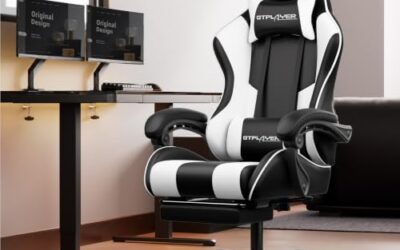
Yes. For keyboard and mouse play, check that your shoulders can relax, your knees have room and the mouse is easy to reach. If you’d rather have a tall upholstered back and a footrest for controller play, compare the shapes and features in our gaming chairs under $200 guide.
Bottom Line
Choose the SIHOO M18 if you want a padded seat and adjustable back support for a desk you use regularly. Buy the M57 if a full mesh seat matters more to you than keeping the price closer to $125. Under $100, the KIME offers the most ways to adjust your position among these picks. The NEO is the cheaper option if you mainly want to tuck the chair away, and the Serta works where removing arms altogether makes the desk easier to use. Measure the desk opening and your preferred seat height before ordering.

























Write Your Review
No reviews yet. Be the first to share your experience!