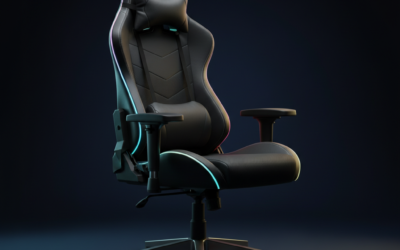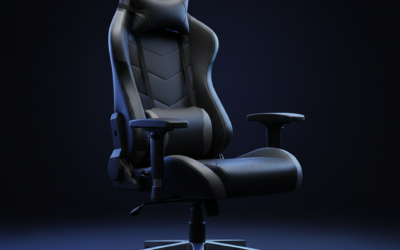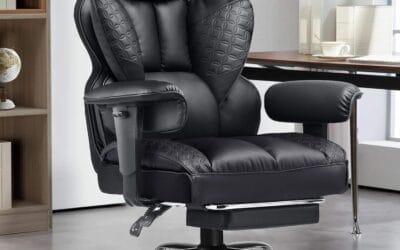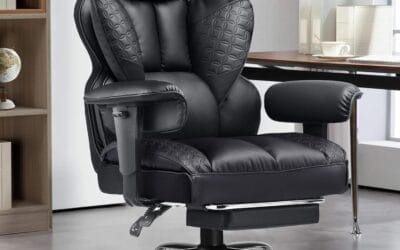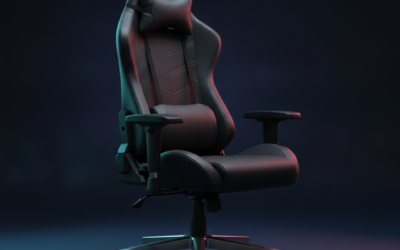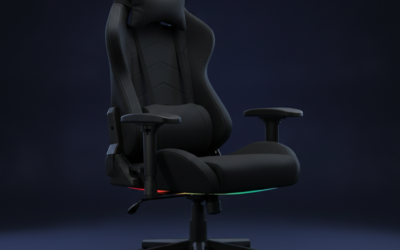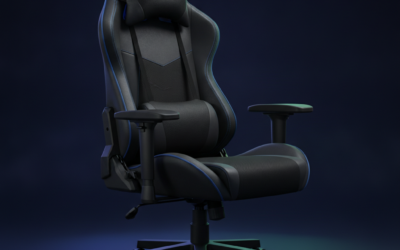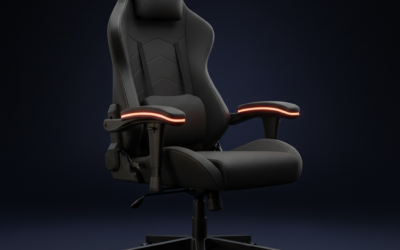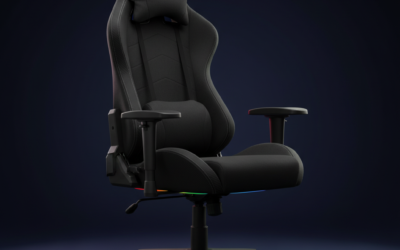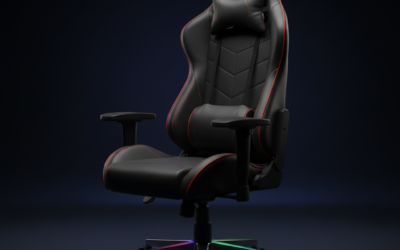

Gaming chairs under $300 used to mean compromise. Cheap foam, wobbly bases, armrests that snapped after six months. That’s changed. The current sub-$300 tier delivers proper lumbar support, weight ratings up to 400 lbs, and ergonomic features that were $500-only territory just two years ago. We researched seven chairs in this price band to find the ones that genuinely hold up to 8-hour gaming sessions and which ones still cut corners where it counts. For a closer look, see our guide on the best gaming chair for tall people.

Pros
- Steel base and 300 lb rating offer solid stability for users up to that limit.
- Included headrest pillow and lumbar cushion permit quick posture tweaks without extra purchases.
Cons
- PU leather surface can retain heat and may develop surface cracks after heavy daily use.
- No fabric or mesh option limits breathability compared to higher-tier chairs.
This is a budget-tier gaming chair aimed at home users who split time between gaming and office work. It features a high-back racing profile, linkage armrests, and a pull-out footrest for basic ergonomic needs.
The most practical feature is the combination of height-adjustable gas lift and reclining backrest that lets users shift between upright typing and relaxed footrest positions without leaving the seat.
Construction uses high-density foam over an FSC-certified wood inner support panel and a steel base, finished in PU leather. The overall build feels typical of entry-level chairs in this price range.
At this tier, expect compromises in long-term cushion resilience and material durability compared with chairs costing twice as much. The linkage armrests do not flip up or detach.
Buy this if you want an affordable adjustable chair with footrest support for sessions under six hours. Skip it if you need breathable mesh or premium stitching that lasts several years of daily abuse.
| Feature | Details |
|---|---|
| Weight Capacity | 300 lbs |
| Armrest Style | Linkage |
| Footrest | Pull-out |
| Surface Material | PU Leather |
| Gas Lift | SGS-certified |
| Base | Heavy-duty steel |
| Swivel | 360 degrees |
| Inner Cushion Support | FSC-certified wood |

Pros
- Metal five-star base rather than plastic, reducing long-term cracking risk under repeated recline load.
- Paded armrests from elbow to wrist reduce pressure points during extended keyboard and mouse sessions.
- Retractable footrest and headrest and lumbar pillow included, no separate ergonomic add-ons needed.
- PU leather surface wipes clean easily, practical for desks shared with food, pets, or kids.
Cons
- Limited owner feedback at time of writing, so long-term durability and QC consistency are hard to verify.
- Weight capacity, seat dimensions, recline angle, and gas lift class are not specified in the source listing.
- PU leather in this tier typically shows peling within one to two years of daily heavy use.
The GTPLAYER Pearl White is an entry-level PU leather gaming chair aimed at buyers who want a racing-style seat with a retractable footrest, detachable headrest pillow, and lumbar pillow without stepping up to mid-range brands. Target buyer is a student, casual gamer, or home-office user seating under roughly eight hours a day.
The defining feature here is the bundled ergonomic kit: footrest, headrest pillow, and lumbar pillow shipped in-box, paired with a full metal leg base instead of the plastic five-star bases common at this tier. Chairs in this bracket typically use nylon or plastic legs, so an all-metal base is a meaningful spec if the build holds up under real use.
Trade-offs are typical at this price point. The listing does not specify weight capacity, seat width, seat depth, recline angle, gas lift class, or BIFMA certification, which makes fit planning difficult for taller or heavier users. PU leather at this tier also tends to crack or peel earlier than fabric or PU-hybrid alternatives, especially in warm rooms.
Buy this if you want a cheap racing-style chair with a footrest and lumbar pillow for light daily use and you are under average height and weight. Skip this if you sit more than eight hours daily, weigh over roughly 100kg, or need documented BIFMA and gas lift certification.
Frame and base: GTPLAYER uses the same metal material as the built-in frame for the five-star legs rather than plastic, which is the main structural differentiator at this tier. Seat iner support is FSC-certified wood. Weight capacity and BIFMA certification are not specified, so verify beforeordering if you are above roughly 100kg.
Lumbar and headrest: A detachable lumbar pillow and headrest pillow ship in the box, strap-mounted rather than height-adjustable via the backrest itself. This is standard for racing-style chairs and works best for users between roughly 165cm and 185cm. Shorter or taller users may find the pillow position fixed and non-ideal.
Footrest and recline: A retractable footrest pulls out from under the seat pan for lean-back rest breaks. Exact recline angle, tilt-lock, and rking tension are not specified in the source listing, so assume the typical 90to 155 degree range common at this tier until confirmed.
Armrests and surface: Armrests are padded from elbow to wrist. 2D, 3D, or 4D adjustability is not specified, so treat them as fixed or 1D until the seller confirms. Upholstery is PU leather over foam, wipe-clean with a soft cloth.

Pros
- 400lbs rated capacity with heavy duty metal base and reinforced frame for larger builds.
- Pocket spring lumbar plus dual-layer sponge backrest addresses common lower-back pressure complaints.
- Wide 3D saddle cushion and enlarged headrest fit taller torsos better than standard racing chairs.
- 90 to 150 degree recline with pull-out footrest covers work, gaming, and rest positions.
Cons
- Limited owner fedback at time of writing, so long-term durability signals are thin.
- PU leather at thisier typically warms up over long sessions versus mesh alternatives.
- Armrest adjustability (2D/3D/4D) and seat depth are not specified in the source listing.
The GTPLAYER Big and Tall is a budget-tier heavy-duty gaming chair built around a 400lbs weight rating, PU leather upholstery, and a retractable footrest. It targets bigger and taller users who find standard 250 to 300lbs racing chairs too narow across the seat pan or too short in the backrest.
The defining feature is the support stack: a pocket spring lumbar pad, dual-layer high-density sponge in the backrest, and a 3D saddle-shaped seat cushion. Combined with the enlarged headrest and pronounced side bolsters, it aims to spread load across the lumbar spine and hips rather than concentrating pressure on the tailbone during multi-hour sessions.
Trade-offs at this tier are typical. PU leather runs warmer than mesh under sustained use, the source does not specify BIFMA certification, seat depth, or armrest DoF, and the 3-level gas lift class is not disclosed. Owner-report data is thin at time of writing, so long-term foam recovery and gas lift longevity remain unverified.
Buy this if you are over 250lbs or above 6 feet and want a wider seat, spring-backed lumbar, and a footrest without stepping up to a specialty big-and-tall office chair. Skip this if you prefer breathable mesh, need certified BIFMA load testing, or require 4D armrests with documented adjustment ranges.
Weight capacity and frame: Rated to 400lbs on a metal frame with heavy duty metal base and 3-level gas lift. That capacity places it above the 300lbs norm for mainstream racing chairs and matches typical big-and-tall office chair ratings. Specific gas lift class (Class 3/4) is not specified in the source.
Lumbar and seat support: Backrest uses dual-layer high-density sponge with a built-in pocket spring lumbar cushion. The 3D saddle-shaped seat is described as wider than standard to wrap the legs and buttocks. Exact seat width, seat depth, and backrest height are not specified.
Recline and footrest: Backrest reclines from 90 to 150 degrees, a 60-degree range covering upright work, reading, and near-flat rest. A retractable footrest is included for leg elevation. Tilt tension and rocking angle are not specified in the source data.
Upholstery and assembly: Embossed PU leather is marketed as breathable, scratch-resistant, and pet-friendly. Assembly is quoted at 15 to 30 minutes with all hardware included. Armrest adjustability (2D/3D/4D) and BIFMA or EN1335 certification are not disclosed.

Pros
- Integrated lumbar arch removes the need for an aftermarket back pillow
- Widened seat base with reduced bolsters accommodates broader hip widths
- High density foam typically holds shape longer than entry-tier cut foam
Cons
- Limited owner feedback at time of writing, assessment based mostly on spec sheet
- 2D armrests only adjust height and rotation, no forward or lateral travel
- Fixed lumbar arch cannot be raised or lowered to match torso height
The Razer Iskur V2 X is an entry-level ergonomic gaming chair sitting below the standard Iskur V2, aimed at buyers who want structured lumbar support and a wider seat pan without the mesh backrest or 4D armrests found on higher trims. Best suited to home office and gaming users seking fabric upholstery over PU leather.
The defining feature is the built-in lumbar arch, molded into the backrest rather than added as a strap-on pillow. This encourages a neutral pelvic tilt during multi-hour sessions and removes the fidget factor of a sliding cushion. Chairs in this tier typically fix the arch near mid-lumbar, so torso fit matters more than usual.
Trade-offs at this tier are visible. The 2D armrests only cover height and rotation, missing the forward or lateral travel that helps desk alignment. The lumbar arch is fixed height, so shorter or taller users may find pressure sits above or below their L3 to L5 zone. Recline stops at 152 degrees, short of lie-flat.
Buy this if you want a structured lumbar profile and wider seat pan for casual gaming and daily desk work at an entry price point. Skip this if you need adjustable lumbar height, 4D armrests, cold-cured foam, or a mesh back, all of which sit further up Razer's Iskur lineup.
Lumbar and recline: The backrest integrates a fixed lumbar arch and reclines up to 152 degrees, which covers upright work posture near 100 degrees through lounge angles for breaks. Lumbar height is not user-adjustable, so torso length compatibility is set by chair geometry rather than owner preference.
Seat base and cushioning: Razer widens the seat pan and reduces the side bolsters, guiding hips toward the center rather than pinching them. High density foam is specified across the cushions, which typically holds structural shape longer than the cut-foam blends used on sub-tier gaming chairs.
Armrests: The 2D armrests adjust for height and rotate inward or outward, but do not slide forward, backward, or laterally. Users who type at deep desks or use wide keyboards may need to compensate with chair distance, since elbow-to-keyboard alignment is limited compared to 3D or 4D armrests.
Upholstery: The chair uses a multi-layer plush fabric finish rather than PU leather. Fabric surfaces generally run cooler in warm rooms and avoid the peeling failure mode common to budget faux leather after two to three years of daily use, based on category norms.
Pros
- 21.5 inch wide seat and 350 lb capacity accommodate big and tall users
- 155 degree recline plus retractable footrest suports break and nap positions
- Adjustable lumbar pillow and headrest pillow address back pain complaints directly
Cons
- Limited owner feedback at time of writing, so long-term durability data is thin
- No BIFMA certification, seat depth, or gas lift class specified by the manufacturer
- Armrest adjustability (2D, 3D, or 4D) and height range not disclosed in source data
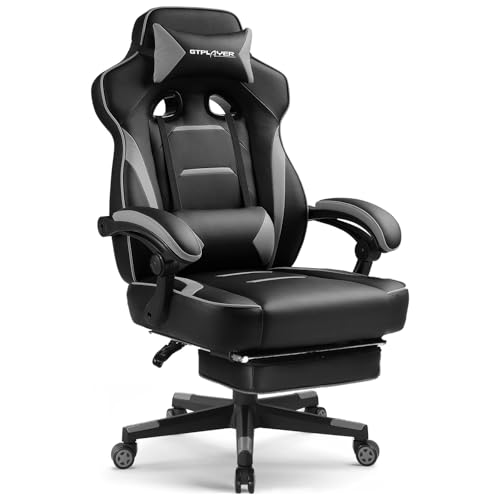
The GTPLAYER Sky Gray is a budget big and tall gaming chairimed at users up to 350 lb who need a wider 21.5 inch seat than standard racing-style chairs offer. It targets shift workers, streamers, and gamers with larger frames who want lumbar support and a reclining backrest without stepping up to Secretlab Titan XL money.
The defining feature is the sizing package: a 21.5 inch seat width, high back, and 350 lb rated frame paired with a 155 degree recline and retractable footrest. Latex memory foam is used in the seat cushion, which typically resists the flat, packed-down feel that cheaper polyurethane foam develops after a few months of daily use.
Trade-offs are typical at this tier. BIFMA certification, gas lift class, seat depth, and armrest adjustability level are not disclosed, which makes side-by-side comparison against Staples or Stelcase alternatives dificult. The included body pillows are helpful for petite users but often get discarded by taller buyers who prefer direct lumbar contact with the backrest.
Buy this if you weigh up to 350 lb, want a wider seat than a standard SL Blackwing or DXRacer, and value recline plus footrest over precise ergonomic tuning. Skip this if you need certified BIFMA durability, 4D armrests, or documented seat depth for a specific torso length.
Sizing envelope: Seat width is stated at 21.5 inches with a rated weight capacity of 350 lb, which places it in big and tall territory rather than standard racing chair sizing. Seat depth, backrest height, and overall chair dimensions are not disclosed in the source data.
Lumbar and recline: The chair uses an adjustable lumbar cushion rather than integrated lumbar with height and depth dials. Backrest recline extends to 155 degrees, which is enough for a full lean-back rest position, and a retractable footrest is included for elevated leg support during breaks.
Cushion construction: Seat and back use latex memory foam per the manufacturer, targeting pressure relief across the sit bones. Density,ILD rating, and cold-cured versus molded foam type are not specified, so long-term compression behavior is unverified.
Base and casters: A reinforced metal frame suports a 5-star base with 360 degree silent casters. Caster material (nylon versus PU) is not specified. Armrest adjustability tier (2D, 3D, or 4D) and gas lift class rating are also not disclosed by GTPLAYER.
Who needs a gaming chair under $300
Anyone who sits for more than three hours daily. That covers gamers, work-from-home professionals, students grinding through coursework, streamers. Office chairs from big-box stores fall apart in 18 months. A proper $200-ish gaming chair with a steel frame and class-4 gas lift typically lasts five-plus years. The cost-per-day math favors gaming chairs by a wide margin once you cross that threshold.
Big-and-tall users deserve special mention. If you’re over 6 feet or above 250 lbs, standard chairs compress quickly. The 350-400 lb rated chairs in this roundup use reinforced bases and denser foam that don’t sag after a year.
What to look for in a sub-$300 chair
Weight rating first. It’s the single best proxy for build quality. A chair rated for 400 lbs uses a thicker steel frame, denser foam, and a beefier gas cylinder than one rated for 250 lbs. You don’t need to weigh 400 lbs to benefit. The chair just lasts longer.
Lumbar support matters next. Built-in lumbar (integrated into the backrest shape) outlasts strap-on pillows. Strap-on pillows shift, flatten, and eventually get tossed in a closet. The Razer Iskur V2 X uses built-in lumbar. So do most GTPlayer big-and-tall models. That’s a real upgrade over $99 chairs with detachable cushions.
Recline angle is third. 150-degree recline lets you lean back for video breaks without standing up. Cheaper chairs cap at 135 degrees, which feels fine for typing but cramped for actual rest. And armrests: 2D adjusts up/down and front/back. 3D adds rotation. 4D adds tilt. More degrees of freedom equals better elbow alignment for long sessions.
How we evaluated these chairs
We compared weight ratings, lumbar implementations, armrest adjustability, and recline range across the seven contenders. We also pulled buyer review data, with special attention to one-star reviews mentioning frame failure, gas-cylinder collapse, or foam compression after the first year. Chairs with low failure-rate signals across thousands of reviews got priority. We also weighed real prices since gaming chair MSRPs are notoriously inflated. Street price is what matters. There’s more on this in our look at the best gaming chair.
Our picks by tier
For the absolute budget pick, the N-GEN GAMING chair at $89.77 surprises. Footrest, lumbar pillow, height-adjustable, leather upholstery, and a 4.6-star average across 3,000-plus reviews. It’s not a 10-year chair. But it’s a perfectly serviceable starter that’s better built than anything Office Depot sells at the same price.
A step up, the GTPlayer Gaming Chair with footrest at $89.76 lands at the same price point with similar features and a much larger review base (17,000-plus reviews at 4.4 stars). Pearl White finish stands out for streamers who want neutral aesthetics.
For big-and-tall users, the GTPlayer Big and Tall at $188.94 is the standout. 400 lb rating, ergonomic pocket-spring lumbar, 3D saddle-shaped cushion, and 34,000-plus reviews averaging 4.5 stars. The pocket-spring lumbar is unusual in this price range. It contours to your back instead of pressing a fixed shape.
For a true ergonomic upgrade, the Razer Iskur V2 X at $239.99 brings built-in lumbar, a widened seat base, high-density foam, and 152-degree recline. The 2D armrests are simpler than the V2 (which has 4D), but you’re saving roughly $200 versus the flagship Iskur. Plush fabric finish breathes better than leather in summer.
Need a heavy-duty pick under $100? The GTPlayer Sky Gray big-and-tall at $99.98 hits a 350 lb rating with high-back lumbar and recline for back-pain relief. It’s the value pick if you want serious capacity without crossing the $200 line.
Bottom line
Pick by weight rating, not aesthetics. The N-GEN and entry-level GTPlayer are fine for users under 220 lbs who want a starter chair. The GTPlayer big-and-tall models earn their price premium with frame durability that lasts years instead of months. And if you want proper built-in lumbar without the $400 flagship tax, the Razer Iskur V2 X is the sweet pick. Skip chairs that hide their weight rating. That’s almost always a red flag.
Common questions
Are gaming chairs actually better than office chairs?
For the price, often yes. Sub-$300 gaming chairs typically include lumbar support, recline, and armrest adjustability that you’d pay $500-plus for in an office chair. Premium ergonomic chairs like Herman Miller still win on long-term comfort. But entry-level office chairs from big-box stores lose to gaming chairs on durability and feature set.
Do I need a footrest?
Only if you recline for breaks. A retractable footrest lets you lean back and prop your legs up without buying a separate ottoman. If you only use the chair upright for typing or gaming, skip the footrest. It adds bulk and complexity that you won’t touch. About half the chairs in this roundup include one.
How long should a gaming chair last?
A properly built chair under $300 should run five-plus years with daily use. The first thing to fail is usually the gas cylinder (class-4 lasts longer than class-3). Foam compression on the seat is next, typically after year three. Frame failures are rare on chairs with steel bases and reinforced wheel arms.
Leather or fabric upholstery?
Fabric for hot climates and long sessions. PU leather looks sharp but traps heat, which becomes uncomfortable after 90 minutes. Fabric breathes better and ages more gracefully (leather peels after a few years). If you’re streaming on camera and want the gamer aesthetic, leather wins on looks. If you actually sit in the chair daily, fabric is the smarter choice.
Is assembly hard?
It’s straightforward but takes 30-45 minutes. Tools are included. The hardest part is attaching the backrest to the seat base, which often requires lifting roughly 25 lbs into alignment while threading bolts. A second pair of hands speeds things up. Don’t skip torquing the bolts properly. Loose hardware causes squeaks that drive you crazy six months later.