

Memory pricing tells a strange story right now. A 32GB DDR4 kit like the G.SKILL RipjawsV runs $229.99, while a 16GB DDR5 kit from Corsair sits at $234.99. Same money, half the capacity on the newer standard. That single price inversion is why the DDR4 versus DDR5 question isn’t settled by “newer is better,” and it’s why plenty of builders still pause before committing. Your motherboard socket usually forces the choice anyway, but the price gap decides how much RAM you actually get for the dollar. If you’re already shopping kits, our guides to the best DDR5 RAM in 2026 and the best DDR5 RAM for gaming pair well with what follows.
Matchup at a glance
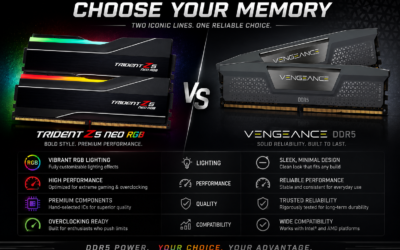
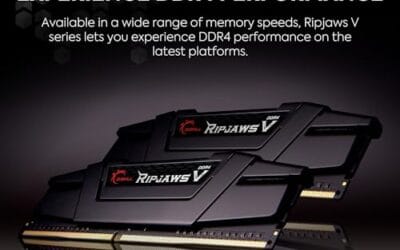
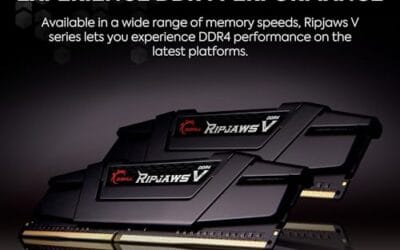
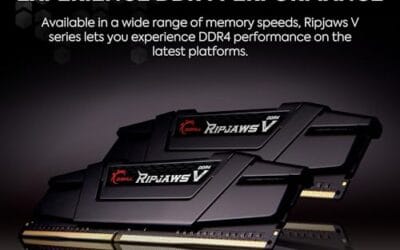
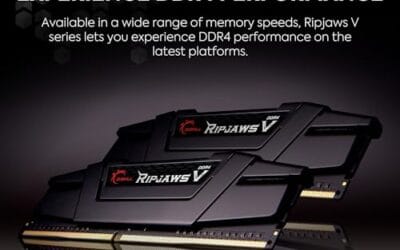
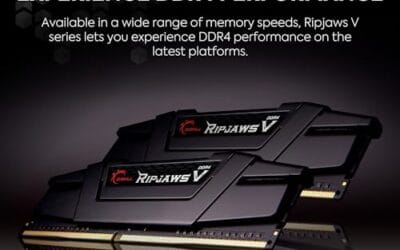
DDR4 has been the desktop default since 2015, and it’s mature, cheap per gigabyte, and available in high-capacity kits at low prices. The G.SKILL RipjawsV kit we researched packs 32GB across two 16GB sticks at 3600MT/s with CL18-22-22-42 timings and a 1.35V rating. That’s a lot of memory for the price. DDR4 boards, chips, and kits are everywhere, so replacements and upgrades stay painless.
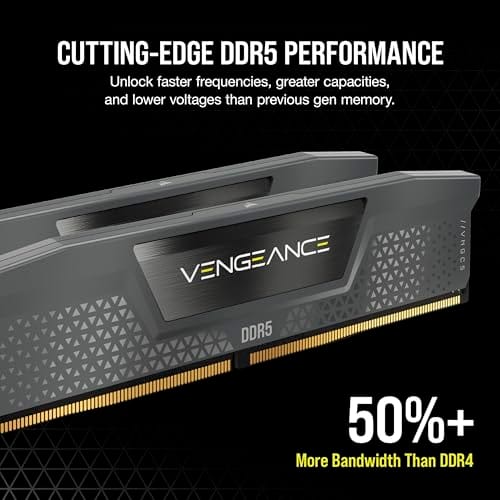
DDR5 is the forward-looking standard, and it brings higher clock ceilings, on-module power management, and better efficiency at scale. The Corsair Vengeance kit here reaches up to 5200MHz with CL40 timings, carries both AMD EXPO and Intel XMP 3.0 profiles, and ships as 16GB in a 2x8GB layout. It’s the platform every new Ryzen and Core build ships on. But you pay more per gigabyte, and the capacity you get at a given budget is smaller. Both kits cost roughly the same. The value math is not.
Spec sheet showdown
| Spec | G.SKILL RipjawsV DDR4 | Corsair Vengeance DDR5 | Why it matters | Edge |
|---|---|---|---|---|
| Capacity | 32GB (2x16GB) | 16GB (2x8GB) | Headroom for multitasking and content work | DDR4 |
| Rated speed | 3600MT/s | Up to 5200MHz | Bandwidth for the CPU to feed cores | DDR5 |
| CAS latency | CL18 | CL40 | Cycles before data returns | DDR4 (raw) |
| Voltage | 1.35V | On-module PMIC | Power delivery and stability | DDR5 |
| Price | $229.99 | $234.99 | What you actually pay | Even |
Read that CAS latency row carefully. CL18 on DDR4 looks far tighter than CL40 on DDR5, but latency in cycles isn’t the same as latency in real time. A higher clock burns through cycles faster, so the actual nanosecond delay narrows a lot. The capacity row, though, is blunt. You’re comparing 32GB against 16GB at the same price.
DDR4 strengths
The obvious win is capacity per dollar. Getting 32GB of the G.SKILL RipjawsV for $229.99 means comfortable headroom for a couple dozen browser tabs, a game, and a Discord call all at once, with room left over. That 4.6-star owner rating reflects a kit that’s been shipping long enough to iron out early quirks. DDR4’s other quiet advantage is platform cost. The boards are cheaper, the CPUs that use them are often discounted now, and the whole ecosystem is a known quantity.
Raw timings help too. CL18 at 3600MT/s is a genuinely responsive setup for latency-sensitive work, and 1.35V is a modest, well-understood voltage that most B450 and B550 boards handle without drama. The weakness is the ceiling. DDR4 tops out lower on bandwidth, and it won’t ride the next wave of CPUs, since new sockets have moved on. If you’re building something you plan to carry forward for years, that dead-end matters. For a build meant to run well today and stay affordable, it barely registers.
DDR5 strengths
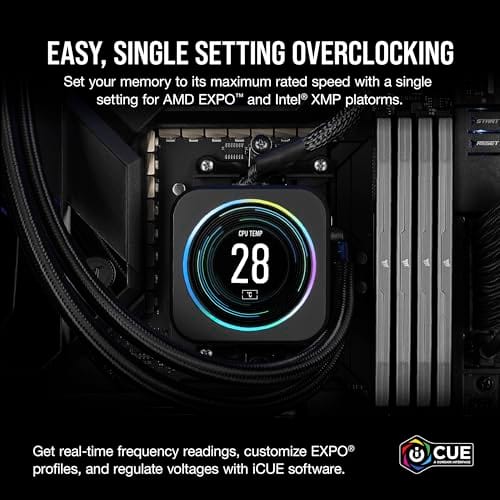
DDR5’s headline is bandwidth. Up to 5200MHz on the Corsair Vengeance kit feeds hungry modern cores far better than DDR4 can, and that gap widens on chips that lean on memory throughput, like AMD’s X3D parts and Intel’s higher core-count Core CPUs. The dual XMP 3.0 and EXPO profiles mean one kit auto-configures on both Intel and AMD boards, so you flip a BIOS toggle and you’re running rated speed. No manual tuning required.
The on-module power management is the underrated part. Moving voltage regulation onto the stick itself gives cleaner, more stable delivery, which is why DDR5 scales to speeds DDR4 can’t approach. The catch is right there in the spec sheet: 16GB for $234.99. That’s fine for gaming and everyday work, but it’s tight for heavy multitasking or creative projects, and stepping up to 32GB of DDR5 costs noticeably more. Owners rate this kit 4.4 stars, and reports point to reliable EXPO behavior on Ryzen boards. If you’re chasing overclock headroom specifically, our best DDR5 RAM for overclocking roundup digs deeper.

Pros
- AMD EXPO profile activates 5200MHz CL40-40-40-77 with a single BIOS toggle on Ryzen 7000 boards.
- Low 35mm module height clears virtually any AM5 or LGA1700 tower cooler without physical conflict.
- 1.25V operating voltage sits within DDR5 spec, reducing thermal stress on integrated PMIC under sustained load.
- Aluminum heatspreader aids passive heat dissipation in open-air cases without requiring active cooling.
Cons
- 16GB total capacity is increasingly marginal for content creation workflows and modern open-world titles running texture packs.
- 5200MHz CL40 offers modest latency compared to DDR5-6000 CL30 kits that hit the Ryzen 7000 FCLK 1:1 ratio sweet spot.
The CORSAIR Vengeance DDR5 16GB 2x8GB is a mid-range DDR5 kit targeting AMD Ryzen 7000 series and Intel 12th-generation-or-newer desktop builds. It ships with both AMD EXPO and Intel XMP 3.0 profiles, making it broadly compatible across AM5 and LGA1700 or LGA1851 platforms without manual timing configuration.
The standout feature is dual-profile support at a frequency that loads with a single BIOS toggle. At 5200MHz CL40-40-40-77 and 1.25V, it sits within DDR5 JEDEC specification territory, and onboard voltage regulation on the module itself reduces dependency on motherboard power delivery for the memory rail, which matters on budget AM5 boards with fewer VRM phases dedicated to DRAM.
The honest trade-off at this tier is frequency positioning. Ryzen 7000 performs best at DDR5-6000 with CL30 timings, where FCLK and memory controller run at a clean 1:1 ratio. This kit at 5200MHz places it below that threshold, meaning buyers on AM5 leave some CPU bandwidth on the table. The 16GB total capacity is also worth scrutinizing for any workload beyond gaming or light productivity.
Buy this if you are building a budget-to-mid AM5 or Intel DDR5 system and need reliable plug-and-play EXPO or XMP activation without manual overclocking. Skip this if your platform is AM5 and you plan to run a Ryzen 7000 CPU near its performance ceiling, where DDR5-6000 CL30 kits deliver measurably better throughput and latency at comparable pricing.
Platform Requirements: DDR5 requires AMD 600-series or newer motherboards paired with Ryzen 7000 series or newer CPUs, or Intel 600-series or 700-series boards with 12th-generation Core or newer. DDR5 is not backward compatible with DDR4 slots. Verify your motherboard QVL lists this kit before purchasing.
EXPO and XMP Activation: The rated 5200MHz speed requires enabling AMD EXPO or Intel XMP 3.0 in BIOS. Without activation, the kit defaults to DDR5-4800 JEDEC. On Ryzen 7000, DDR5-6000 is the accepted 1:1 FCLK sweet spot; this kit at 5200MHz runs below that threshold, which carries a small but measurable bandwidth and latency penalty versus a tuned DDR5-6000 kit.
Physical Clearance: Module height is 35mm, which clears nearly all air coolers without conflict. The 1.25V operating voltage and onboard PMIC mean power comes from the module itself rather than solely from the motherboard, reducing stress on budget boards with lighter DRAM power stages.
Capacity and Channel Config: The 2x8GB configuration fills two slots in dual-channel. CORSAIR explicitly advises against mixing kits, so expansion to 32GB requires replacing both modules with a validated 2x16GB kit rather than adding a second 2x8GB pair.
Real-world scenarios
Pure gaming at 1440p or 4K
At higher resolutions the GPU does the heavy lifting, and the memory standard barely swings frame rates. 16GB of DDR5 is plenty for almost every current title. DDR4 at 32GB won’t hold you back either. Here the choice follows your CPU socket, not benchmarks.
Content creation and heavy multitasking
This is where 32GB earns its keep. Video timelines, large Photoshop files, and virtual machines eat RAM fast. The G.SKILL DDR4 kit’s extra 16GB is more useful here than DDR5’s bandwidth edge, unless your workflow specifically loves throughput. For creators on a new platform, though, jumping to 32GB of DDR5 is the cleaner long-term move.
Competitive esports and high refresh
CPU-bound shooters at 1080p reward memory bandwidth and low latency, and DDR5’s higher clocks give a measurable, if small, frame-time benefit on the right chip. That’s the one gaming case where the newer standard pulls ahead. Even then, we’re often talking single-digit percentages.
Budget builds and upgrades
If you already own a DDR4 board, adding the RipjawsV kit is the smart, cheap path. No new motherboard, no new CPU. Reusing what you’ve got beats chasing a standard your socket can’t accept.
Pricing and availability
Both kits land within five dollars of each other, which is the whole story. DDR4 at $229.99 buys 32GB. DDR5 at $234.99 buys 16GB. DDR4 supply is deep and stable, so you’ll find kits and compatible boards easily. DDR5 pricing has been volatile, and it can spike, so watch the number before you commit. On a fresh AM5 or newer Intel build, you don’t get a vote anyway, since those sockets are DDR5-only. On older platforms, DDR4 remains the cheaper, higher-capacity pick.
Which to buy
Start with your motherboard. If your board or planned CPU socket takes only one standard, that’s your answer, full stop. Modern Ryzen 9000 and current Intel platforms are DDR5, and pairing them with a proper kit is covered in our best DDR5 RAM for Ryzen 9000 guide. For those builds, the Corsair Vengeance kit’s EXPO and XMP support makes setup trivial.
If you have a choice, or you’re keeping an existing DDR4 rig alive, the value tilts hard toward DDR4. The G.SKILL RipjawsV gives you 32GB for essentially the same money as 16GB of DDR5, and for gaming plus general use that extra capacity is more useful than the bandwidth you’d gain. It’s a research-backed pick with a 4.6-star track record and timings that stay responsive. Buy DDR5 when your platform demands it or your workload genuinely craves throughput. Buy DDR4 when you want the most memory per dollar on hardware you already own.

Pros
- DDR4-3600 XMP at 1.35V is the Ryzen AM4 sweet spot, aligning FCLK 1:1 at 1800MHz for best latency.
- Matched 2x16GB kit is factory-tested as a pair, reducing dual-channel instability compared to mixing sticks.
- Compatible with both Intel XMP and AMD DOCP/A-XMP BIOS profiles without manual sub-timing adjustments.
- Ships with JEDEC SPD fallback so the system always boots safe at default clocks before XMP is enabled.
Cons
- CL18 primary latency is mid-range; DDR4-3600 CL16 kits exist for buyers prioritizing tighter timings.
- No ECC support, so workstation or Threadripper ECC builds need a different kit entirely.
The G.SKILL RipjawsV F4-3600C18D-32GVK is a mid-range DDR4 desktop kit targeting Intel and AMD mainstream platform builders who want 32GB capacity at DDR4-3600 without overpaying for CL14 or CL16 enthusiast kits. It ships as a matched 2x16GB dual-channel pair in the standard 288-pin U-DIMM form factor.
The defining spec here is the XMP profile: DDR4-3600 at CL18-22-22-42, 1.35V. On AMD AM4 Ryzen systems, 3600MHz is the well-documented sweet spot for achieving a 1:1 FCLK ratio at 1800MHz, which keeps infinity fabric latency in check and translates to measurable gains in lightly-threaded workloads and gaming frame times compared to DDR4-3200 or lower.
CL18 is a genuine trade-off at this speed. Competing DDR4-3600 kits with CL16 or CL14 exist and offer lower absolute latency, though they typically carry a price premium. Owners report stable XMP operation across a wide range of B450, X570, and Z490/Z590 boards, but reaching rated speed on some budget AM4 boards may require manual sub-timing adjustments or AGESA microcode updates.
Buy this if you are building or upgrading an AM4 Ryzen or Intel LGA1700 desktop and want reliable 32GB DDR4-3600 dual-channel performance without tuning. Skip this if you need CL16 or tighter for competitive latency, or if your board has a limited QVL and you have not verified compatibility via G.SKILL's configurator tool first.
Platform Support: This kit uses 288-pin DDR4 U-DIMM and is compatible with Intel LGA1700 (Z690/Z790) and AMD AM4 (B450/X470/B550/X570) platforms. AM5 uses DDR5 exclusively, so this kit is not compatible with Ryzen 7000/9000 series builds on AM5 boards.
XMP and DOCP Activation: Rated speed of DDR4-3600 CL18-22-22-42 at 1.35V requires enabling XMP (Intel) or DOCP/A-XMP (AMD) in BIOS. Default JEDEC SPD boots at DDR4-2133 or DDR4-2400. On AM4, DDR4-3600 aligns FCLK at 1800MHz for a 1:1 ratio, which is the recommended operating point for Ryzen 3000 and 5000 series CPUs.
Slot Population and Mixing: Install both sticks in the recommended dual-channel slots per your motherboard manual, typically A2 and B2 in a 4-slot board. G.SKILL explicitly warns against mixing this kit with other modules; doing so voids the matched-pair guarantee and risks instability at XMP speeds.
Cooler Clearance: Exact heatspreader height is not specified in the source data, but RipjawsV modules are noted for a lower profile than Trident Z or RGB variants, reducing conflicts with wide tower coolers. Verify clearance if using a low-clearance cooler on a tight ITX board.
Platform choice usually settles this debate before specs do. DDR4 and DDR5 are not interchangeable in the same slot, so your CPU and motherboard decide which one you can run. A current build almost always lands on DDR5, while DDR4 mainly makes sense for a budget upgrade on an older board you already own.
Price gaps have narrowed too. DDR5 kits used to carry a steep premium, but mainstream 32GB DDR5 has fallen close enough to DDR4 that the newer standard is the sensible default for most fresh builds.
Common questions
Is DDR5 always faster than DDR4 in games?
No. At 1440p and 4K the GPU sets the pace, so both standards land close together. DDR5’s bandwidth edge shows up mostly in CPU-bound 1080p esports on a strong processor, and even then the gap is usually small.
Can I put DDR5 in a DDR4 motherboard?
You can’t. The notches and pin layouts differ, and the two standards are physically and electrically incompatible. The board’s slots dictate which memory you buy, so check your motherboard before ordering.
Why is CL40 DDR5 not slower than CL18 DDR4?
Latency measured in clock cycles isn’t the same as time. DDR5 runs at a much higher frequency, so each cycle is shorter. The real-world nanosecond delay between CL40 at 5200MHz and CL18 at 3600MT/s ends up far closer than the raw numbers suggest.
Is 16GB of DDR5 enough in 2026?
For gaming and everyday tasks, yes. Most titles run fine within 16GB. If you edit video, run virtual machines, or juggle heavy creative apps, you’ll want 32GB, and on DDR5 that costs more than the Corsair kit’s price here.
Should I buy a DDR4 build in 2026 at all?
If you already own a DDR4 platform, absolutely. The value is excellent and the parts are cheap. For a brand-new build meant to last, a DDR5 platform is the more future-ready foundation, since new CPU sockets have left DDR4 behind.




Write Your Review
No reviews yet. Be the first to share your experience!