A 30-second power flicker can corrupt a save file, fry a hard drive, or interrupt a 4-hour render at the 3:55 mark. A proper UPS prevents all of that. The modern gaming UPS sits at 1,500VA / 1,000W, sine-wave output, with 10-13 outlets and USB-C charging built in. We researched seven battery backups across CyberPower and APC to figure out which units deliver real runtime under gaming-PC loads and which ones cheap out on the inverter waveform.
Pros
- Pure sine wave output plays nicely with modern active PFC ATX PSUs
- Six battery backup outlets plus six surge only cover a full desk setup
- Color LCD with 22-degree tilt shows load, runtime, and input voltage clearly
Cons
- Limited owner feedback at time of writing, verify current buyer reports before purchase
- Source data lists both 1000W and 900W continuous, confirm actual rating before sizing
- Mini tower form factor is not rack mountable and input cord is only five feet
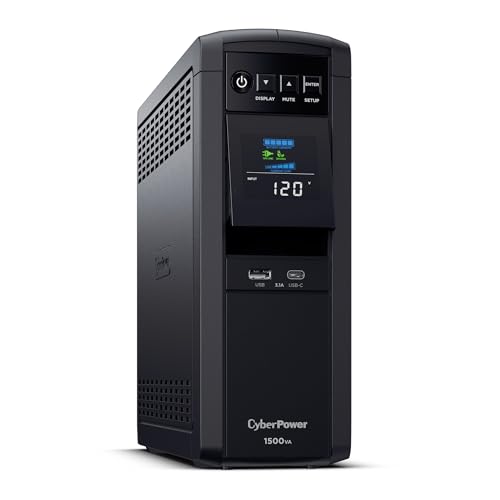
The CP1500PFCLCD is a mini tower line-interactive UPS with pure sine wave output, rated at 1500VA/1000W across12 NEMA 5-15R outlets. It targets desktop PC owners running active PFC power suplies, small workstations, and home network gear who need clean runtime through short outages and brownouts.
Pure sine wave output is the defining spec here, since active PFC PSUs in modern PCs can trip or shut down on the steped approximation used by cheaper UPS models. Automatic Voltage Regulation corrects minor sags and surges without draining the battery, extending cell life during frequent low-voltage events on noisy circuits.
The 1000W real-power ceiling is typical at this VA class, so a rig pulling 700W under sustained gaming load will get short runtime and should size expectations down. Source data lists both 1000W and 900W in different fields, and the five-foot input cord limits placement flexibility behind deep desks.
Buy this if you run a single desktop or workstation under about 900W total draw with an active PFC PSU and want AVR plus clean sine wave through short blackouts. Skip this if your combined system pull exceeds 1000W, or if you need rack mounting, hot-swap bateries, or network management card slots.
Capacity and topology: Rated at 1500VA/1000W with line-interactive topology and pure sine wave output on battery. Suits active PFC ATX PSUs found in modern gaming PCs and workstations. Source lists 1000W in the title and 900W in the feature bullets, so verify continuous wattage against your specific build.
Outlets and ports: Twelve NEMA 5-15R outlets total, split into six battery backup plus surge protected and six surge only. Includes one USB Type-A and one USB Type-C charging port for phones and tablets. Input is a NEMA 5-15P right-angle 45-degree offset plug on a five-fot cord.
Display and controls: Multi-function color LCD reports load, input voltage, battery capacity, and runtime estimate, with a scren that tilts up to 22 degrees for desk-height reading. AVR corrects minor fluctuations without triggering battery cutover. Bundled PowerPanel software adds shutdown scheduling and event logging over USB.
Warranty and certification: Three-year warranty covering the unit and internal battery, with a connected equipment guarantee handled through CyberPower's claims process. UL certified for North American use. Form factor is a mini tower, not rack mountable, so plan for floor or shelf placement near the protected system.

Pros
- Sine wave output is safe for active PFC PSUs found in gaming and workstation builds.
- Front-facing outlet is unique in the lineup and practical for desk-accessible device swaps.
- Dual USB-C ports remain powered on battery, covering controllers, headsets, and phones simultaneously.
- 1445-joule surge rating and seven battery-backed outlets cover a full gaming rig plus networking gear.
Cons
- Limited owner feedback at time of writing makes long-term reliability hard to assess independently.
- 9.2-minute half-load runtime assumes roughly 500W draw; a high-end GPU at full tilt will cut that well under 3 minutes.
The GX150C2-E is a mid-range standby UPS rated at 1500VA and 1000W, positioned for gaming desks running a full PC, monitor, networking gear, and console simultaneously. Its sine wave output targets buyers using PSUs with active PFC circuits, which are standard in any quality gaming build above the budget tier.
The standout spec here is the sine wave waveform. Most UPS units at this capacity ship with simulated sine wave, which can cause audible buzzing or instability in active PFC PSUs from brands like Seasonic, Corsair, or be quiet!. Sine wave output eliminates that risk. The seven battery-backed outlets, including the front-facing one, cover the scenarios where simulated wave units commonly fail users.
Runtime is the honest trade-off. At half load (around 500W), the unit is estimated to run 9.2 minutes, dropping to 2.3 minutes at full 1000W load. A gaming PC with an RTX 4080 or above under load can hit 600W or more on its own, leaving minimal runway for a clean shutdown. This UPS is best treated as a shutdown buffer, not extended runtime insurance.
Buy this if you run a mid-to-high-end gaming PC with an active PFC PSU and need protected runtime to save your game and shut down safely. Skip this if your rig draws near the 1000W ceiling consistently, as runtime will be too short to add meaningful protection.
Power Capacity: Rated at 1500VA and 1000W with a sine wave output waveform. This covers a mid-range gaming PC, one or two monitors, and a network switch simultaneously, provided total draw stays below 1000W continuous.
Outlet Layout: Thirteen NEMA 5-15R outlets total: seven with battery backup and surge protection, six with surge protection only. Surge protection is rated at 1445 joules. The front-facing outlet is battery-backed, a layout advantage over comparable units in the lineup.
Runtime Estimates: CyberPower specifies 9.2 minutes at half load and 2.3 minutes at full 1000W load. Builds drawing 600W or more (RTX 4080-class systems under gaming load) should expect runtime closer to the 2-4 minute range, enough for an orderly shutdown only.
Charging and Connectivity: Two USB-C charging ports are included and remain active during battery operation. Input plug is a NEMA 5-15P with a 45-degree offset and a five-foot cord. PowerPanel Personal software is available as a free download for load and battery monitoring.

Pros
- Pure sine wave output pairs cleanly with Active PFC PSUs found in modern gaming PCs
- 1500VA/900W rating leaves headroom for a typical 400 to 600W desktop load at the wall
- User-replaceable APCRBC163 battery module avoids full unit replacement once cells degrade
Cons
- Limited owner feedback at time of writing makes long-term reliability harder to gauge
- 900W real-power ceiling constrains RTX 4080/4090 rigs that can transient spike above rating
- Cited 73 minute runtime is at a 100W load, real 300 to 500W PC draws cut minutes sharply
The APC BR1500MS2 is a mid-tier consumer line-interactive UPS rated at 1500VA and 900W with pure sine wave output. It targets home office and gaming PC owners running Active PFC power supplies, NAS units, or workstations that need graceful shutdown headrom during short outages rather than extended off-grid operation.
Pure sine wave output is the defining spec here. Active PFC PSUs can trip or drop load on cheaper simulated sine wave units, so this matters for any modern build. APC cites up to 73 minutes at a 100W draw, though typical desktop loads of 300 to 500W will land in the 5 to 10 minute range based on category norms.
The 900W real-power ceiling is the honest limitation. High-end rigs with an RTX 4080 or 4090 can spike well past that during transients, tripping the overload alarm even when average draw looks safe. AVR handles brownouts without cycling the battery, but this is line-interactive topology, not double-conversion, so expect a brief transfer window.
Buy this if you run a mid-range Ryzen or Core i5 build with a single GPU below RTX 4070 class and want clean sine wave backup plus AVR for a home office. Skip this if your PSU is rated above 850W or you need double-conversion topology for a server rack.
Capacity: Rated at 1500VA apparent power and 900W real power, implying a 0.6 power factor. The 900W ceiling suits systems averaging 400 to 600W at the wall, leaving transient headroom for GPU spikes on cards up to roughly RTX 4070 Super class.
Outlets and ports: Ten outlets total, six with battery backup plus surge for PC, monitor, router, and NAS, four surge-only for peripherals. Coax and Ethernet pass-through ports protect data lines. Front-panel USB-A and USB-C charging ports skip the protected outlet count.
Waveform and regulation: Pure sine wave inverter output listed as Active PFC compatible. Automatic Voltage Regulation corects out-of-range voltage without switching to battery, standard line-interactive behavior. The silenceable alarm and angled LCD display live load wattage, runtime remaining, and battery health.
Battery and support: User-replaceable APCRBC163 battery module extends service life beyond a single cell cycle. APC cites a 3-year warranty per source data. Rated runtime of 73 minutes applies at a 100W draw and drops sharply as load scales toward the 900W ceiling.

Pros
- Sine wave output pairs cleanly with active PFC PSUs used in modern gaming PCs.
- Thirteen outlets with wide spacing accommodate bulky console and monitor power bricks.
- USB-C ports run off battery, keping controllers and headsets charged during outages.
- UL certification plus three-year waranty including battery and Connected Equipment Guarantee.
Cons
- Limited owner fedback at time of writing, real-world runtime and reliability data is sparse.
- 1000W real-power ceiling is tight for high-end GPU builds puling sustained transient spikes.
- Standby topology (not line-interactive or online) means brief transfer time during utility loss.
The CyberPower GX150C2 is a mid-tier standby UPS aimed at gaming PCs, consoles, and streaming rigs. It rates 1500VA/1000W with sine wave output, 13 NEMA 5-15R outlets, USB-C charging, and RGB lighting. Target buyer is a mid-range PC or console owner needing outage protection without stepping up to line-interactive gear.
The defining feature is sine wave output at 1000W real power, which maters because active PFC gaming PSUs can trip or shut down on stepped-wave UPS units during transfer. That makes this unit safer with modern RTX or Radeon builds than cheaper simulated sine wave models. Runtime figures are not specified in source data.
Trade-offs are typical at this tier. Standby topology means a brief transfer delay on outage, which is fine for PSUs with adequate hold-up capacitance but less forgiving than line-interactive designs. The 1000W ceiling also leaves limited headroom for a 4080-class GPU plus a high-refresh monitor and peripherals under sustained load. Rating data is thin.
Buy this if you run a mid-range gaming PC or console under roughly 700W total pull and want sine wave clean power with USB-C convenience. Skip this if you need line-interactive AVR, extended runtime beyond a graceful shutdown, or headroom for a 4090-tier system.
Capacity and topology: Rated 1500VA/1000W standby with sine wave output. The 1000W real-power figure is the hard ceiling, so size your load at roughly 60to 70 percent for runtime, keeping a gaming PC plus monitor under about 700W to allow shutdown margin during outages.
Outlets and input: Thirteen NEMA 5-15R outlets, split seven battery plus surge and six surge only. Widely spaced positions fit oversized console and monitor bricks. Input is a NEMA 5-15P right-angle plug offset 45 degrees on a five-foot cord, useful behind desks tight to the wall.
USB-C and PSU pairing: USB-C fast charging runs during outages for controllers and headsets. Sine wave output pairs cleanly with active PFC ATX 3.0 or 3.1 gaming PSUs that can misbehave on stepped-wave inverters. Exact USB-C wattage is not specified in source data.
Waranty and safety: UL listed, three-year warranty inclusive of the battery, and a Connected Equipment Guarantee. Free PowerPanel software download handles auto-shutdown scripting over USB, standard for CyberPower units at this tier.

Pros
- 900W real-watt ceiling supports mainstream desktop, monitor, and network gear combined loads
- AVR handles minor voltage fluctuations without draining battery, preserving runtime during extended events
- Two widely spaced outlets accommodate bulky transformer bricks common on network and audio gear
Cons
- No verified owner feedback at time of writing, treat rating as provisional and validate on arival
- Simulated sine wave output can cause hum or shutdown on some active PFC PSUs at higher loads
- 900W envelope excludes high-end gaming rigs pairing RTX 4080 or 4090 class GPUs with a big CPU
This is a mid-tier line-interactive UPS rated 1500VA/900W with automatic voltage regulation, an LCD status panel, and 10 NEMA 5-15R outlets. It targets home office users, small workstation builds, and mainstream gaming PCs that need clean shutdown coverage during brief outages plus continuous brownout correction on unstable utility feds.
The defining feature is AVR paired with the 900W real-watt ceiling, which handles a typical desktop plus 27-inch monitor plus router draw with usable headroom. Line-interactive units at this tier typically deliver 2 to 5 minutes runtime near full load, enough for graceful PowerPanel-triggered shutdown before the battery drops.
Trade-offs are real at this price band. Simulated sine wave output can conflict with active PFC power supplies during battery transfer, occasionally triggering PSU shutdown or audible hum. Buyers running an RTX 4070 Ti Super or higher will exceed the 900W envelope quickly. USB monitoring is single-host, so shared setups need workarounds.
Buy this if you run a mainstream desktop, home network stack, or console setup and want AVR plus a few minutes of runtime for safe shutdown. Skip this if your PSU is active PFC sensitive under load, or if your combined sustained draw approaches 700W, since headroom evaporates fast.
Capacity and topology: Rated 1500VA aparent and 900W real power in line-interactive topology with simulated sine wave output on battery. The 0.6 power factor is standard for this class. Sizing sustained real-watt load below 720W preserves runtime and reduces fan cycling under transient spikes.
Outlets and input: Ten NEMA 5-15R outlets split five battery-plus-surge and five surge-only, with two spaced positions for wall-wart adapters. Input is a NEMA 5-15P plug on a six-foot cord, adequate for placement behind most desks or on under-desk equipment shelves.
Monitoring and software: Multifunction LCD reports battery capacity, load percentage, input voltage, and fault conditions. USB connection to free PowerPanel software enables scheduled self-tests and automatic OS shutdown once runtime falls below a user-defined threshold, useful for unattended NAS or workstation setups.
Waranty and safety: Backed by a 3-year warranty that includes the internal battery, UL listed for safety compliance, and shipped with a connected equipment guarantee per manufacturer terms. Mini-tower form factor sits vertically to minimize desk footprint versus horizontal rack-style UPS units at similar capacity.
Who needs a UPS for a gaming PC
Anyone in an area with brownouts, frequent flickers, or summer storm outages. That covers most of the US east coast in hurricane season, Texas during winter freezes, and pretty much all of California in fire season. Even a half-second drop in voltage can crash an unsaved game, corrupt an NTFS write-in-progress, or trip the PSU‘s overcurrent protection in ways that aren’t great for long-term hardware health.
Content creators get double the benefit. A 90-minute Adobe Premiere export at 2:55 minutes from done is worth roughly an hour of your time. A $240 UPS prevents that loss the first time it happens. Pro photographers and streamers running on-air gear lean on UPS units to keep the stream alive through 5-second blips.
What to look for in a gaming UPS
Wattage first. A gaming PC with an RTX 4070 and a Ryzen 7 7700X under full load draws roughly 450-550W. Add a 32-inch monitor (50W), speakers (20W), and peripherals (10W). You’re at 530-630W of real load. A 1,000W rated UPS gives you headroom and 8-12 minutes of runtime, which is plenty to save and shut down cleanly.
Sine wave output is non-negotiable for active-PFC PSUs (basically every modern gaming PSU). Simulated sine wave UPS units can cause modern PSUs to shut down or buzz under battery operation. Pure sine wave or PFC sine wave is what you want. All five units in this roundup deliver it.
Outlet count is third. 10-13 outlets is standard. Half are battery-backed (for the critical gear). Half are surge-only (for printers, lamps, anything that can lose power without consequence). USB-C charging ports are a recent feature on the gaming-targeted CyberPower GX series and the new APC Back-UPS Pro line. They’re surprisingly useful for charging a phone or controller during an outage.
How we evaluated these UPS units
We compared wattage ratings, runtime curves at typical gaming loads (around 500W), outlet counts, and inverter type. We also looked at AVR (automatic voltage regulation) capability since brownouts (where voltage drops without a full outage) are the more common real-world event and AVR handles them without switching to battery. Battery life and replaceability mattered too. CyberPower and APC both sell replacement battery packs, which extends UPS unit life to 6-8 years total instead of the 3-4 year battery lifespan.
Our picks by tier
For the long-standing classic, the CyberPower CP1500PFCLCD at $239.95 is the reference. 1,500VA / 1,000W, PFC sine wave, 12 outlets, AVR, mini-tower form factor, and an 11,500-plus review base averaging 4.6 stars. It’s been the default gaming UPS pick for years for a reason. Reliable, well-supported, and the battery is easy to swap when it eventually fails.
For budget runtime, the CyberPower CP1500GAVR at $189.99 trades the pure sine wave for line-interactive operation. It’s fine for older PSUs without active PFC, but skip it if you’re on a modern Gold-rated gaming PSU. 1,500VA / 900W, 10 outlets, LCD display. The $50 savings versus the PFCLCD makes sense only if your PSU is compatible.
For the gamer aesthetic, the CyberPower GX150C2-E at $299.99 brings RGB lighting, USB-C charging, 13 outlets, and the same 1,500VA / 1,000W backbone. If you’ve got an RGB-themed setup and want the UPS to match, this is the one. The USB-C port is genuinely useful too. It charges a Steam Deck or phone at 18W during an outage.
There’s also a non-E variant of the GX150C2 at $299.99 with similar specs but a smaller review base. Stick with the GX150C2-E unless you find the non-E discounted.
For the APC alternative, the Back-UPS Pro BR1500MS2 at $299.99 hits 1,500VA / 900W with active-PFC compatibility, AVR, LCD, 10 outlets, and a USB-C charging port. APC’s reliability record is strong and their replacement battery program is the most mature in the category. If you’re already on APC PowerChute software for graceful shutdowns, the BR1500MS2 fits the workflow.
Bottom line
For most gaming rigs, the CyberPower CP1500PFCLCD at $240 is the sane default. Proven over a decade, easy replacement batteries, sufficient runtime for a clean save-and-shutdown. If you want USB-C charging and don’t mind paying $60 more, the GX150C2-E adds RGB and a useful port. APC fans should grab the BR1500MS2. And skip simulated-sine-wave UPS units entirely. They’ll buzz, click, or refuse to back up modern active-PFC PSUs.
Common questions
How much runtime will a 1500VA UPS give my gaming PC?
At a real load of 500W (typical gaming with a mid-range GPU), you’ll get roughly 5-8 minutes. At idle (around 150W during desktop work), expect 20-25 minutes. The UPS isn’t meant to keep you gaming through an outage. It’s meant to give you enough time to save, close apps, and shut down cleanly. 5-8 minutes is enough for that.
Do I need pure sine wave or is simulated fine?
Pure sine wave for any PC built in the last decade. Modern PSUs use active power-factor correction circuits that misread simulated sine wave as dirty power. The PSU may shut down, click, or buzz. For older PCs or non-PC loads (lamps, modems, NAS units), simulated sine wave saves money and works fine. For gaming rigs, spend the extra and get pure sine.
How often do I replace the battery?
Every 3-4 years for sealed lead-acid batteries, which is what most UPS units in this price range use. Newer lithium-iron-phosphate UPS units last 8-10 years but cost double. CyberPower and APC sell replacement packs for roughly $60-90, and swap takes under 10 minutes. Set a calendar reminder. A failed UPS battery is silent until you actually need it.
Should I plug my monitor into the UPS?
Yes for the primary monitor, no for secondary monitors. You need to see the screen to save your work during an outage. But adding a 32-inch curved or a second 4K panel can cut runtime by 30%. Plug the secondary into the surge-only outlets if your UPS has them. Or just unplug it during the brief outage window.
Does a UPS protect against lightning?
It helps but isn’t a guarantee. UPS units include surge protection rated at 600-1,200 joules. A direct lightning strike on nearby power lines exceeds that easily. For real lightning protection, combine a UPS with whole-house surge protection at the breaker panel. And unplug everything during severe storms. Belt-and-suspenders is the only reliable approach.