

Pick the wrong case and you’ll notice it every single day, either as a CPU that hovers 12 to 15 degrees warmer than it should or as a fan whine that follows you around a quiet room at 11pm. That’s the real fork in the road: an airflow case that pulls cool air across your parts with mesh and open panels, or a silent case that wraps everything in sound-dampening foam to hush the noise. Both cost roughly the same at similar tiers, so the money question isn’t price, it’s which trade you’re willing to live with. We researched how each design behaves under load and where the extra dollars actually land, drawing on owner reports and published case specs rather than lab claims.
If you already know your components run hot, our roundup of the best PC case for airflow 2026 covers the mesh-front options in detail, while the best budget PC case for a silent build guide leans the other direction. This head-to-head sits between them.
Matchup at a glance
An airflow case treats cooling as the priority. Mesh front panels, open top vents, and generous fan mounts let a chassis move a lot of air, which keeps GPU and CPU temperatures down when a game or render pushes the system for hours. The tradeoff is noise: with less material between the fans and your ears, you hear more of everything. Fan hum, coil whine, the occasional bearing tick. It’s all a bit closer.

A silent case flips that. Solid steel or aluminum panels, foam padding on the doors, and restricted vent paths cut the noise that escapes the box. You gain calm. You give back a few degrees of thermal headroom, because the same panels that trap sound also slow the air. Neither approach is wrong. They’re built for different rooms and different tolerance levels, and the correct pick depends far more on your parts and your desk than on the badge.

Spec sheet showdown
| Attribute | Airflow-first case | Silent-first case | Temperature impact | Noise impact |
|---|---|---|---|---|
| Front panel | Fine steel mesh, open intake | Solid panel with foam lining | Airflow wins by 8-15C on hot parts | Silent wins, panels muffle fans |
| Fan behavior | Fans spin slower for same temps | Fans spin faster to fight restriction | Airflow keeps thermals lower at load | Mixed, faster fans can offset foam |
| Best components | High-wattage GPU, hot CPU | Efficient mid-range parts | Airflow suits 300W+ GPUs | Silent suits cooler builds |
| Dust | More intake, more filters to clean | Sealed panels, less dust ingress | Neutral if filters stay clean | Silent slightly cleaner over time |
| Price at mid tier | Around $100-$140 | Around $100-$150 | Similar spend either way | Similar spend either way |
The numbers tell a consistent story. Airflow chassis let fans run at lower RPM to hit the same temperatures, so a well-built airflow rig can actually end up close to silent under light load. Silent cases only pull ahead on noise once the system is working hard and both designs are pushing air.
Airflow case strengths
The core win is thermal margin, and it’s a big one. Owner reports across mesh-front builds routinely show GPU temperatures dropping 8 to 15 degrees versus a sealed case running the same hardware. That margin matters more every year as flagship GPUs push past 300 and 400 watts. A cooler card boosts higher, holds clocks longer, and its fans don’t have to scream to keep up. You get performance and, in a roundabout way, some quiet too, because a fan that isn’t fighting heat spins slower.
The Lian Li O11 Vision Compact is a clean example of this school. At $124.99 with a 4.4 rating, it pairs tempered glass on two sides with a back-connect layout that keeps cable clutter out of the air path, and its open chassis design is built to feed multiple radiators and fans. It’s aimed squarely at people running warm parts who want airflow without a bland industrial look. The weakness is honest: those glass and open sections do little to contain fan noise, so a loud cooler stays loud.

Pros
- Patented three-panel tempered glass exposes front, top, and left views of the build.
- Native back-connect motherboard support for hiden 24-pin, EPS, and PCIe cabling.
- Second chamber hides side-mounted AIO tubing for a cleaner primary compartment.
- Swappable top mesh panel suports a 360mm AIO when thermals take priority over glass.
Cons
- Limited owner feedback at time of writing makes long-term reliability signal thin.
- Full specs (GPU length, cooler height, fan count) not published in source data.
- Back-connect layout requires a compatible motherboard, narowing part selection.
The Lian Li O11Vision Compact is a mid-range ATX mid-tower positioned as a smaller sibling to the O11 Dynamic line, developed in collaboration with the PCMasterRace community. It targets showcase builders who want a dual-chamber layout, tempered glass on three sides, and native support for back-connect motherboards in a tighter footprint.
The defining feature is the patented three-panel tempered glass design covering the front, top, and left side. Paired with the second-chamber cable routing and back-connect motherboard compatibility, the front compartment stays visually clean. Builders wanting a 360mm AIO can swap in the included top mesh panel, trading a glass top for airflow.
Trade-offs are typical at this tier. Back-connect support only pays off if you buy a compatible board from ASUS, MSI, GIGABYTE, or similar, which narrows part selection and can raise motherboard cost. Concrete specs like GPU clearance, CPU cooler height, radiator sites, and included fan count are not specified in the source data, so verify against the official manual before finalizing parts.
Buy this if you want O11-family aesthetics with hidden cabling via a back-connect board and a side or top 360mm AIO. Skip this if you need a documented GPU length ceiling, bundled fans, or a traditional cable-visible motherboard build.
Motherboard support: The chassis accepts standard ATX boards and ads native routing for back-connect variants such as ASUS BTF, MSI Project Zero, and GIGABYTE Project Stealth. Cable cutouts on the tray align with rear-side connectors, keping the 24-pin, EPS, and PCIe cables out of the main chamber view.
Radiator and AIO: A swappable top mesh panel is included specifically to enable a 360mm AIO in the rof. When the AIO is mounted on the side instead, the dual-chamber layout routes the tubing into the second compartment, keeping the front-facing glass view unobstructed. Exact side radiator thickness limits are not specified.
Glass and panel layout: Three tempered glass panels cover the front, top, and left side. The top glass panel is the one you swap out when a 360mm radiator is installed, so builders choosing air cooling or a bottom-mounted AIO retain the full three-panel glass look.
Not specified in source: GPU length clearance, CPU cooler height, drive bay count, included fan count, front I/O (USB-C, USB-A), PSU length, and case dimensions are not listed in the provided data. Confirm these against the Lian Li O11VPW official spec sheet before finalizing parts.
Silent case strengths
Silence is a feature you feel constantly, and for some setups it’s worth a few degrees. A silent case with foam-lined doors and solid panels can shave real perceived loudness off a system, which is why they’re popular for bedrooms, home offices, and any desk within earshot of a microphone. If your build tops out at a mid-range GPU and a 65 to 105 watt CPU, the thermal penalty of a sealed design is small enough that you barely notice it, and the quiet is immediate.
The catch shows up under sustained load. Because the panels choke intake, the fans have to work harder to move the same air, and past a certain heat output they get loud enough that the foam can’t keep up. So a silent case paired with a hot 350-watt GPU can end up noisier than an airflow case with the same parts, since its fans are pinned near maximum. Match the chassis to efficient components and the formula holds. Overload it and the promise breaks.
Real-world scenarios
Gaming rig with a hot GPU
If you’re running a high-wattage card for hours of gaming, airflow is the clear call. The extra thermal headroom keeps clocks stable and lets the GPU fans idle lower between spikes. A sealed case here just makes the fans work overtime.
Quiet home office build
For a mid-range machine that mostly handles documents, browsing, and light editing, a silent case is lovely. The parts don’t generate much heat, so the sealed panels cost you almost nothing thermally and buy you a genuinely calm desk.
Streaming or recording setup
Microphones hate case noise. A silent chassis reduces the fan hum a condenser mic picks up, which is a real edge for creators. Just keep the components efficient, because a struggling silent case defeats the purpose the moment its fans ramp.
Small apartment or shared room
When the PC sits three feet from where you sleep, noise usually beats a few degrees. A silent build with modest parts is the friendlier neighbor, and you won’t hear it spin up during a late download.
Pricing and availability
Here’s the part that surprises people: the two philosophies cost about the same at every tier. Mid-range airflow and silent cases both land roughly in the $100 to $150 band, and budget options for either sit around $60 to $90. You’re not paying a premium for cooling or for quiet. You’re choosing a design goal. The Lian Li O11 Vision Compact at $124.99 sits right in that mid band, and comparable foam-lined silent cases price within a few dollars of it.
Availability is steady for both camps, though airflow mesh cases have been the louder trend in recent years, so you’ll find more fresh models on that side. If you want the widest selection of dampened builds, our best mid-tower case for a silent build guide tracks current stock.
Which to buy
Start with your warmest-running component. If your GPU pulls 300 watts or more, or your CPU runs warm under load, buy airflow and don’t overthink it. The thermal margin protects your performance and, counterintuitively, often keeps the system quieter overall because the fans never have to floor themselves. Something like the Lian Li O11 Vision Compact fits that brief well.
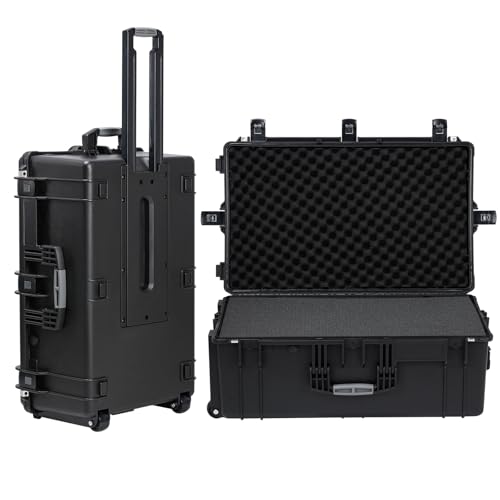
If your parts are efficient and your room is quiet, go silent. You’ll trade a handful of degrees you’ll never feel for calm you’ll notice every day. And if you haul your machine to events or move it between rooms often, protecting it in transit matters as much as cooling it. A padded rolling hard case like the Regetek, at $279.99 with a 4.6 rating and shockproof, waterproof foam sized at 32.5 by 20.5 by 13 inches, keeps a tower safe on the road so your careful build survives the trip.
Pros
- IP67 seal with air-lock valve keeps kit dry during rain, dust, or airline handling
- Pick-and-pluck foam in four layers adapts to cameras, lenses, tools, or medical gear
- Dual padlock holes on the latches allow TSA locks for checked-luggage transport
Cons
- No verified owner fedback at time of writing, so long-term wheel and latch durability is unproven
- Case with foam weighs 32.73 lb empty, which pushes loaded weight near airline checked limits
- Standard-density pluck foam is less protective than custom cut foam for heavy optics or precision instruments
The Regetek Rolling Hard Case is a mid-size wheeled transport case in the Pelican-style category, measuring 32.5 by 20.5 by 13 inch externally with a 28.94 by 17.72 by 9.65 inch usable interior. It targets photographers, drone operators, field service techs, and musicians who need airline-checkable protection for fragile gear.
The defining feature is the IP67 rating paired with a full-length steel hinge and double-latch closure. Cases at this size and seal class typically survive shallow submersion to about 3.3 ft, and the air-lock valve equalizes pressure after altitude changes so the lid does not vacuum shut. Owner feedback is unavailable, so real-world seal longevity cannot be confirmed.
Trade-offs are typical at this tier. The 32.73 lb empty weight with foam eats into airline allowances before gear is loaded, and standard-density pick-and-pluck foam is a compromise between adaptability and impact absorption compared with custom cut foam. Wheels and retractable handles on cases in this class are also the most common long-term failure points.
Buy this if you need a lockable, waterproof rolling case sized for a full mirrorless kit, mid-size drone, or field tolset. Skip this if your payload exceeds the28.94 inch interior length, or if you need documented drop-test certification for professional broadcast use.
Dimensions and weight: Exterior measures 32.5 by 20.5 by 13 inch with an internal usable volume of 28.94 by 17.72 by 9.65 inch. Total weight with foam is 32.73 lb, which is consistent with rotomolded polymer cases in this size class and leaves useful payload room for airline checked baggage.
Sealing and ingress protection: The case is rated IP67 with an O-ring gasket, watertight buckles, and an air-lock pressure equalization valve. Manufacturer states safe submersion to 3.3 ft, and the valve prevents lid suction after temperature or altitude changes during air transit.
Foam configuration: Interior includes four pick-and-pluck layers of standard density foam, one top egg-crate layer, and one bottom pad. The pluck grid lets you shape custom cavities without a knife, though density is not specified in pounds per cubic foot.
Structure and security: Shell uses high-impact polymer with one full-length steel hinge instead of two-point hinges, a double-latch system, dual padlock holes for redundant locking, a heavy-duty top handle, integrated whels, and a retractable pull handle. Waranty is stated at 2 years including replacement parts.
Common questions
Does an airflow case really run that much cooler?
In most owner reports, yes. Mesh-front designs commonly show GPU and CPU temperatures 8 to 15 degrees lower than a sealed case with identical parts. The gap widens as the components get hotter, so high-wattage builds benefit the most.
Can a silent case ever be louder than an airflow one?
It can. When you put hot parts in a sealed case, its fans have to spin faster to compensate for the restricted intake. Past a certain heat load, those faster fans can produce more noise than an airflow case whose fans loaf along at lower RPM.
Is one design better for dust?
Silent cases pull in slightly less dust because their panels are more sealed, but airflow cases include filters on their intakes. Keep those filters clean and the difference mostly evens out over time. Either way, plan on a wipe-down every couple of months.
Do I need extra fans for an airflow case?
Not always, but airflow cases reward extra fans more than silent ones do, since there’s less resistance for them to fight. Two intakes and one exhaust is a solid baseline, and you can add radiators or more fans as your thermals demand.
Which should a first-time builder pick?
For a first build, airflow is the safer default. It’s more forgiving of cable mistakes and hot components, and it hides thermal errors better. You can always add quieter fans later. Starting sealed with hot parts is the setup that bites new builders most.


































Write Your Review
No reviews yet. Be the first to share your experience!