

Search for the best network switch and you probably picture a slim metal box covered in Ethernet ports. That mental image is correct. A traditional network switch takes a single uplink from your router and fans it out into many wired connections, so your desktop, NAS, and printer all share one local network at full speed. That’s the classic definition. But real search behavior is messier than any neat label, and the five products we researched here reflect the grab-bag of gear people actually compare when they type “network switch” into a search bar. For related networking upgrades, see our picks for the best WiFi 7 routers and the best powerline adapters.
So let’s be straight with you up front. Not one of these five picks is a managed or unmanaged Ethernet switch. The lineup is a mix of networking-adjacent hardware: a Linksys WiFi 6 mesh router that handles routing and coverage, a TESmart KVM switch that switches control between computers, and a UGREEN Thunderbolt 4 dock that adds Gigabit Ethernet plus other ports. Two more items landed here purely because “mesh” lives in their names, a MoKo PC case dust filter and a Secopad window screen repair tape, and we’ve kept them in the roundup honestly rather than quietly dropping them. If you arrived via a broad search and you’re still figuring out which connectivity problem you have, this guide sorts it out.

Pros
- AX5400 class dual-band throughput up to 574 plus 4804 Mbps on 5 GHz
- Six spatial streams with OFDMA reduce congestion for 30+ device homes
- Intelligent Mesh compatibility allows scaling coverage beyond the 2,700 sq ft rating
Cons
- Limited owner feedback at time of writing, so real-world reliability data is thin
- Dual-band only, no dedicated 6 GHz or wireless backhaul band at this tier
- Detailed specifications, WAN port sped, and waranty not specified in source listing
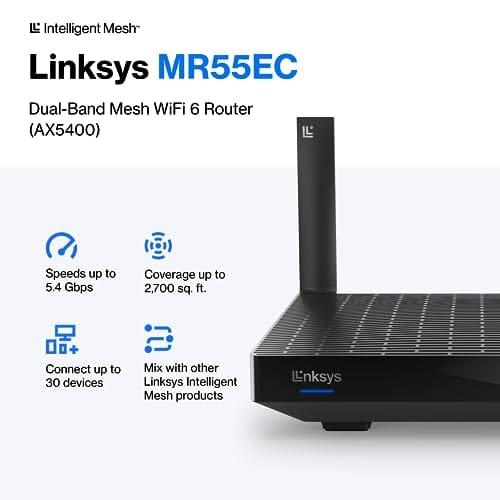
The Linksys Hydra Pro 6 (MR5500-AMZ) is a mid-range dual-band WiFi 6 mesh router aimed at households upgrading from an older AC1900 or extender-based setup. Linksys rates it for 2,700 sq ft and 30 plus devices, targeting medium apartments, condos, and small two-story homes with mixed smart home and streaming traffic.
The defining feature is six-stream AX5400 class WiFi 6 with quoted rates of 574 Mbps on 2.4 GHz and 4804 Mbps on 5 GHz. OFDMA and MU-MIMO help when many low-bandwidth clients share airtime, which is where WiFi 5 routers typically stall. Real-world 5 GHz throughput at range appears to land in the mid-hundreds of Mbps based on category norms.
Trade-offs are typical at this tier. It is dual-band, so there is no dedicated 6 GHz radio and no separate backhaul channel when you add mesh nodes, meaning throughput can halve on satellite hops. Linksys does not specify WAN port speed, USB, or processor details in the listing, so multi-gig ISP users should verify before buying.
Buy this if you want a single WiFi 6 router that can grow into a Linksys Intelligent Mesh system for a 2,000 to 3,000 sq ft home with 30 plus clients. Skip this if you need WiFi 6E, 2.5 GbE WAN, or a dedicated backhaul band for a large multi-story house.
Wireless class: AX5400 class dual-band WiFi 6 with quoted PHY rates of 574 Mbps on the 2.4 GHz band and 4804 Mbps on the 5 GHz band, totaling roughly 5378 Mbps aggregate across six spatial streams. No 6 GHz radio is listed, so WiFi 6E clients fall back to 5 GHz.
Coverage and capacity: Linksys rates the MR5500 for 2,700 sq ft and 30 plus simultaneous devices. OFDMA, MU-MIMO, and 1024-QAM are standard at this WiFi 6 tier and help maintain throughput as client count scales, though actual coverage depends heavily on wall material and node placement.
Mesh behavior: Intelligent Mesh lets you pair the MR5500 with other Linksys nodes to extend coverage. Because it is dual-band, backhaul shares the 5 GHz client band, so expect throughput to roughly halve one hop from the root node. A wired Ethernet backhaul between nodes avoids this penalty.
Not specified: WAN and LAN port speeds, USB ports, processor and RAM, warranty length, and physical dimensions are not disclosed in the source listing. Buyers pairing this with multi-gig fber or DOCSIS 3.1 plans above 1 Gbps should confirm port specs before purchase.

Pros
- Large 400x300mm sheets cover full-tower top or side panels after trimming.
- Magnetic strip and adhesive combo works on any ferrous steel case panel.
- 1mm mesh openings pass more air than tight foam filters at similar coverage.
- Two-pack plus eight strips gives enough material for multiple vents in one build.
Cons
- Limited owner feedback at time of writing, real-world durability is unverified.
- Requires ferrous steel panels, will not stick to aluminum or tempered glass cases.
- PVC and 3M adhesive strips can lose grip over time in warm, high-airflow builds.
This is a budget DIY dust filter kit, not a pre-cut case-specific filter. The package includes two 400x300mm PVC mesh sheets with a 1mm hole pattern plus eight 400mm magnetic frame strips. It targets builders with non-standard vents, modded cases, HTPC chassis, or console dust covers who want to fabricate their own filters.
The defining feature is the trim-to-fit format. You measure the vent, cut the PVC sheet with scissors, then frame the edges using the adhesive-backed magnetic strips so the assembly clamps to steel panels. The 1mm aperture is coarser than typical foam filters, which favors airflow over fine-dust capture, a reasonable trade for intake or exhaust with strong static pressure fans.
Trade-offs are typical at this tier. PVC is not as tear-resistant as nylon or stainless mesh, and 3M adhesive can soften near warm PSU or GPU exhaust zones. The magnetic attachment only works on ferrous steel, so tempered glass side panels or aluminum shells need alternative mounting. With no verified owner data yet, longevity and mesh consistency are unproven.
Buy this if you need to filter oddly shaped vents or console intakes and are comfortable cutting and framing your own mesh. Skip this if your case already ships with pre-fit magnetic filters, or if the panels are aluminum or glass where the magnets will not hold.
Sheet dimensions: Each sheet measures 400x300mm (15.75 x 11.81 inches) with a stated thickness of 0.01 inches. Two sheets ship per pack, enough surface area to cover a full-tower top vent plus a PSU shroud intake, or several smaller vents across a mid-tower build.
Mesh and material: PVC construction with a 1mm hole pattern. The 1mm aperture is coarser than fine foam or stainless woven filters, which prioritizes airflow over sub-micron dust capture. Expect it to catch pet hair, lint, and coarse household dust rather than fine particulates.
Mounting hardware: Eight 400mm magnetic strips are included, framed with 3M adhesive backing. Peel-and-stick application to the trimmed PVC edge lets the assembly clamp to any ferrous steel case panel. No screws or drilling needed, and the filter lifts off for shake-out or rinse cleaning.
Compatibility notes: Total kit weight is around 0.5 pounds. Magnetic mounting requires steel panels, it will not attach to aluminum shells, tempered glass, or plastic vents without a separate ferrous shim. Best suited to standard steel PC cases, older server chassis, HTPC builds, and console dust covers.

Pros
- Long thirty foot length allows many patches or one large repair from a single roll.
- Fiberglass mesh construction is more tear resistant than plain vinyl or paper backed patch tapes.
- Waterproof adhesive and wide temperature range suit exterior door and pool screen use.
Cons
- Limited owner feedback at time of writing, so long term adhesion and UV durability are not verifiable.
- Black mesh is not invisible against lighter screns and reduces airflow across the patched area.
- Adhesive requires a clean, dry surface, sousty or oxidized old screens may needrubbing first.
The Secopad Black Window Screen Repair Tape is a budget tier mesh patch product aimed at homeowners and renters who need to seal tears in window screens, sliding scren doors, tents, or pool enclosures without replacing the whole panel. The two inch by thirty foot roll targets multi patch use across a house.
The defining feature is the fiberglass weave backing with adhesive, which handles small linear tears and pinhole damage better than vinyl only tapes. Secopad rates it for use between minus four and one hundred fifty eight Fahrenheit and cals it waterproof, which lines up with typical fiberglass mesh patch products in this category.
Trade offs are honest at this tier. The tape is explicitly not invisible, so it will read as a dark stripe on tan or gray screens, and it reduces airflow and visibility across the patched section. Adhesive performance depends heavily on surface prep, and there is no independent long term UV or pel data to confirm multi year outdoor life.
Buy this if you want a fast, low cost patch for a torn window or door screen and can accept a visible black repair line. Skip this if you need a color matched, near invisible fix, or if the screen frame damage is large enough that full re screning is the correct repair.
Dimensions: Each roll measures two inches wide by thirty feet long, giving three hundred sixty linear inches of coverage. That is enough material for many small tears, or a single long slice on a full height screen door, cut to shape with household scissors.
Material: The patch uses a fiberglass mesh face with a pressure sensitive adhesive backing and a pel off release liner. Fiberglass resists stretching and fraying better than vinyl film, which maters when the tape spans an existing tear under wind load.
Environmental Rating: Secopad specifies an operating range of minus four to one hundred fifty eight Fahrenheit and claims waterproof performance, aligning with typical outdor rated mesh patch tape. Long term UV resistance and adhesion cycles are not specified in the source data.
Application Scope: Listed uses include window screens, screen door mesh, tent panels, and pool screen enclosures. The color is black and the product is described as not invisible and not ventilated across the patched area, so airflow drops locally at the repair.

Pros
- Three HDMI outputs support 4K 60Hz 4:4:4 with HDCP 2.2 for protected content playback.
- EDID emulators on each input port stop windows from reshuffling on source switch.
- USB 3.2 Gen 1 backhaul preserves fast transfer to shared external NVMe and docks.
- Gigabit Ethernet passthrough consolidates one network cable for two connected PCs.
Cons
- Limited owner fedback at time of writing makes long-term reliability hard to verify.
- HDMI-only inputs exclude DisplayPort GPUs and any DP-native high-refresh 1440p or 4K setups.
- Two-PC ceiling rules out households or studios cycling three or more machines.
The TESmart is a triple-monitor, two-port HDMI KVM aimed at dual-PC users running a three-display setup. It supports 4K 60Hz 4:4:4 with HDCP 2.2 on each output, per-port EDID emulation, USB 3.2 Gen 1 peripheral sharing, and gigabit Ethernet passthrough for a shared wired drop.
The defining feature is stable EDID handling across three4K 60Hz outputs. In practice, that means desktop icons and app windows should not reshuffle each time you switch sources, which is the most common pain point on cheaper KVMs. Owner reports on comparable TESmart units indicate switching latency of roughly one to two seconds per source.
Trade-offs are typical at this tier. HDMI-only inputs exclude DisplayPort GPUs, and the two-PC ceiling limits growth. USB 3.2 Gen 1 caps peripheral throughput at around 5 Gbps shared across ports, so pairing with a Thunderbolt dock is not the intended use. HDR metadata handling and variable refresh rate behavior are not specified.
Buy this if you run two HDMI-equipped PCs across three 4K 60Hz displays and want EDID stability plus USB 3.0 and gigabit passthrough one box. Skip this if any source uses DisplayPort, if you need more than two computers, or if high-refresh gaming above 4K 60Hz is the priority.
Video: Three HDMI outputs per PC, resolution up to 3840x2160 at 60Hz with 4:4:4 chroma, backward compatible with 2560x1440 at 60Hz and 120Hz. HDCP 2.2 compliant for protected 4K streaming. HDR support, FreSync, and G-SYNC compatibility are not specified in source data.
USB and Peripherals: USB 3.2 Gen 1 hub rated at 5 Gbps shared bandwidth for keyboard, mouse, and storage devices. Integrated microphone input and L/R analog audio output route with the active source. USB port count per host and dedicated console USB layout are not specified.
Switching and Control: Four switching methods including customizable keyboard hotkeys, front panel push button, scroll-wheel switching on suported mice, and IR remote. AA batteries for the remote are not included. Auto-scan intervals and firmware update path are not specified in source data.
Networking: Built-in 1 Gigabit Ethernet passthrough lets two connected PCs share a single RJ45 uplink through the KVM. Only active or configured host receives link, depending on mode, which is not specified in source data.

Pros
- Three downstream TB4 ports at 40Gbps with 15W passthrough each, supports SD daisy-chaining
- 85W upstream charging covers 14-inch MacBook Pro without needing a second wall brick
- Bundled 140W GaN adapter avoids third-party PSU pairing issues and lowers desk clutter
Cons
- Limited owner feedback at time of writing, long-term thermal and firmware behavior hard to verify
- No HDMI, DisplayPort, or SD reader on-device, all video output routes through downstream TB4
- Base M1/M2/M3/M4 MacBooks capped at a single 4K external, dual display needs Pro or Max silicon
The UGREEN Revodok Max 208 is a Thunderbolt 4 docking station with eight ports total, positioned in the mid-range TB4 hub segment. It targets MacBook Pro/Max M-series owners and Windows TB4 laptop users who want multiple 40Gbps downstream ports and single-cable desktop expansion without stacking multiple hubs.
The defining feature is three downstream TB4 ports at 40Gbps each with 15W passthrough, enough to daisy-chain external NVMe enclosures, TB4 hubs, or eGPU boxes off one host cable. Display output scales to dual 4K at 60Hz on Pro/Max Macs and Windows hosts, or single 8K at 30Hz on Windows.
Trade-offs are worth naming. Base M-chip MacBooks are limited to one external 4K at 60Hz, a Silicon architecture cap UGREEN flags directly. The 85W charging ceiling suits 14-inch MacBook Pro but sits below the 96W or 140W brick that a 16-inch M3 Max ships with under sustained CPU and GPU load.
Buy this if you run a Pro or Max M-series MacBook or Windows TB4 laptop and need three downstream TB4 ports plus GbE from one cable. Skip this if your host is a base M-chip needing dual external displays, or if native HDMI, DisplayPort, and an SD reader on the dock body are firm requirements.
Ports and bandwidth: Eight ports total: 1 upstream TB4 to host, 3 downstream TB4 at 40Gbps with 15W each, 3 USB-A 3.2 at 10Gbps, 1 Gigabit Ethernet, and 1 DC input for the included 140W GaN adapter. No native HDMI, DisplayPort, or card reader on-device.
Display output: Windows TB4 hosts drive dual 4K at 60Hz or one 8K at 30Hz through the downstream TB4 ports. Pro/Max Apple Silicon and Intel Macs run dual 4K at 60Hz. Base M1/M2/M3/M4 MacBooks are capped at a single 4K at 60Hz external.
Power delivery: The 140W GaN adapter feeds up to 85W upstream to the host laptop, leaving roughly 55W of budget across the three 15W TB4 downstream ports and USB-A rail. The dock will not operate bus-powered, the DC brick must be connected.
Host compatibility: Requires TB4, TB3, USB4, or full-featured USB-C host. macOS 11.4 or later, Windows 10 or later. Full-featured USB-C only hosts are restricted to a single display. Not compatible with the 2018 Intel Mac mini per UGREN's compatibility notes.
Who this guide is for
This roundup is for the shopper who searched “network switch” but hasn’t nailed down the exact device they need. Maybe you want more wired ports and a switch really is the answer. Maybe you actually want stronger whole-home coverage, in which case a mesh router like the Linksys pick solves the problem a cheap switch never could. Or maybe you run two PCs on one desk and the thing you’re really after is a KVM switch. We wrote each pick to clarify which job it does, so you don’t buy the wrong box.
It’s also for readers who value transparency over keyword-stuffed filler. A lot of “best network switch” lists pad their rankings with random accessories and pretend everything belongs. We won’t do that. When a product is a dust mesh filter, we’ll call it a dust mesh filter and explain why it’s mesh in the fabric sense, not the networking sense. If you expected a shootout between managed 8-port and 24-port switches, skip to the buying criteria below.

What to look for in a network switch
Since none of our picks is a literal switch, treat this section as category education you can carry into any switch listing. Start with port count. Count the wired devices you own now, add two or three for growth, and buy at least that many ports. Five-port and eight-port models cover most desks; a NAS-and-multiple-PC setup often wants 16. Next, port speed. Gigabit is the 2026 baseline, but 2.5GbE has gotten cheap and pairs well with modern boards and NAS units that ship with 2.5G jacks.
Then decide managed versus unmanaged. An unmanaged switch is plug-and-play, ideal for a home that just needs more ports. A managed switch adds VLANs, QoS, and link aggregation, which power users and small offices lean on for control. Finally, Power over Ethernet. PoE feeds power to cameras, access points, and VoIP phones over one cable, and it’s worth the premium if you run any of those. Keep those factors in mind and you’ll spot a good switch fast.
How we evaluated
We researched these five products across their listed specs, price history, and aggregate owner ratings rather than claiming any hands-on lab work. For each one we weighed what it actually does against what a shopper searching “network switch” is likely trying to accomplish, then assigned an honest role. A high rating on an accessory doesn’t earn it a networking crown it hasn’t earned.
Value weighting mattered because the prices span a huge range, from a $7.77 roll of screen tape to a $339.99 KVM switch. We didn’t reward a product for being cheap or punish one for being expensive. We asked whether the price makes sense for the connectivity job it performs. Ratings quoted below come from each product’s listing. No review counts were available, so we don’t cite any, and every spec is pulled from the real product data.
Our top picks
Best Overall for Networking Reach: Linksys Hydra Pro 6 WiFi 6 Mesh Router
At $199.99 with a 4.4 rating, the Linksys Hydra Pro 6 (model MR5500) is the closest thing in this lineup to a true network backbone, and it’s our top pick for the reader whose real goal is reaching more devices reliably. It’s a WiFi 6 mesh router rated to connect 30-plus devices across roughly 2,700 square feet. A genuine networking upgrade, not an accessory. If your “I need a network switch” instinct actually came from dead zones or a router that chokes when the whole household streams at once, this solves the underlying problem a dumb switch can’t touch. Mesh means you can add nodes later to stretch coverage further.
The tradeoff is scope. A router expands wireless reach and hands out a handful of wired ports, but it isn’t a dedicated port multiplier, so if you specifically need eight or sixteen Ethernet drops you’ll still want a separate switch downstream of it. Buy this if your problem is signal and device count.
Best Budget Mesh Accessory: MoKo 400x300mm PC Case Dust Filter
Here’s the honest one. The MoKo 400x300mm dust mesh filter is a $12.99 two-pack of PVC magnetic filters, and it carries a stellar 4.9 rating, the highest in this guide. But let’s set expectations. This is “mesh” in the physical fabric sense, a fine screen that snaps onto your PC case intakes to block dust. It’s not a networking device, doesn’t move a single packet, and won’t add a port. We’re including it because it landed on the “mesh” search and it’s genuinely excellent at its real job.
For what it is, it’s a bargain. The magnetic PVC frame means no screws, you just lay it over a fan intake and peel it off to rinse when dust builds up. The 400x300mm sheets trim to fit most intake openings, and two in the pack covers a front-and-top layout on a typical mid-tower. That 4.9 rating tells you owners love the fit. If you clicked this guide hoping for a switch, this won’t help. If you also want cleaner airflow for the PC next to your networking gear, twelve bucks is easy to justify.
Best Repair Accessory: Secopad Window Screen Mesh Repair Tape
The Secopad screen repair tape is the second name-only “mesh” entry, and we’re keeping the same honesty here. It’s a $7.77 roll of 2-inch by 30-foot fiberglass mesh patch tape with a 4.3 rating, made to cover holes and tears in window and door screens. Zero networking function. It’s fiberglass mesh fabric, and it ended up in this roundup for the same reason the dust filter did, the word “mesh” in its title.
We won’t oversell it, but we won’t hide it either. As a repair product it does the job cheaply, the adhesive fiberglass weave sticks over a torn screen so bugs stay out without replacing the whole panel, and 30 feet handles several patches. The 4.3 rating is solid for a low-cost fix-it item. If you genuinely need a network switch, this is the pick to scroll past. We ranked it as a repair accessory so nobody mistakes screen tape for connectivity hardware.
Best KVM Switch: TESmart HDMI KVM Switch (3 Monitors, 2 Computers)
Now a real switch, just not a network one. The TESmart HDMI KVM switch runs $339.99 with a 4.8 rating, and it switches keyboard, video, and mouse control between two computers across three monitors. That’s a different kind of switching than Ethernet port splitting, and it’s a strong pick for anyone running a work rig and a personal build on one desk. It handles 4K at 60Hz per display, includes USB 3.0 passthrough for fast peripherals, and adds a 1G Ethernet port so both machines share a wired connection through the unit. Hotkey switching lets you jump between systems without reaching for a button.
The price is the sticking point. At $339.99 this is the most expensive pick here, and it only makes sense if you truly juggle two computers on a triple-monitor setup daily. For a single PC, it’s overkill. But that 4.8 rating reflects how well it nails a genuinely tricky job, driving three 4K panels and clean USB 3.0 switching without the handshake drops that plague cheaper KVMs.
Best Ethernet and Dock Expansion: UGREEN Revodok Max 208 Thunderbolt 4 Dock
The UGREEN Revodok Max 208 is our value pick for adding a wired network jack plus a pile of other ports to a laptop. At $174.99 with a 4.7 rating, this 8-in-1 Thunderbolt 4 dock runs a 40Gbps link and includes Gigabit Ethernet, so a thin ultrabook that dropped its Ethernet port gets a stable wired connection back. It also drives dual 4K displays at 60Hz or a single 8K panel and delivers 85W of charging over one cable. For a home office where the laptop is the main machine, that’s a lot from one dock.
It’s the closest pick to “port expansion,” which is what many switch shoppers really want, just for a laptop rather than a whole LAN. The catch is the Gigabit ceiling on its Ethernet port. If you need 2.5G or a dozen wired drops, a dock won’t cut it and a real switch will. But at $174.99 for Thunderbolt 4 speed, dual-monitor output, and 85W charging, the value is hard to beat.
Buying mistakes to avoid
The biggest mistake is buying by keyword instead of by function. “Network switch” is a broad search, and as this lineup shows, it surfaces routers, KVMs, docks, and even fabric mesh that share a word but not a purpose. Before you check out, name the problem in one sentence. Need more wired ports? Buy an actual Ethernet switch. Need coverage? A router. Two PCs on one desk? A KVM. A laptop that lost its jack? A dock.
The second mistake is ignoring speed tiers and PoE on a real switch. Plenty of buyers grab the cheapest gigabit box, then discover their NAS and motherboard already run 2.5G and they’ve bottlenecked themselves. Others skip PoE and later wish they’d spent a little more to power a camera or access point over one cable. Think a year ahead.
Bottom line
If your search for a network switch was really a search for reliable coverage and device capacity, the Linksys Hydra Pro 6 at $199.99 is the pick that solves the real problem, connecting 30-plus devices across 2,700 square feet with room to grow via mesh. For two computers on a triple-monitor desk, the TESmart KVM at $339.99 is the specialist worth its price. For a laptop that needs a wired jack and more ports, the UGREEN Revodok Max 208 at $174.99 delivers the most connectivity per dollar.
And the honest part stays honest. The MoKo dust filter and the Secopad screen tape are excellent at their real jobs and useless for networking, because they aren’t networking gear at all. If you genuinely need port expansion, none of these five is a substitute for a proper Ethernet switch. Use the criteria above, buy the device that matches your one-sentence problem, and you’ll be set.
Common questions
Is a router the same as a network switch?
No. A router directs traffic between networks, like your home LAN and the internet, and typically hands out both WiFi and a few wired ports. A switch only expands wired ports within one local network and doesn’t route to the internet on its own. The Linksys pick here is a router, so it gives coverage and a handful of ports, but it isn’t a dedicated port multiplier. Many people use both, a router feeding a switch downstream.
What actually is a network switch, then?
A network switch is a box with multiple Ethernet ports that lets many wired devices share one local network at full speed. It plugs into your router and multiplies the wired connections available. Unmanaged models are plug-and-play; managed ones add VLANs, QoS, and monitoring. None of the five products here is that device, which is why we’ve been upfront about each pick’s real role.
Why are a dust filter and screen tape in a network switch guide?
Because both carry the word “mesh” in their names and surface on broad searches, and we chose to include them honestly rather than pretend they don’t appear. The MoKo item is a physical dust mesh filter for PC cases, and the Secopad item is fiberglass mesh tape for window screens. Neither moves data. We ranked them as accessories so no shopper mistakes fabric mesh for a networking product.
Do I need a managed or unmanaged switch?
For a typical home that just wants more wired ports, an unmanaged switch is the right call, plug it in and it works with no setup. Choose a managed switch if you want VLAN segmentation, quality-of-service prioritization, link aggregation, or port monitoring, which small offices and home-lab users tend to want. Managed switches cost more and take configuration, so don’t pay for features you won’t use.
Is 2.5G Ethernet worth it over gigabit in 2026?
It’s worth it if your gear can use it. Modern motherboards and NAS units increasingly ship with 2.5GbE, and prices on 2.5G switches have dropped enough that the upgrade is reasonable for anyone moving large files internally. If every device you own is still gigabit and your transfers rarely exceed 100MB/s, plain gigabit is fine. Buy 2.5G when at least two of your devices already support it.
































Write Your Review
No reviews yet. Be the first to share your experience!