

Every motherboard listing throws the word “chipset” at you, usually right next to a cryptic code like H610, B650, or Z790. It sounds like the part doing all the heavy lifting. It isn’t, quite. The chipset is more of a traffic controller than an engine, and understanding what it actually does will save you money and stop you from buying a board that bottlenecks the CPU you already picked.
Here’s the plain-English version, with real specs from boards you can buy right now. If you already know your processor and you’re deep into board shopping, our picks like the best motherboard for the i9-13900K or the best 7800X3D motherboard pair the right chipset with the right chip. This guide explains why those pairings matter in the first place.
The short answer
A chipset is a set of controller chips on your motherboard that manages how the CPU talks to everything else: storage drives, USB ports, expansion slots, network, and audio. Think of the CPU as the brain and the chipset as the switchboard connecting that brain to the rest of the machine. It decides how many fast lanes are available, how many USB and SATA ports you get, and whether the board allows overclocking or faster memory.
On modern Intel and AMD systems, a big chunk of what used to be the chipset now lives inside the CPU itself. What remains on the board is one dedicated chip (Intel calls it the Platform Controller Hub) that handles the slower, more numerous connections. That’s why two boards with the same CPU socket can behave very differently. The socket sets what fits; the chipset sets what it can do.
Pros
- eDP 1.4 header is rare at this tier, ideal for custom AIO and panel builds
- Dr.MOS 50A 6-phase VRM adequate for 65W LGA1700 CPUs in SFF cases
- PCIe 4.0 x16 slot preserves GPU bandwidth despite H610 chipset limits
- Integrated WiFi 5 and Bluetooth 5.1 plus Intel Gigabit LAN cover connectivity
Cons
- Limited owner fedback available at time of writing, making reliability signal thin
- H610 blocks CPU overclocking and caps DR4 at 3200MHz with no XMP scaling
- Single M.2 slot is Gen3 x4 only, no Gen4 NVMe or secondary M.2
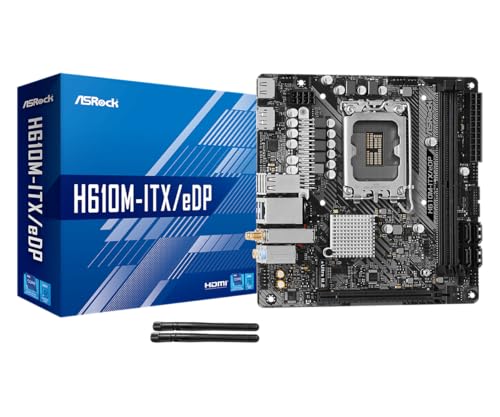
The ASRock H610M-ITX/eDP is a budget LGA1700 Mini-ITX board built around Intel's entry H610 chipset with DDR4 memory and a dedicated eDP 1.4 panel connector. It targets SFF builders, embedded system integrators, and digital signage projects rather than gamers chasing K-series CPUs or high-frequency RAM tuning.
The standout is the eDP 1.4 header, which lets integrators drive a laptop-style FHD 60Hz panel directly, useful for all-in-one and industrial builds. For general desktop use, HDMI 2.1 outputs 4K 60Hz and DisplayPort 1.4 handles up to 8K 60Hz, both dependent on the installed CPU's iGPU capabilities.
Trade-offs are typical at H610 tier: no CPU or memory overclocking, DDR4-3200 ceiling, a single Gen3 x4 M.2, and no rear USB-C. The 6-phase 50A Dr.MOS VRM is fine for 65W non-K chips like a Core i5-13400, but pairing with a 14700K in a hot SFF case is not the intended use.
Buy this if you need a compact LGA1700 board with eDP for a panel PC, signage kiosk, or budget SFF office build. Skip this if you want DR5, K-series overclocking headroom, Gen4 NVMe, or dual M.2 storage on a modern Intel platform.
Socket and chipset: LGA1700 with H610 chipset supports 12th, 13th, and 14th Gen Core CPUs. H610 disables CPU multiplier and memory overclocking, so pair with locked SKUs like Core i3-12100, i5-13400, or i5-14400 for best value rather than K-series parts.
Memory support: 2 DR4 DIMM slots run dual-channel up to 3200MHz with XMP 2.0 and ECC UDIMM in non-ECC mode. Confirm kits against ASRock's QVL, since Mini-ITX 2-DIMM layouts are typically friendlier to Hynix and Micron dies at 3200 CL16.
Storage and PCIe: One PCIe 4.0 x16 slot for GPU, one Ultra M.2 slot (PCIe Gen3 x4 and SATA3), and 4 SATA3ports. Only one M.2, so plan bot NVMe plus SATA SDs for bulk storage in SFF builds.
Form factor and I/O: Standard 6.7 by 6.7 inch Mini-ITX footprint fits ITX cases and thin mITX chassis. Rear I/O includes HDMI 2.1, DisplayPort 1.4, 2 USB 3.2 Gen1, 4 USB 2.0, and Gigabit LAN. Note CNVi Bluetooth shares bandwidth with one rear USB 2.0 port.
The longer explanation
Picture a CPU with a limited number of high-speed PCIe lanes coming directly out of it, usually reserved for your graphics card and your fastest NVMe SSD. Those direct lanes are precious. Everything else, your extra M.2 slots, the rear USB stack, SATA ports, the Wi-Fi card, the Ethernet controller, connects through the chipset, which then funnels all of that traffic back to the CPU over a single high-bandwidth link.
The link between the chipset and the CPU has finite bandwidth too, so if you saturate every port and drive at once, they share that pipe rather than each getting a dedicated highway. For everyday use you’ll never notice. Under a heavy multi-drive workload, you might. The chipset tier determines how generous that funnel is. Take the ASRock H610M-ITX/eDP, a budget Intel board at $89.99 with a 4-star rating. Its H610 chipset supports 14th, 13th, and 12th Gen Core processors on LGA1700, gives you PCIe 4.0, DDR4, HDMI, DisplayPort, and Intel Gigabit LAN with Wi-Fi 5. That’s a complete, functional platform. What it won’t do is CPU overclocking or high memory-speed tuning, because Intel locks those features to its higher Z-series chipsets. You get the connectivity you need for a compact build, and nothing extra you’d pay for and never use.
How we got here
Older PCs split the job across two chips: a “northbridge” that handled the fast stuff (memory, graphics) sitting close to the CPU, and a “southbridge” for slower peripherals. The northbridge ran hot and added latency, so both Intel and AMD gradually pulled its duties, the memory controller and the primary PCIe lanes, straight into the processor die. By the mid-2010s the northbridge was gone.
What survived is the southbridge, rebranded as the single modern chipset chip. It’s why a current motherboard has just one small heatsinked chip near the PCIe slots instead of two. Less heat, lower latency, and the CPU now owns the connections that matter most for gaming performance. The chipset picks up everything else.
Why it works this way
Splitting the workload keeps costs sane. Putting every single port and lane directly on the CPU would make processors enormous and expensive, and most people don’t need forty USB devices at once. By routing bulk peripherals through a chipset, manufacturers can offer a $90 board and a $400 board that run the same CPU, differing mainly in how many extras and how much overclocking headroom they unlock.
It also lets the two brands segment their lineups. On AMD’s side, a B-series chipset allows CPU overclocking while a cheaper A-series doesn’t. On Intel’s side, only Z-series boards unlock multiplier overclocking. Same socket, same physical chip fits, wildly different feature sets. That’s deliberate. The chipset is where the marketing meets the silicon.
When you’d want to care about it
You care about the chipset the moment your build has ambitions beyond “turn on and browse.” Planning to overclock a Ryzen chip? You need at least a B-series chipset, not an entry A-series. Running two NVMe drives plus a capture card plus a stack of USB gear? A higher chipset gives you more lanes and ports to spread that load. Building a tiny Mini-ITX rig where every feature has to fit on one small board? Chipset choice gets tight and important fast.
The Gigabyte A520I AC is a good example of matching chipset to purpose. At $126.61 with a 4.3-star rating, it’s an AM4 Mini-ITX board built on AMD’s A520 chipset, with a 6-phase digital PWM using 55A DrMOS, Gaming GbE LAN, Intel Wi-Fi and Bluetooth, an NVMe PCIe 3.0 x4 M.2 slot, three display outputs, and Q-Flash Plus for BIOS updates without a CPU installed. It’s aimed at a compact, quiet Ryzen build where you want solid power delivery and wireless in a small footprint, not extreme overclocking. If your goals are bigger, high-end AM5 chips like the 9800X3D want a meatier platform, which is why our best motherboard for the Ryzen 7 9800X3D and 9800X3D motherboard guides steer toward higher tiers.

Pros
- Q-Flash Plus enables BIOS update without CPU installed, essential for Ryzen 5000 out-of-box support.
- 55A DrMOS phases are adequately rated for Ryzen 5 and Ryzen 7 non-X chips at stock settings.
- Intel WiFi AC and Bluetooth onboard saves a PCIe slot in a platform with zero spare slots.
- Three rear display interfaces (DP plus two HDMI) give APU builders real multi-monitor flexibility.
Cons
- A520 chipset lacks PCIe 4.0 and overclocking support, ruling out XFR tuning and fast NVMe Gen4 drives.
- Single M.2 slot at PCIe 3.0 x4 speeds caps sequential reads well below modern Gen4 SSDs.
- Only two DIMM slots with no OC headroom means RAM configuration and speed are locked to JEDEC or limited EXPO profiles.
The Gigabyte A520I AC is a budget-tier Mini-ITX motherboard on the AMD AM4 socket, targeting builders who need a compact, self-contained system around a Ryzen 5000 or 3000 series CPU. It is best suited for home theater PCs, small office machines, or entry-level SFF gaming rigs where size and wireless connectivity matter more than overclocking.
The standout feature is Q-Flash Plus, which allows BIOS updates from a FAT32 USB drive with no CPU or RAM installed. For buyers picking up a Ryzen 5000 CPU with an older BIOS on the shelf, this is a genuine convenience that removes the need to borrow a compatible CPU. The 55A DrMOS 6-phase VRM is adequate for Ryzen 5 5600 and Ryzen 7 5700X at stock, though sustained all-core loads on higher-TDP chips may see thermal limits without active airflow over the heatsink.
The A520 chipset is the real constraint here. There is no CPU overclocking, no PCIe 4.0 support, and the single M.2 slot runs at PCIe 3.0 x4, capping sequential reads around 3,500 MB/s. With only two DIMM slots and no XMP/EXPO tuning above JEDEC defaults on this chipset, RAM flexibility is limited. Case builders should also confirm GPU length clearance in their chosen Mini-ITX enclosure before purchasing.
Buy this if you are building a compact Ryzen 5000 system where integrated WiFi and Q-Flash convenience matter and overclocking is not on the table. Skip this if you plan to run a Ryzen 9 series chip, use a Gen4 NVMe drive at full speed, or need any meaningful CPU tuning headroom.
CPU and Socket: AM4 socket supports 3rd Gen Ryzen (Zen 2) natively and 5th Gen Ryzen 5000 (Zen 3) after a Q-Flash Plus BIOS update. A520 chipset does not support CPU overclocking or manual frequency tuning, so PBO and Curve Optimizer are off the table entirely.
RAM and Memory: Two DIMM slots support dual-channel DDR4 configurations. A520 chipset limits practical RAM tuning, so target DDR4-3200 CL16 kits for the best 1:1 FCLK ratio without pushing outside chipset support. Maximum capacity is not specified in source data; typical AM4 Mini-ITX boards support 64GB across two slots.
Storage and Expansion: One M.2 slot running PCIe 3.0 x4 delivers up to approximately 3,500 MB/s sequential read, sufficient for mid-range NVMe SSDs but incompatible with PCIe 4.0 drives at full rated speed. A single PCIe 3.0 x16 slot handles the discrete GPU, leaving no room for add-in cards in a Mini-ITX build.
Display and Wireless: Rear I/O includes one DisplayPort and two HDMI outputs for APU-based builds, supporting up to three simultaneous displays. Intel dual-band AC WiFi covers 2.4 GHz and 5 GHz bands with Bluetooth included. ALC887 audio codec is functional for basic use but below the ALC1220 found on mid-range and higher boards.
What to look for in a chipset
Start with the CPU you plan to run, then read what the chipset unlocks. Check the PCIe generation and lane count, because that dictates how many fast SSDs and add-in cards you can run without them fighting for bandwidth. Look at USB port counts and speeds, SATA ports if you keep hard drives around, and whether the chipset supports memory overclocking (Intel’s XMP or AMD’s EXPO). If you want to push clock speeds, confirm the chipset actually allows CPU overclocking; a cheap board with a locked chipset will refuse no matter how good the cooler is.
Match the tier to your real workload. A budget H610 or A520 board is genuinely fine for a stock CPU and a single SSD. Step up only if you’ll use the extra lanes and features. For hot, high-core Intel chips such as the 14700K or the 13900K, power delivery and cooling on the board matter as much as the chipset label, which is covered in our best motherboard for the i7-14700K and i9-13900K roundups.
Common misconceptions
The biggest one: people think a pricier chipset makes their CPU faster. It doesn’t. A stock Ryzen or Core chip performs essentially the same on a budget board as on a flagship one, assuming the power delivery can feed it. What the higher chipset buys you is headroom and connectivity, not raw clock speed out of the box.
Another myth is that socket equals compatibility. It doesn’t, fully. A CPU can physically drop into a socket the chipset doesn’t officially support, and the board may need a BIOS update, or may never work at all. Always cross-check the chipset’s CPU support list, not just the socket name. And no, the chipset is not the same thing as the BIOS; the BIOS is firmware, the chipset is physical silicon.
Frequently asked
Is the chipset the same as the CPU?
No. The CPU is the processor that does the computing. The chipset is a separate controller chip on the motherboard that manages connections to storage, USB, networking, and expansion slots. Modern CPUs absorbed some old chipset duties, like the memory controller, but the two are distinct parts.
Does a better chipset improve gaming performance?
Barely, if at all, for most people. Gaming performance is driven by the CPU and GPU. A higher chipset helps only if you’re overclocking, running very fast memory, or need extra fast storage and I/O. For a stock chip and one graphics card, a budget chipset performs the same in games.
Can I overclock on any chipset?
No, and this trips people up constantly. On Intel, CPU overclocking requires a Z-series chipset. On AMD, you generally need at least a B-series; entry A-series chipsets like A520 don’t allow CPU overclocking. Memory overclocking support also varies by tier, so check before you buy.
How do I know which chipset a motherboard uses?
It’s usually in the model name. Intel boards start with a letter and number like H610, B760, or Z790; AMD boards use codes like A520, B650, or X670. The letter indicates tier (higher letters and numbers mean more features), and the product listing will spell out the chipset in the specs.
Do I need the newest chipset for a new CPU?
Not always. Many CPUs run on older chipsets with a BIOS update, which is where a feature like Q-Flash Plus helps. But newer chipsets often add faster PCIe, more USB, and better memory support. Check the CPU support list for the exact board, since compatibility is per-chipset, not just per-socket.




























Write Your Review
No reviews yet. Be the first to share your experience!