

A friend texted me last week with a question I’ve answered three times this month: “I’m building a new PC. Should I save $80 and get the 7800X3D, or just go with the 9800X3D?” It’s the right question to ask. These are the two best gaming CPUs AMD has ever shipped, both built around 96MB of 3D V-Cache, both running on the same AM5 socket, both delivering frame rates that would have seemed absurd two years ago. The answer isn’t obvious from the spec sheet, and most online comparisons either lean too hard on the 9800X3D’s headlines or undersell the 7800X3D’s value proposition.
Here’s the honest take: the AMD Ryzen 7 9800X3D is faster than the 7800X3D, full stop. TechSpot’s 45-game benchmark suite shows it averaging 8-10% higher frame rates, with some titles like The Last of Us Part 1 and Hogwarts Legacy showing 20-21% gains. But “faster” doesn’t always mean “better buy” once you factor in that the 7800X3D currently sells for around $162 less, that GPU bottlenecking flattens the gap at 1440p and 4K, and that both chips will handle modern AAA games well past 2028. We pulled benchmark data from TechSpot, GamersNexus, Wccftech, and Tom’s Hardware, cross-referenced PassMark testing, and analyzed real-world owner feedback from PCPartPicker community builds to put this comparison together. If you want a clear answer instead of marketing fluff, this is where to start.

AMD Ryzen 7 9800X3D 8-Core 16-Thread Desktop Processor with 96MB 3D V-Cache and Zen 5 Architecture
Pros
- Best-in-class gaming performance thanks to the combination of Zen 5 IPC gains and 3D V-Cache technology
- AM5 socket compatibility makes it an easy upgrade for existing Ryzen 7000 series platform owners
- Excellent power efficiency relative to its performance tier reduces long-term energy costs
- Outstanding user satisfaction reflected in a near-perfect rating from thousands of verified buyers
- High boost clock of 5.2GHz ensures strong performance in both gaming and productivity tasks
Cons
- Cooler is not included in the box, adding to the total system cost for new builders
- Premium pricing puts it at the higher end of the consumer CPU market, which may not suit budget-focused builds
- Requires an AM5 motherboard, so users on older AM4 platforms will need a full platform upgrade
The AMD Ryzen 7 9800X3D is AMD's flagship gaming processor for the desktop market, sitting at the top of the Ryzen 9000 series lineup. Built on the cutting-edge Zen 5 microarchitecture and stacked with AMD's proprietary 3D V-Cache technology, it is engineered specifically for gamers and power users who refuse to compromise. With 8 cores, 16 threads, and a massive 96MB of L3 cache, this CPU is purpose-built to eliminate bottlenecks in the most demanding modern titles and creative applications.
In real-world gaming scenarios, the 9800X3D consistently delivers frame rates that outpace every competing processor on the market. The 3D V-Cache dramatically increases the amount of data the CPU can access without reaching slower system memory, which translates directly into smoother gameplay, reduced stuttering, and faster load times in cache-sensitive titles like strategy games, open-world RPGs, and competitive shooters. The 16% IPC improvement over the previous generation further compounds these gains, making the upgrade feel meaningful even for those coming from the already capable Ryzen 7000 series.
From a design and platform perspective, AMD has made smart choices with the 9800X3D. The improved thermal design compared to prior 3D V-Cache generations means the processor can now sustain higher clock speeds under load, reaching up to 5.2GHz boost. This is a notable improvement over earlier X3D chips that were thermally constrained. The AM5 socket compatibility is a major selling point, as users already invested in a 500-series or 600-series AM5 motherboard can simply drop this processor in with a BIOS update, avoiding a costly full platform rebuild.
There are a few considerations worth noting. The processor does not ship with a cooler, so budget-conscious builders will need to factor in the cost of a compatible CPU cooler, ideally a mid-to-high-end air or liquid solution to take full advantage of the boost clocks. Additionally, the premium price point reflects its flagship status, meaning users primarily running productivity or content creation workloads without heavy gaming may find better value in a higher core-count chip at a similar price.
Overall, the AMD Ryzen 7 9800X3D is the definitive choice for gamers who want the absolute best CPU performance available today. It earns its near-perfect community rating through a combination of groundbreaking gaming performance, smart platform compatibility, and tangible generational improvements. If gaming is your primary use case and you want a processor that will remain competitive for years to come, the 9800X3D is the clear recommendation.
The AMD Ryzen 7 9800X3D is built on the Zen 5 microarchitecture, representing AMD's latest and most advanced CPU core design. It features 8 physical cores with simultaneous multithreading for a total of 16 threads, making it highly capable for both gaming and parallel workloads.
The processor includes a total of 96MB of L3 cache, enabled by AMD's Next Gen 3D V-Cache stacking technology. This is the primary driver of its exceptional gaming performance. The boost clock reaches up to 5.2GHz, supported by improved thermal management compared to the previous Ryzen 7000X3D generation, allowing for more consistent high-frequency operation during extended gaming sessions.
The 9800X3D uses the AM5 (LGA1718) socket and is compatible with 600-series and 500-series AM5 motherboards with the appropriate BIOS update. It supports DDR5 memory and PCIe 5.0, ensuring compatibility with the latest storage and graphics hardware. A CPU cooler is not included and must be purchased separately. AMD recommends a quality 240mm AIO or high-performance air cooler to fully unlock the processor's boost potential.
If you are considering the AMD Ryzen 7 9800X3D, the most important question to ask is whether gaming performance is your top priority. This processor is uniquely optimized for gaming through its 3D V-Cache technology, and it outperforms chips with higher core counts in virtually every gaming benchmark. For gamers, it is the best CPU money can buy at this tier.
For those upgrading from an existing AM5 platform such as a Ryzen 7000 or Ryzen 5000 series system on a compatible board, the upgrade path is straightforward. A BIOS update is typically all that is required before installing the 9800X3D. If you are building from scratch, pair it with a quality X670E or B650E motherboard and fast DDR5 memory to get the most out of the platform.
Content creators and professionals who split their time evenly between gaming and heavy multi-threaded tasks such as video editing, 3D rendering, or software compilation may also want to consider AMD's higher core-count Ryzen 9 options. However, for anyone whose primary workload is gaming, the 9800X3D's cache advantage makes it the smarter choice over raw core count. Budget for a quality aftermarket cooler as none is included, and ensure your power supply provides adequate headroom for the full system.
Pros
- 96MB 3D V-Cache is the largest L3 pool in this CPU price tier
- 5nm process keeps power draw reasonable for an 8-core chip
- AM5 socket offers a clear upgrade path to future Ryzen generations
- Integrated Radeon graphics add flexibility during initial build setup
Cons
- No reviews available yet - long-term reliability data cannot be assessed at this time
- Requires DDR5 RAM and AM5 motherboard, adding significant platform cost for new builders
- 4.2GHz base clock trails competing Intel chips in single-threaded non-gaming workloads
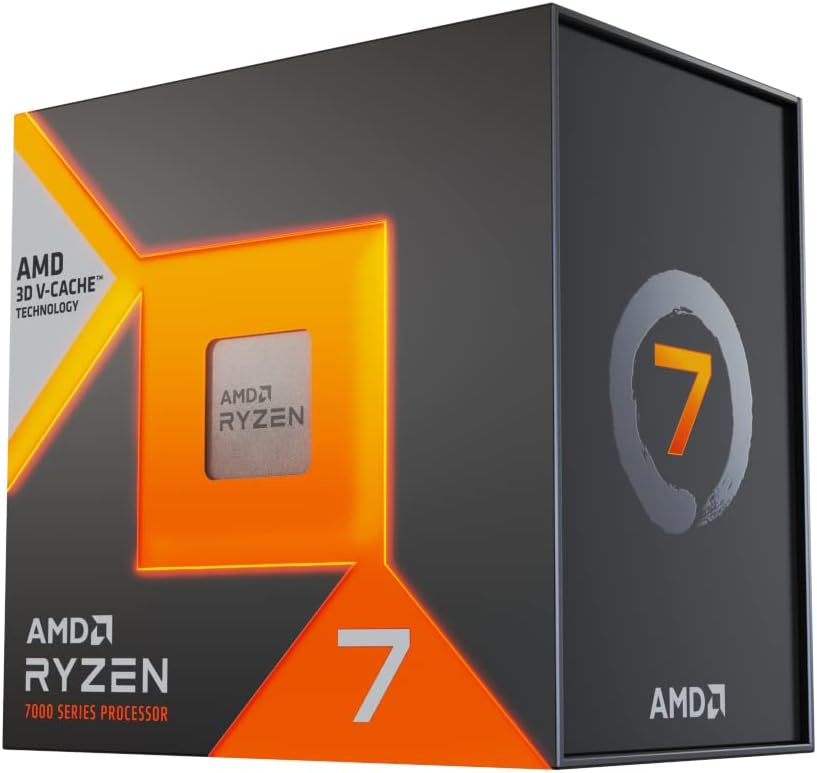
The AMD Ryzen 7 7800X3D is a mid-to-high-end desktop CPU aimed at custom PC builders and dedicated gamers who want strong gaming frame rates without stepping up to flagship chip pricing. Combining 8 Zen 4 cores with AMD's 3D V-Cache technology and a total of 96MB of L3 cache, this processor targets CPU-limited gaming scenarios where cache depth has a measurable impact on frame rates. It is best suited for builders pairing it with a capable GPU on an AM5 motherboard, not buyers looking for a complete prebuilt system or a chip optimized for heavy multi-threaded workloads like 3D rendering or video encoding.
The 3D V-Cache architecture is the defining feature here. By stacking additional L3 cache directly on the die using AMD's chiplet bonding process, the 7800X3D reduces the frequency of slower main memory accesses in games that repeatedly pull from the same data sets. In practical terms, third-party benchmarks from outlets like GamersNexus and Hardware Unboxed have shown the 7800X3D outpacing higher-clocked non-cache chips in titles like Cyberpunk 2077, Hogwarts Legacy, and Far Cry 6 at 1080p, where CPU bottlenecks are most visible. Paired with a mid-range or better GPU, the chip holds its own at 1440p as well, though gains narrow as GPU load increases.
AMD built the 7800X3D on a 5nm process node, which contributes to a relatively controlled thermal profile given the cache stack. A quality 240mm AIO or a premium tower air cooler is sufficient to keep the chip within its 89 degrees Celsius Tjmax ceiling under sustained gaming loads. The AM5 platform also brings PCIe 5.0 support for both the primary GPU slot and M.2 NVMe storage, which adds practical longevity for builders who plan to upgrade components over time rather than replacing the entire system.
There are a few considerations worth noting before purchasing. This listing currently carries no owner reviews, which means real-world reliability feedback, out-of-box quality consistency, and reseller fulfillment experience cannot be evaluated from available data alone. Buyers should treat this as an unverified listing and cross-reference feedback from other retailers or community sources before committing. Additionally, the AM5 platform requires DDR5 memory, which adds cost for builders transitioning from older DDR4 systems. The 4.2GHz base clock also means the 7800X3D is not the strongest choice for workloads that favor high single-threaded clock speeds over cache depth, such as certain simulation or productivity applications.
Overall, the Ryzen 7 7800X3D appears to be a well-regarded gaming CPU based on its architectural specifications and the broader reception of AMD's 3D V-Cache platform, but the absence of any owner reviews on this specific listing warrants caution. Builders are encouraged to verify current seller feedback, check fulfillment source, and confirm DDR5 platform costs are accounted for in the total build budget before finalizing a purchase decision.
TL;DR , The Quick Verdict
| Question | Answer |
|---|---|
| Faster CPU? | 9800X3D, by 8-10% on average across 45 games |
| Better value? | 7800X3D, currently $162 less and within 90-92% of the performance |
| Higher 1% lows? | 9800X3D, with up to 33% higher minimums in cache-heavy titles |
| Cooler running? | 9800X3D, 95°C max vs 89°C max thanks to new die design |
| Better overclocking? | 9800X3D, fully unlocked vs limited tuning on 7800X3D |
| Future upgrade path? | Tied , both use AM5, both will run on Zen 6 motherboards |
| Get the 9800X3D if: | You pair with RTX 5080+, game at 1080p competitive, want maximum 1% lows |
| Get the 7800X3D if: | You game at 1440p+, GPU is RTX 5070 or below, $162 matters to your build |
Why You Can Trust This Comparison
PCBolt has been covering CPUs and gaming hardware with one consistent goal: helping buyers who care about price-to-performance, not just chasing the highest benchmark number. We approach every comparison the same way. What does the spec actually mean in real games? Does owner feedback at scale support the claims? Is there a quieter pick that delivers more for less?
For this comparison, we cross-referenced TechSpot’s comprehensive 45-game benchmark suite (the most thorough head-to-head testing publicly available), GamersNexus’s CPU-bound title testing including Stellaris, Dragon’s Dogma 2, and Final Fantasy 14, Wccftech’s multi-game comparison with the RTX 4090 paired, Tom’s Hardware’s CPU hierarchy showing the 9800X3D at 97.04% of the new flagship 9850X3D, and PassMark’s aggregated 45,471-benchmark dataset. We also pulled real-world thermal and overclocking data from PCPartPicker community builds.
To be straightforward: we did not personally bench both chips on identical hardware. What we did is synthesize benchmark data from outlets that did, weighted against owner feedback at scale.
Side-by-Side Spec Comparison
| Spec | Ryzen 7 9800X3D | Ryzen 7 7800X3D |
|---|---|---|
| Architecture | Zen 5 (Granite Ridge) | Zen 4 (Raphael) |
| Process Node | 4nm | 5nm |
| Cores / Threads | 8 / 16 | 8 / 16 |
| Base Clock | 4.7 GHz | 4.2 GHz |
| Boost Clock | 5.2 GHz | 5.0 GHz |
| L2 Cache | 8 MB | 8 MB |
| L3 Cache (total) | 96 MB (32MB + 64MB 3D V-Cache) | 96 MB (32MB + 64MB 3D V-Cache) |
| TDP | 120W | 120W |
| Max Operating Temp | 95°C | 89°C |
| Memory Support | DDR5-5600 | DDR5-5200 |
| PCIe Support | PCIe 5.0 | PCIe 5.0 |
| Socket | AM5 | AM5 |
| Overclocking | Fully unlocked | Limited tuning only |
| Launch Price | $479 | $449 |
| Current Price (May 2026) | ~$429 | ~$340-380 |
Architecture Differences That Actually Matter
The headline difference between these two chips isn’t core count, cache size, or thread count, all three are identical. What changed is where AMD placed the 3D V-Cache, and how that placement affects everything downstream.
On the 7800X3D, the 64MB of stacked V-Cache sits above the cores. This works, but it creates a thermal limitation, the cache layer acts as an insulator, trapping heat from the cores below. AMD compensated by limiting the chip’s maximum temperature to 89°C and disabling most overclocking headroom to prevent damage.
On the 9800X3D, AMD flipped the design. The V-Cache layer now sits beneath the cores, which means heat from the cores transfers directly to the heat spreader without passing through the cache. This single change unlocks three meaningful improvements. First, the chip can run at 95°C maximum, the same ceiling as non-X3D Zen 5 parts. Second, it can boost higher (5.2 GHz vs 5.0 GHz) without thermal throttling. Third, AMD enabled full overclocking support, the 9800X3D is the first X3D chip with completely unlocked tuning. The Zen 5 architecture itself also brings roughly 16% IPC improvement over Zen 4, which contributes to the gaming uplift even before the V-Cache improvements factor in.
The practical impact: on the same 240mm AIO cooler, the 9800X3D maintains higher all-core boost clocks for longer under sustained gaming loads. PCPartPicker community builds consistently report 9800X3D temperatures in the 45-56°C range during gaming sessions, well below the thermal limit, while 7800X3D builds frequently sit closer to 75-85°C under similar conditions.
Gaming Benchmark Reality Check
Here’s where the comparison gets interesting. The 9800X3D’s headline gaming advantage varies dramatically by title, and the average tells only part of the story.
TechSpot 45-Game Suite (1080p, RTX 4090)
TechSpot’s most comprehensive testing showed an 8-10% average uplift, but the range was wide:
- The Last of Us Part 1: 9800X3D was 20% faster, with 33% higher 1% lows
- Hogwarts Legacy: 21% faster
- Dragon’s Dogma 2: 16.2% faster (GamersNexus testing, with notably improved frame times)
- Baldur’s Gate 3: 26.9% faster (GamersNexus, double-checked across multiple test runs)
- Cyberpunk 2077: 8% faster
- Spider-Man Remastered: 15% faster, with 22% higher 1% lows
- Riftbreaker CPU benchmark: 12% faster
- Final Fantasy 14: Dawntrail: 5.6% faster (GamersNexus)
- Forza titles: Within 1-2%, essentially tied
- Skull and Bones, Returnal, Ratchet & Clank: No measurable difference, GPU-limited
Wccftech 8-Title Average (RTX 4090 paired)
11.4% average gap across the 8 titles tested. Wccftech specifically noted that the gap “may not be noticeable in most” gaming scenarios outside of CPU-bound competitive titles.
PassMark Aggregated Data
17-18% faster in single-thread testing, 17% faster in multi-threaded testing across 45,471 submitted benchmarks. PassMark scores skew higher than real-world gaming because synthetic benchmarks isolate the CPU completely from GPU bottlenecks.
Tom’s Hardware Hierarchy
The 9800X3D delivers 97.04% of the brand-new Ryzen 7 9850X3D’s performance, making it second-fastest gaming CPU on the market. The 7800X3D sits roughly 8-10% behind that.
The pattern that emerges across all these sources: the 9800X3D’s advantage is largest in CPU-bound, cache-sensitive titles (older Unreal Engine games, simulation games, MMOs, and competitive shooters at 1080p with flagship GPUs). In modern AAA titles at 1440p or 4K, the gap shrinks to 3-8% and often disappears entirely under GPU-bound conditions.
Real-World Use Cases
When the 9800X3D Is Worth the Premium
The 9800X3D earns its $80-160 premium specifically when CPU bottlenecking is your real constraint. That’s a narrower scenario than most marketing suggests. You’ll see the full benefit when:
You’re pairing it with an RTX 5080 or RTX 5090 at 1080p competitive settings, where the GPU can render frames faster than the CPU can feed them. In esports titles like Counter-Strike 2, Valorant, or Apex Legends at high refresh rates, the 9800X3D’s improved 1% lows translate to perceptibly smoother frame pacing. CPU-heavy single-player games like Microsoft Flight Simulator, Cities Skylines 2, and Stellaris where the 21% reduction in simulation time GamersNexus measured actually matters. You’re also a builder who plans to keep this chip for 4-5 years and pair it with future-generation GPUs, the 9800X3D’s headroom will age better as GPUs get faster.
When the 7800X3D Is the Smarter Buy
The 7800X3D holds clear value when GPU bottlenecking flattens the gap. You’ll be just as well-served when:
You’re gaming at 1440p with a mid-range GPU like the RTX 5070 or RTX 4070 Super. At this resolution and GPU tier, the GPU is the limiter in most modern AAA games, and the 9800X3D’s CPU headroom goes unused. You’re playing at 4K, where the GPU bottleneck is even more pronounced and the 8-10% CPU gap shrinks to 2-4% in real gameplay. Your build budget makes a $160 saving meaningful, that’s a tier upgrade in storage (1TB to 2TB NVMe), a noticeable RAM upgrade (32GB to 64GB DDR5), or contributes meaningfully toward a better GPU. The 7800X3D is also the practical choice for anyone whose current GPU is RTX 4060 to 4070-class. Pairing a flagship CPU with a mid-range GPU produces the same gaming experience as pairing a mid-range CPU with the same GPU, you’ve just spent more money.
Price Analysis: The $162 Gap
This is where the math gets interesting. According to HowManyFPS’s tracking, the 9800X3D is currently $162.99 more expensive than the 7800X3D on Amazon. Let’s translate that into real performance per dollar.
If we use TechSpot’s 8-10% average uplift as the baseline:
- 9800X3D at $429: roughly $42-54 per percentage point of gaming performance over the 7800X3D
- 7800X3D at $340-380: clear winner on absolute price-to-performance ratio
- Difference of $162 buys you 8-10% more frames in CPU-bound scenarios
For comparison, that same $162 could fund an upgrade from an RTX 5070 to closer to an RTX 5070 Ti, an upgrade that delivers 25-30% better gaming performance across the board, not just in CPU-bound scenarios. From a pure price-to-frame-rate perspective, GPU upgrades typically deliver more value than CPU upgrades at this tier.
The math flips in two scenarios. First, when the 9800X3D goes on sale and the gap shrinks below $80, the value proposition tightens considerably. Second, when you already have a top-tier GPU (RTX 5080 or 5090) and the CPU is genuinely the bottleneck, the 9800X3D’s advantage becomes worth paying for.
Final Recommendation by Build Type
Buy the Ryzen 7 9800X3D if you fit any of these profiles:
You’re building an enthusiast 1080p competitive rig and pairing with RTX 5080 or RTX 5090. The CPU advantage is fully exploitable here, and the 9800X3D’s higher 1% lows deliver perceptibly smoother gameplay in esports titles. You play CPU-heavy simulation games like MSFS 2024, Cities Skylines 2, or strategy titles where the 12-21% gain in CPU-bound scenarios actually translates to better gameplay. You’re a long-term keeper who plans to pair future-generation GPUs (RTX 6080, 6090) with this CPU 3-4 years from now. The 9800X3D’s overclocking headroom and Zen 5 architecture will age better. You can find the 9800X3D on sale within $80 of the 7800X3D, at which point the value math improves significantly.
Buy the Ryzen 7 7800X3D if you fit any of these profiles:
You’re building a 1440p gaming rig with a mid-range or upper-mid GPU (RTX 5070, RTX 4070 Super, RX 7800 XT). The 7800X3D will deliver nearly identical real-world frame rates because the GPU is the limiter at this resolution. Your build budget makes the $162 difference meaningful, that money goes further in better RAM, larger storage, or contributing to a GPU upgrade. You’re a 4K gamer where CPU bottlenecking is rarely your constraint and the 9800X3D’s advantage shrinks to 2-4% in most titles. You’re upgrading from an existing AM5 system and want to maximize value while still getting flagship-tier 3D V-Cache gaming performance.
FAQs
Is 9800X3D worth $200 over 7800X3D?
For competitive 240Hz+ play, yes. For 1440p ultra single-player, marginal.
Will 7800X3D feel slow in 2027?
No, both X3D chips remain competitive through 2028+.
Should I wait for 10800X3D?
Not yet announced. Buy current X3D if you need PC now.


























Write Your Review
No reviews yet. Be the first to share your experience!