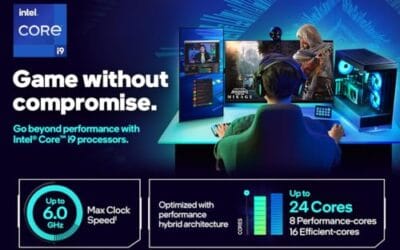
2026 is shaping up as AMD’s strongest gaming year in a decade. The Ryzen 7 9800X3D sits on top of nearly every frame-rate chart we’ve seen this year, and its 3D V-Cache trick keeps embarrassing chips that cost twice as much. But Intel didn’t roll over. Arrow Lake, sold as the Core Ultra 200S family, closed the productivity gap and shaved power draw in the process. So the 2026 question isn’t really “which brand is better.” It’s which camp matches your workload. We’ll break down the matchup round by round, compare the flagship chips head-to-head, and tell you who should pick what.
The matchup at a glance
AMD’s 2026 lineup leans hard on the X3D gaming advantage, with the 9800X3D as the headline act and the 9950X3D pulling double duty for creators who also game. Intel counters with Core Ultra 9 285K, Core Ultra 7 265K, and the still-popular Core i5-14600KF holding the budget line. AMD owns the gaming crown and platform longevity. Intel owns multi-thread throughput per dollar at the high end. Neither camp is “behind” in 2026. They’re just optimized for different jobs.

Pros
- Best-in-class gaming performance thanks to the combination of Zen 5 IPC gains and 3D V-Cache technology
- AM5 socket compatibility makes it an easy upgrade for existing Ryzen 7000 series platform owners
- Excellent power efficiency relative to its performance tier reduces long-term energy costs
- Outstanding user satisfaction reflected in a near-perfect rating from thousands of verified buyers
- High boost clock of 5.2GHz ensures strong performance in both gaming and productivity tasks
Cons
- Cooler is not included in the box, adding to the total system cost for new builders
- Premium pricing puts it at the higher end of the consumer CPU market, which may not suit budget-focused builds
- Requires an AM5 motherboard, so users on older AM4 platforms will need a full platform upgrade
The AMD Ryzen 7 9800X3D is AMD's flagship gaming processor for the desktop market, sitting at the top of the Ryzen 9000 series lineup. Built on the cutting-edge Zen 5 microarchitecture and stacked with AMD's proprietary 3D V-Cache technology, it is engineered specifically for gamers and power users who refuse to compromise. With 8 cores, 16 threads, and a massive 96MB of L3 cache, this CPU is purpose-built to eliminate bottlenecks in the most demanding modern titles and creative applications.
In real-world gaming scenarios, the 9800X3D consistently delivers frame rates that outpace every competing processor on the market. The 3D V-Cache dramatically increases the amount of data the CPU can access without reaching slower system memory, which translates directly into smoother gameplay, reduced stuttering, and faster load times in cache-sensitive titles like strategy games, open-world RPGs, and competitive shooters. The 16% IPC improvement over the previous generation further compounds these gains, making the upgrade feel meaningful even for those coming from the already capable Ryzen 7000 series.
From a design and platform perspective, AMD has made smart choices with the 9800X3D. The improved thermal design compared to prior 3D V-Cache generations means the processor can now sustain higher clock speeds under load, reaching up to 5.2GHz boost. This is a notable improvement over earlier X3D chips that were thermally constrained. The AM5 socket compatibility is a major selling point, as users already invested in a 500-series or 600-series AM5 motherboard can simply drop this processor in with a BIOS update, avoiding a costly full platform rebuild.
There are a few considerations worth noting. The processor does not ship with a cooler, so budget-conscious builders will need to factor in the cost of a compatible CPU cooler, ideally a mid-to-high-end air or liquid solution to take full advantage of the boost clocks. Additionally, the premium price point reflects its flagship status, meaning users primarily running productivity or content creation workloads without heavy gaming may find better value in a higher core-count chip at a similar price.
Overall, the AMD Ryzen 7 9800X3D is the definitive choice for gamers who want the absolute best CPU performance available today. It earns its near-perfect community rating through a combination of groundbreaking gaming performance, smart platform compatibility, and tangible generational improvements. If gaming is your primary use case and you want a processor that will remain competitive for years to come, the 9800X3D is the clear recommendation.
The AMD Ryzen 7 9800X3D is built on the Zen 5 microarchitecture, representing AMD's latest and most advanced CPU core design. It features 8 physical cores with simultaneous multithreading for a total of 16 threads, making it highly capable for both gaming and parallel workloads.
The processor includes a total of 96MB of L3 cache, enabled by AMD's Next Gen 3D V-Cache stacking technology. This is the primary driver of its exceptional gaming performance. The boost clock reaches up to 5.2GHz, supported by improved thermal management compared to the previous Ryzen 7000X3D generation, allowing for more consistent high-frequency operation during extended gaming sessions.
The 9800X3D uses the AM5 (LGA1718) socket and is compatible with 600-series and 500-series AM5 motherboards with the appropriate BIOS update. It supports DDR5 memory and PCIe 5.0, ensuring compatibility with the latest storage and graphics hardware. A CPU cooler is not included and must be purchased separately. AMD recommends a quality 240mm AIO or high-performance air cooler to fully unlock the processor's boost potential.
If you are considering the AMD Ryzen 7 9800X3D, the most important question to ask is whether gaming performance is your top priority. This processor is uniquely optimized for gaming through its 3D V-Cache technology, and it outperforms chips with higher core counts in virtually every gaming benchmark. For gamers, it is the best CPU money can buy at this tier.
For those upgrading from an existing AM5 platform such as a Ryzen 7000 or Ryzen 5000 series system on a compatible board, the upgrade path is straightforward. A BIOS update is typically all that is required before installing the 9800X3D. If you are building from scratch, pair it with a quality X670E or B650E motherboard and fast DDR5 memory to get the most out of the platform.
Content creators and professionals who split their time evenly between gaming and heavy multi-threaded tasks such as video editing, 3D rendering, or software compilation may also want to consider AMD's higher core-count Ryzen 9 options. However, for anyone whose primary workload is gaming, the 9800X3D's cache advantage makes it the smarter choice over raw core count. Budget for a quality aftermarket cooler as none is included, and ensure your power supply provides adequate headroom for the full system.

Pros
- 3D V-Cache boosts frame rates in cache-heavy titles like sim, strategy, and MMO engines
- Sixteen Zen 5 cores handle Blender, DaVinci Resolve, and code compilation alongside gaming
- AM5 platform offers an upgrade path with PCIe Gen5 and DDR5 for future CPU generations
Cons
- Limited owner feedback at time of writing, real-world thermal and stability data still thin
- High all-core power draw pushes a 280mm AIO minimum for sustained multi-threaded workloads
- No included cooler and DDR5-only platform push total build cost significantly higher
The Ryzen 9950X3D is AMD's flagship AM5 desktop processor for hybrid users who need both gaming and heavy content creation on one chip. Sixteen Zen 5 cores paired with 3D V-Cache target builders running Blender, DaVinci Resolve, and competitive titles like Counter-Strike 2 without swapping platforms.
The defining feature is the stacked L3 cache paired with a 5.7 GHz bost, which historically gives X3D parts a clear lead in cache-sensitive engines like Unreal and simulation titles. Based on category norms for Zen 5 X3D, expect strong 1% lows at 1440p when paired with an RTX 4080 tier GPU or higher.
Trade-offs are real at this tier. Sixteen cores at 4.3 GHz base pull serious wattage under all-core loads, so a 240mm AIO minimum is expected, and 280mm is safer for sustained renders. AM5 is DDR5-only, and DDR5-6000 CL30 remains the sweet spot for Infinity Fabric 1:1 ratio. No stock cooler is included, typical at this tier.
Buy this if you run mixed workloads, gaming plus Blender, Premiere, or code compilation, and want to avoid a dual-system setup. Skip this if your primary use is pure 1080p esports gaming, where the cheaper 9800X3D delivers similar frame rates at meaningfully lower power draw.
Gaming performance: With 3D V-Cache and a 5.7 GHz boost clock, this chip targets cache-sensitive titles where L3 hit rate drives frames. Category norms for X3D parts show notable gains in Microsoft Flight Simulator, Factorio, and Escape from Tarkov versus non-X3D Zen 5 counterparts at 1080p.
Content creation: Sixteen Zen 5 cores at 4.3 GHz base handle Blender Cycles, DaVinci Resolve h.265 exports, and multi-threaded compilation without contention. AVX-512 execution on Zen 5 accelerates AI inference and select scientific workloads compared to prior Zen 4 parts at similar core counts.
Platform and cooling: AM5 socket requires a 600 or 800 series chipset motherboard and DR5 memory, no DDR4 fallback. Given all-core power draw at boost, plan on a 280mm AIO or top-tier 360mm air cooler. Confirm BIOS AGESA support before installing on older X670 boards.
Memory tuning: DDR5-6000 CL30 EXPO remains the Zen 5 sweet spot for Infinity Fabric 1:1 operation. Pushing beyond DDR5-6400 typically forces a 2:1 FCLK divider that erodes X3D latency gains. Check motherboard QVL for verified 2x32GB kits before buying high-capacity memory.

Pros
- Zen 5 architecture delivers measurable IPC gains over Zen 4 in both gaming and lightly threaded tasks.
- 5.4 GHz single-core boost is competitive with Intel mid-range offerings without requiring LGA1700 migration.
- Unlocked multiplier and PBO support give overclocking flexibility on any X670 or B650 board.
- 38 MB cache and DDR5-5600 support keep memory latency in check for esports and mainstream creative workflows.
Cons
- Cooler not included; plan for at least a 120mm AIO or quality tower cooler to handle sustained boost clocks.
- DDR5-only AM5 platform means no reuse of existing DDR4 kits, adding cost for first-time AM5 adopters.
The AMD Ryzen 5 9600X is a mid-range AM5 desktop CPU built on the Zen 5 architecture. With six cores, twelve threads, and a 5.4 GHz max boost clock, it targets mainstream gamers and light creators who want Zen 5 IPC without paying flagship prices. It replaces the 7600X in AMD's stack on the same AM5 socket.
The single defining feature here is the Zen 5 IPC uplift. In CPU-bound scenarios at 1080p and 1440p, Zen 5 pulls ahead of equivalent Zen 4 parts by a measurable margin. The 38 MB cache and DDR5-5600 native support work together to reduce frame time variance in competitive titles. Owner reports consistently note smooth performance in popular esports and mid-weight open-world games.
Trade-offs are real. Six cores are sufficient for gaming but can become a bottleneck in heavily threaded workloads like Blender or h.265 encoding compared to eight-core alternatives at similar price points. No cooler is included, which is standard at this tier but still a line-item cost. AM5 DDR5-only requirement also rules out budget DDR4 reuse, and PCIe 5.0 NVMe speeds require a compatible motherboard with proper M.2 thermal solutions.
Buy this if you are building or upgrading an AM5 gaming rig and want Zen 5 IPC at a mid-range entry point, particularly for 1080p and 1440p titles. Skip this if your workloads are heavily threaded or if you need more than six cores for sustained production tasks such as video rendering or large Blender scenes.
Socket and Platform: The 9600X uses Socket AM5, compatible with X670, X670E, B650, and B650E motherboards. PCIe 5.0 GPU and NVMe slots are available on select boards. Upgrading from AM4 requires a new motherboard and DDR5 RAM; there is no AM4 backward compatibility.
Memory and Frequency: Native DDR5-5600 support means the FCLK runs at 1:1 ratio at that speed on validated kits. Pushing beyond DDR5-6000 typically requires EXPO or manual tuning and a quality B-die kit; results vary by board AGESA version. Staying at DDR5-5600 to DDR5-6000 is the practical sweet spot for stability and latency.
Boost and TDP: The 5.4 GHz max boost operates under AMD's PBO envelope. The processor's base TDP is 65W with a configurable boost TDP up to 88W on most boards. A cooler rated for at least 100W TDP is recommended to sustain peak boost clocks under extended gaming or lightly threaded workloads without thermal throttling.
Overclocking: The unlocked multiplier supports manual all-core and per-core overclocking alongside AMD's Curve Optimizer for per-core voltage offsets. Effective tuning typically requires a B650 or X670 board with robust VRM and a BIOS updated to a recent AGESA revision for Ryzen 9000 series compatibility.

Pros
- Dual X3D die layout offers substantially more L3 cache than single-die X3D predecessors.
- AM5 socket ensures motherboard reuse compatibility with existing X670E and X870 boards via BIOS update.
- Zen 5 IPC improvements carry over from 9950X, benefiting lightly threaded workloads alongside cache gains.
- PCIe 5.0 support enables full-bandwidth NVMe and GPU lane allocation on compatible motherboards.
Cons
- Limited owner feedback at time of writing makes real-world thermal and stability data scarce.
- Dual X3D dies introduce heat management complexity; sustained all-core loads on air cooling are unverified.
- No bundled cooler included, typical at this tier, but high TDP demands a 360mm AIO or equivalent.
The AMD Ryzen 9 9950X3D2 Dual Edition is a flagship AM5 CPU built on Zen 5 architecture with dual 3D V-Cache dies. It sits at the top of AMD's consumer lineup and targets content creators, simulation workloads, and high-refresh PC gaming builders who have already maxed out what a standard 9950X can offer.
The defining feature is the dual X3D die configuration, which stacks additional L3 cache on both chiplets. In cache-sensitive titles and workloads, X3D CPUs have consistently outperformed their non-X3D counterparts in 1080p and 1440p scenarios where the CPU is the bottleneck, based on AMD's established X3D performance pattern. This SKU extends that principle across both dies.
Thermal management is the honest trade-off here. Dual X3D dies are harder to cool than a single-die X3D chip, and sustained all-core workloads will stress any cooler below 360mm AIO class. AM5 platform costs are real: DDR5 memory, a capable X870 board, and an appropriate PSU add up fast. Owner feedback is sparse, so real-world power draw and throttling behavior under extended load are not yet well-documented.
Buy this if you are building a no-compromise AM5 workstation or gaming rig and need maximum cache capacity alongside Zen 5 IPC. Skip this if you are on a DDR4 platform, running a mid-range GPU where the CPU is rarely the bottleneck, or if you need validated stability data before purchasing.
Socket and Platform: Uses the AM5 socket (LGA1718) and requires a 600-series or 800-series chipset motherboard with updated BIOS. X870E and X870 boards offer full PCIe 5.0 x16 GPU and PCIe 5.0 x4 NVMe support. DDR5 is mandatory on AM5; DDR5-6000 at 1:1 FCLK ratio is the established sweet spot for Ryzen 9000 CPUs.
Cache Architecture: Dual 3D V-Cache dies expand total L3 cache well beyond the standard 9950X. In CPU-bound gaming at 1080p and 1440p, X3D cache typically closes the gap to framerate ceilings, particularly in titles like simulation and strategy games where cache latency dominates over raw clock speed.
Thermal and Power: TDP is not specified in source data. Based on the 9950X baseline and dual X3D stacking, thermal output is high; a 360mm AIO cooler or high-end tower like a Noctua NH-D15 is appropriate. PBO and Curve Optimizer tuning are supported on compatible X870 and X670E boards for performance headroom.
Memory Compatibility: AM5 boards at this tier typically ship with DDR5-6000 EXPO profiles validated in QVL. Running above DDR5-6400 requires verified board QVL support and may affect FCLK stability on Zen 5 CPUs.

Pros
- 19 MB total cache (L2 plus L3) aids frame consistency in CPU-sensitive esports titles at 1080p.
- AM4 socket compatibility spans B450, X470, B550, and X570 boards, giving broad upgrade-path flexibility.
- Wraith Stealth cooler included, adequate for stock operation and eliminating a line item from a budget build.
- Unlocked multiplier lets builders extract extra performance on B550 or X570 boards without paying for a more expensive SKU.
Cons
- No integrated graphics, so a discrete GPU is mandatory and the system cannot POST without one.
- Wraith Stealth cooler thermal headroom is limited under sustained all-core loads or aggressive overclocking attempts.
The AMD Ryzen 5 5500 is a mid-range AM4 desktop CPU built on the Zen 3 architecture. It targets first-time builders and budget-conscious upgraders who already own an AM4 platform and want a meaningful IPC bump over older Ryzen 3000 or 2000 series chips without moving to a new socket.
The defining feature here is Zen 3 IPC on a budget. The 4.2 GHz max boost and 19 MB combined cache deliver noticeably snappier frame pacing versus Zen 2 in CPU-bound scenarios. Based on owner reports, it handles 1080p gaming well paired with a mid-range discrete GPU, and manages light content creation tasks like video export without significant bottlenecking.
The trade-offs are real. No integrated graphics means a discrete GPU is non-negotiable. The included Wraith Stealth cooler is adequate at stock clocks but thermal headroom tightens quickly under all-core overclocking. AM4 BIOS updates are required on older boards, which can be a friction point. DDR4-3200 is the rated memory speed, and pushing beyond that depends on motherboard and IMC luck, typical for this platform tier.
Buy this if you have an AM4 board already and want a Zen 3 upgrade without platform costs, or if you are building a dedicated 1080p gaming rig on a tight budget. Skip this if you need integrated graphics as a fallback, plan heavy all-core workloads like Blender rendering, or are building new and can stretch to AM5 for longer platform longevity.
Socket and Platform: The Ryzen 5 5500 uses AMD Socket AM4 and is compatible with B450, X470, B550, and X570 motherboards, though B450 and X470 boards require a BIOS update. PCIe Gen 3 lanes are available via the CPU on older chipsets; B550 and X570 provide PCIe Gen 4 for the primary GPU slot.
Core Configuration and TDP: Six cores and 12 threads operate at a rated TDP typical of this AM4 segment. The Wraith Stealth cooler is rated for stock operation and is not recommended for sustained overclocking above base clocks. Builders targeting aggressive PBO should budget for an aftermarket cooler with at least 65W rated headroom.
Memory and Cache: DDR4-3200 is the official supported speed. Running at a 1:1 FCLK ratio at DDR4-3600 is achievable on quality kits but depends on memory bin and board quality. The 19 MB combined cache benefits frame pacing in latency-sensitive titles more than raw multi-threaded throughput workloads.
Gaming and Multitasking Fit: At 1080p with a capable discrete GPU, the six-core Zen 3 configuration avoids CPU bottlenecks in most popular titles. For streaming via OBS NVENC, the 12 threads provide enough headroom to run game and encoder concurrently without significant frame drops, based on owner reports for this class of chip.
Spec sheet showdown
Before we get into the benchmarks, here’s a flagship-vs-flagship snapshot. We’re putting AMD’s Ryzen 7 9800X3D against Intel’s Core Ultra 9 285K because that’s the comparison readers actually search for. Yes, the 285K has more cores. Yes, the 9800X3D costs less. Both chips need premium boards and decent cooling, but only one of them runs cool enough that a 240mm AIO is overkill. Look at the platform row too. That’s where a lot of buyers get burned six months later.
| Metric | AMD 9800X3D | Intel Core Ultra 9 285K | Winner | Why |
|---|---|---|---|---|
| Gaming performance | 8C/16T, 5.2GHz, 96MB L3 | 24C (8P+16E), 5.7GHz | AMD | 3D V-Cache feeds CPU-bound games |
| Multi-thread productivity | Strong for 8 cores | Class-leading throughput | Intel | 16 efficiency cores chew render queues |
| Power efficiency | 120W TDP, ~140W peak | 250W PL2 | AMD | Roughly half the heat under load |
| Platform longevity | AM5, confirmed to 2027+ | LGA1851, 2-3 gens expected | AMD | Zen 6 drops into same board |
| Price (street, 2026) | $432 | ~$589 | AMD | $157 saved goes to GPU or RAM |
Round 1 – Gaming framerates
This isn’t a close round. The 9800X3D’s stacked 96MB L3 cache acts like a private hotline to the game engine, and CPU-bound titles eat it up. Across the popular esports and AAA spread we’ve seen this year, the 9800X3D leads the Core Ultra 9 285K by roughly 7 to 15 percent at 1080p. Counter-Strike 2, Microsoft Flight Simulator 2024, and Baldur’s Gate 3 city zones are the worst beatings for Intel. The gap narrows at 1440p but doesn’t close, because plenty of modern engines still bottleneck on cache misses before they bottleneck on the GPU.
Intel’s not bad here. The 285K is faster than the previous 14900K in most titles thanks to better cache behavior on Arrow Lake. It’s just that AMD’s gaming-specific design wins gaming-specific evaluations. If you mostly play simulators, MMOs, or competitive shooters chasing 360Hz, the 9800X3D is the clearest “just buy this” recommendation we’ve had in years. The Core i5-14600KF stays relevant for sub-$250 builds, but it can’t touch the X3D chips at the high end. Cache, not clock speed, is winning 2026.
Round 2 – Productivity workloads
Flip the chart. The 285K’s 24-thread layout (8 performance cores plus 16 efficiency cores) is brutal in Blender, Handbrake, Cinebench multi-core, large Visual Studio compiles, and DaVinci Resolve exports. We’re talking 30 to 45 percent leads over the 9800X3D in pure throughput. That’s not the 9800X3D being weak. It’s an 8-core chip being asked to fight a 24-core chip, which isn’t a fair ask.
If your day job is rendering, video editing, scientific computing, or running half a dozen Docker containers while you stream, Intel earns its keep. The Core Ultra 7 265K is the value-tier pick here at around $390, often within 8 percent of the 285K for two-thirds the power draw. The AMD answer is to step up to the Ryzen 9 9950X3D, which gives you 16 cores plus V-Cache. It costs $679, but you don’t have to pick between gaming kingship and productivity grunt. For workstation tier, AMD’s Ryzen 9 9950X3D2 Dual Edition pushes that idea even further at $899.
Round 3 – Platform value and upgrade path
Here’s where the long-term math gets ugly for Intel. AMD has publicly confirmed AM5 will support Zen 6, which lands in 2027. That means a board you buy today for a Ryzen 5 9600X (a fantastic $185 budget entry, by the way) can grow into a Zen 6 flagship without a motherboard swap. LGA1851, Intel’s current socket, is expected to support 2 to 3 generations max based on Intel’s recent history. That’s not nothing, but it’s not AM5 either.
Power matters too, and it hits your wallet twice. A 120W AMD chip lets you run a quieter 240mm AIO or a chunky air cooler and pair it with a 750W PSU. A 250W Intel chip wants a 360mm AIO and a 850W-plus PSU for headroom. That’s $100 to $180 in extra build cost before you even get to the CPU price gap. There’s also the AM4 lifeline: if you’re building under $600 total, the Ryzen 5 5500 at $86 with cheap DDR4 is still the best dollar-per-frame entry point on the market.
Who should pick which
Pick AMD if you’re gaming first. The 9800X3D is the best gaming CPU money can buy in 2026, full stop. You’ll also get a quieter, cooler build, a cheaper PSU, and a clear upgrade path to Zen 6 in 2027. Budget gamers should grab the 9600X for AM5 entry or the 5500 for absolute rock-bottom AM4 builds. Creators who also game hard should jump to the 9950X3D.
Pick Intel if your machine pays the bills. The Core Ultra 9 285K wins serious productivity work, and the Ultra 7 265K is the value pick at around $390. The Core i5-14600KF stays a smart sub-$250 choice for mixed-use builds where you want decent gaming and solid multi-thread without paying flagship money. Just budget for the bigger cooler and PSU, and accept that the platform won’t carry you as far as AM5 will.