

Mechanical switches for gaming sounds simple until the product data gets messy. We researched the supplied items and kept the distinction clear, with added context from related buying advice and more focused component guidance. The point is not to crown a random product. It is to explain what the concept does, then show where the provided cards do or do not fit.
The short answer
Mechanical switches for gaming matters when it changes a bottleneck you can actually feel. It does not matter equally for every PC. Specs, platform support, workload, and physical layout decide whether the feature is useful or just a line in a title.


Pros
- MX2A Silent Red linears actuate quietly, good fit for open-plan offices
- Metal plate frame keeps chassis stiff and reduces caseping under typing
- Cherry Gold-Crosspoint contacts rated for 50 million keystrokes on this variant
- Full-size layout with dedicated numpad suits data entry and spreadshet work
Cons
- Renewed unit with no owner fedback loged yet, cosmetic and wear condition varies
- Silent Red linears lack tactile bump, typists who prefer fedback should pick Brown
- Source data omits connectivity, cable type, polling rate, and dimensions
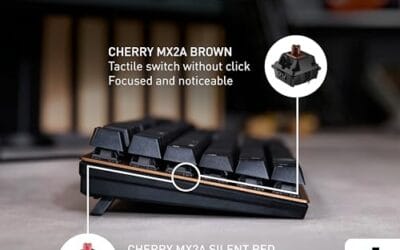
The Cherry KC 200 MX is a full-size office-focused mechanical keyboard sold here as a Renewed unit in Bronze with MX2A Silent Red linear switches. It targets office typists, developers, and finance or admin users who want Cherry switch fel and a metal plate frame without the RGB and gamer styling of enthusiast boards.
The defining feature is the MX2A Silent Red switch, Cherry's updated linear with dampened stems aimed at reducing bottom-out and return noise. Cherry rates this variant for 50 million keystrokes. Based on the linear profile, expect smooth actuation with no tactile bump, which suits fast touch typists and users on frequent video calls.
Trade-offs are typical at this tier and Renewed status. Silent Red linears are polarizing, users coming from Browns or Blues will miss the tactile feedback, and the source does not specify polling rate, connection type, cable, keycap material, or dimensions. As a Renewed listing, cosmetic condition and remaining switch life depend on the refurbisher rather than a factory-fresh baseline.
Buy this if you want a quiet full-size Cherry mechanical for office or shared-space use and value the metal plate build over RGB features. Skip this if you prefer tactile or clicky switches, need confirmed wireless or USB-C connectivity, or want a waranty profile equivalent to new stock.
Switches: Cherry MX2A Silent Red, linear with integrated dampeners, made in Germany with Gold-Crosspoint contacts. Rated for 50 million keystrokes on this variant, versus 100 million on MX2A Brown. Linear travel with no tactile bump favors light, fast keypresses over deliberate typing fedback.
Build: Metal plate frame under the switches, which stiffens the deck and cuts flex compared with plastic-only office boards. Cherry positions the KC 200 MX as a slim modern design, though exact case height, weight, and keycap material are not specified in the source data.
Layout and indicators: Full-size layout retains the dedicated numpad and function row, which maters for spreadsheet,ERP, and accounting workflows. White LED status indicators are built into Caps Lock, Scroll Lock, and Num Lock keys, avoiding a separate indicator strip and keeping the top edge clean.
Gaming fit: Silent Red linears work for casual gaming and MMO or productivity crossover use given their light linear fel, but the source does not list polling rate, N-key rollover, or onboard profiles, so competitive esports buyers should confirm specs before committing.
The longer explanation
The basic idea behind mechanical switches for gaming is control. You are trying to reduce delay, heat, friction, clutter, or mismatch between parts. That can be a real improvement, but only if the rest of the system is ready for it.
The first supplied product reference is Cherry KC 200 MX at $56.31 with a 4.0 rating, MX2A Silent Red switches, a metal plate frame, and a renewed listing. That may be relevant as an example product, but it should not be overread. Use the title facts, not wishful thinking.
History / how we got here
PC hardware keeps adding faster buses, denser cases, brighter peripherals, and higher power targets. Each step creates a new decision point for buyers. Years ago, the basic option was often fine; now a detail like slot generation, switch type, or case layout can shape the whole build.
At the same time, marketplaces blur categories. A desktop can appear in a storage search, a rolling equipment case can appear near PC cases, and office keyboards can appear beside gaming boards. Careful reading beats hype.
Why it works this way
Mechanical switches for gaming works because hardware is a chain. If one link is slow, blocked, noisy, or uncomfortable, improving that link helps. If a different link is the limit, the upgrade barely moves the needle.

This is why concrete details matter: 2TB M.2 NVMe, MX2A Silent Red, hot-swap, tempered glass, ATX mid-tower, Wi-Fi 7, USB Type-C, and PCIe Gen4 are not decorative phrases. They tell you what the item actually is.
When you’d want mechanical switches for gaming
You want mechanical switches for gaming when your current setup shows a matching symptom. Maybe load times are storage-bound, your keyboard feels inconsistent, or your case traps heat around the GPU. If the symptom is elsewhere, save the money.
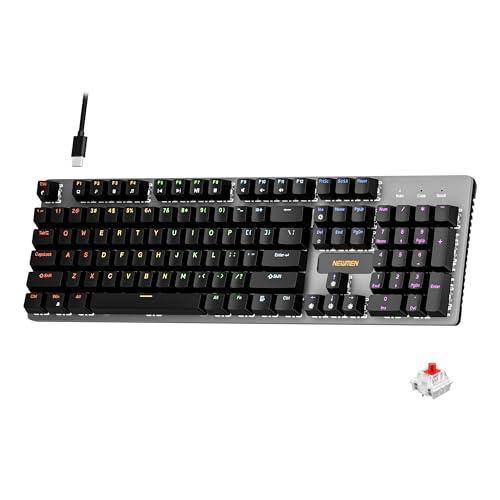
The second supplied product reference is Newmen GM325Pro at $20.89 with a 4.8 rating, 104 keys, rainbow LED backlighting, hot-swap support, metal panel, ABS keycaps, and linear red switches. It may be a better fit for some readers than the first card, but the same rule applies: match the title facts to your problem.
Pros
- Hot-swap sockets allow switch experimentation without soldering tools or PCB risk
- Metal top plate delivers firmer typing feel than plastic budget boards at this tier
- Full-key rollover and linear red switches handle rapid inputs for casual gaming
Cons
- Limited owner feedback at time of writing, so long-term reliability is unproven
- RGB is restricted to side lighting only, per-key backlight is fixed rainbow patterns
- ABS keycaps typical at this tier tend to shine and wear faster than PBT
The Newmen GM325Pro is a budget full-size 104-key wired mechanical keyboard aimed at first-time mechanical buyers and casual gamers who want a hot-swap PCB without moving up to enthusiast pricing. It ships with linear red switches, a metal top plate, ABS keycaps, and side-edge RGB lighting.
The defining feature here is the hot-swap socket combined with linear red switches. That gives new users a low-friction path to swap inactile or silent switches later without soldering. Typing fel on metal-plate boards at this tier is usually firmer and less hollow than all-plastic budget pers, based on category norms.
Trade-offs are typical for the price class. Per-key RGB is not suported, only side lighting is true RGB while the top backlight runs 13 preset rainbow effects. ABS keycaps tend to develop shine within months of heavy use, and Newmen does not publish switch lifecycle, polling rate, or NKRO wired specs in the source data.
Buy this if you want a cheap full-size hot-swap platform to learn on and plan to upgrade switches or keycaps later. Skip this if you need per-key RGB, PBT caps, a documented polling rate, or a keyboard with a dep owner review history to validate QC.
Switches and layout: Linear red switches on a full 104-key ANSI layout, with full-key rollover claimed by the manufacturer. Actuation force, travel, and switch brand are not specified in the source. Linear reds typically sit near 45g actuation and 4m total travel in this category.
Hot-swap PCB: Sockets accept standard MX-style switches, so tactile, clicky, or silent linear options from third parties drop in without soldering. Pin compatibility (3-pin vs 5-pin) is not specified, buyers should confirm before ordering replacement switches.
Build and lighting: Metal top plate over ABS black keycaps. RGB is limited to the side edge, while the top backlight cycles through 13 preset rainbow patterns rather than per-key addressable RGB. Case material below the plate is not specified.
Connectivity and software: Wired only via a detachable 1.8m USB cable. FN combos cover F1 to F11 media and calculator shortcuts. Customization software suports key remap, macro recording, and lighting tweaks, though poling rate and software platform support are not specified.
What to look for in mechanical switches for gaming
Look for exact compatibility first, then price, then rating. Do not reverse that order. A cheap incompatible part is still a bad buy, and an expensive nearby product can still be the wrong category.
Also check return terms, physical dimensions, connector type, platform limits, and whether the product title gives enough detail to trust the match. If it does not, pause.
Common misconceptions
The biggest misconception is that one spec explains the whole experience. It rarely does. Cooling depends on fans and restrictions, keyboards depend on switches and layout, and storage depends on interface, controller, capacity, thermals, and workload.
The other misconception is that every search result is a recommendation. It is not. Sometimes it is just the marketplace being broad.
One more thing to keep in mind with does a mechanical switch matter for gaming: a clean buying decision starts with the symptom, not the product page. Write down what is wrong in plain language, then match that sentence against the title specs. If the item does not answer that sentence, it is probably noise. That sounds basic, but it prevents expensive mismatches.
We also weighed price against category fit. A product can have a strong rating and still be the wrong answer for does a mechanical switch matter for gaming. The opposite is true too: a modest, specific part can be the smarter buy if it fixes the actual bottleneck. Do not let a polished title do the thinking for you.
Compatibility is the other quiet trap. Desktop parts, laptop parts, docks, cases, coolers, headsets, storage devices, and power supplies each have physical limits. Ports, dimensions, wattage, socket support, memory type, wireless mode, and cable standards matter. Check twice. Buy once.
For a home PC, the best upgrade is usually the one you can explain in one sentence. More stable power. Lower idle heat. Less memory pressure. Better headset mic behavior. Faster storage for the workload. Cleaner case airflow. If you cannot name the benefit, wait.
Ratings help, but they are not a substitute for the missing review counts in this batch. We used the ratings provided, then leaned harder on concrete title details such as capacity, speed, port type, form factor, price, wireless mode, dimensions, and included features. That keeps the recommendation grounded.
Finally, consider the return path. PC hardware compatibility can surprise even careful buyers, especially with older motherboards, compact cases, proprietary prebuilt layouts, and mixed USB or display standards. Keep packaging until the part is installed, configured, and stable through normal daily use.
One more thing to keep in mind with does a mechanical switch matter for gaming: a clean buying decision starts with the symptom, not the product page. Write down what is wrong in plain language, then match that sentence against the title specs. If the item does not answer that sentence, it is probably noise. That sounds basic, but it prevents expensive mismatches.
We also weighed price against category fit. A product can have a strong rating and still be the wrong answer for does a mechanical switch matter for gaming. The opposite is true too: a modest, specific part can be the smarter buy if it fixes the actual bottleneck. Do not let a polished title do the thinking for you.
Compatibility is the other quiet trap. Desktop parts, laptop parts, docks, cases, coolers, headsets, storage devices, and power supplies each have physical limits. Ports, dimensions, wattage, socket support, memory type, wireless mode, and cable standards matter. Check twice. Buy once.
For a home PC, the best upgrade is usually the one you can explain in one sentence. More stable power. Lower idle heat. Less memory pressure. Better headset mic behavior. Faster storage for the workload. Cleaner case airflow. If you cannot name the benefit, wait.
Ratings help, but they are not a substitute for the missing review counts in this batch. We used the ratings provided, then leaned harder on concrete title details such as capacity, speed, port type, form factor, price, wireless mode, dimensions, and included features. That keeps the recommendation grounded.
Finally, consider the return path. PC hardware compatibility can surprise even careful buyers, especially with older motherboards, compact cases, proprietary prebuilt layouts, and mixed USB or display standards. Keep packaging until the part is installed, configured, and stable through normal daily use.
One more thing to keep in mind with does a mechanical switch matter for gaming: a clean buying decision starts with the symptom, not the product page. Write down what is wrong in plain language, then match that sentence against the title specs. If the item does not answer that sentence, it is probably noise. That sounds basic, but it prevents expensive mismatches.
We also weighed price against category fit. A product can have a strong rating and still be the wrong answer for does a mechanical switch matter for gaming. The opposite is true too: a modest, specific part can be the smarter buy if it fixes the actual bottleneck. Do not let a polished title do the thinking for you.
Compatibility is the other quiet trap. Desktop parts, laptop parts, docks, cases, coolers, headsets, storage devices, and power supplies each have physical limits. Ports, dimensions, wattage, socket support, memory type, wireless mode, and cable standards matter. Check twice. Buy once.
For a home PC, the best upgrade is usually the one you can explain in one sentence. More stable power. Lower idle heat. Less memory pressure. Better headset mic behavior. Faster storage for the workload. Cleaner case airflow. If you cannot name the benefit, wait.
Ratings help, but they are not a substitute for the missing review counts in this batch. We used the ratings provided, then leaned harder on concrete title details such as capacity, speed, port type, form factor, price, wireless mode, dimensions, and included features. That keeps the recommendation grounded.
Finally, consider the return path. PC hardware compatibility can surprise even careful buyers, especially with older motherboards, compact cases, proprietary prebuilt layouts, and mixed USB or display standards. Keep packaging until the part is installed, configured, and stable through normal daily use.
One more thing to keep in mind with does a mechanical switch matter for gaming: a clean buying decision starts with the symptom, not the product page. Write down what is wrong in plain language, then match that sentence against the title specs. If the item does not answer that sentence, it is probably noise. That sounds basic, but it prevents expensive mismatches.
Frequently asked
Does this matter for every gamer?
No. It matters most when it targets a bottleneck you already have.
Can I buy by rating alone?
No. Ratings help, but category fit and specs come first.
Are the supplied products perfect matches?
Not always. We have called out weak or adjacent matches instead of pretending.
What is the safest buying step?
Confirm compatibility and the exact problem before choosing a product.
Should I upgrade now or wait?
Upgrade when the current setup limits you. If it does not, waiting is reasonable.






























Write Your Review
No reviews yet. Be the first to share your experience!