

Corsair and Thermalright sit at opposite ends of the CPU cooling world, and the gap between them is the whole story. Corsair sells polish: liquid coolers with RGB, slick software, and premium prices that often clear $150. Thermalright built a cult following by doing the opposite, delivering air coolers that match pricey rivals for a fraction of the cost, sometimes under $40. That contrast makes this one of the most useful matchups in PC building, because it forces the question every builder faces. How much cooling performance does your money actually buy? For context on where each fits, our guides to the best CPU cooler 2026 and the best air CPU cooler are worth keeping open.
Matchup at a glance
Corsair’s cooling lineup leans heavily on all-in-one liquid coolers, the kind with a pump, radiator, and glowing fans that anchor a showpiece build. The brand charges for that experience, and its iCUE software ties lighting and fan control together across a whole system. For builders who want a clean, quiet, high-capacity cooler that looks the part behind tempered glass, Corsair has spent years earning that reputation, and its premium pricing reflects it.

Thermalright comes at cooling from pure value. Its air coolers, most famously the Peerless Assassin, routinely beat coolers costing twice as much, which is why budget builders champion the brand relentlessly. You give up flashy software and some of the liquid-cooling ceiling, but you keep a lot of cash. The core decision is philosophical: pay for the premium liquid experience and aesthetics, or chase raw performance-per-dollar with proven air cooling.

Spec sheet showdown
| Spec | Corsair (liquid focus) | Thermalright (air focus) | Intel Stock Cooler | Thermal Grizzly Duronaut Paste |
|---|---|---|---|---|
| Cooling type | AIO liquid | Air tower | Air (stock) | Thermal interface |
| Typical price | $100 to $180+ | $35 to $70 | $15.99 | $24.99 |
| Rating | Brand-dependent | Brand-dependent | 4.1 stars | 4.4 stars |
| Best for | Showpiece high-TDP builds | Value performance builds | Basic office CPUs | Any CPU or GPU |
| RGB / software | Yes, iCUE | Usually none | None | N/A |
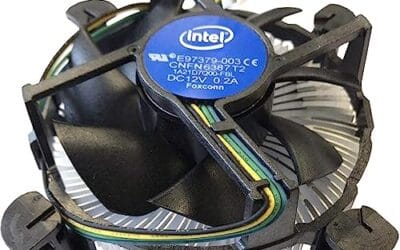
The table frames the tiers clearly. Corsair asks a premium for liquid cooling and its software ecosystem, while Thermalright delivers most of the cooling performance for a lot less with air. The two reference parts show the extremes: the Intel stock cooler at $15.99, a basic aluminum-heatsink unit for socket 1150 through 1156 chips, and Thermal Grizzly Duronaut paste at $24.99, a high-conductivity thermal interface that helps any cooler in this comparison perform closer to its potential.
Corsair strengths
Corsair’s advantage is the complete package. Its AIO liquid coolers move a lot of heat, which suits high-TDP processors that run hot under sustained load, and the radiator-and-pump design keeps the area around the CPU socket clear. The iCUE software unifies lighting and fan curves across compatible parts, so a full Corsair build behaves as one coordinated system. For anyone building a striking machine behind glass, that cohesion and the RGB matter.
The cost is the obvious downside. Corsair coolers command premium prices, and liquid cooling adds a pump as a potential point of failure that air coolers don’t have. You’re paying for aesthetics and software as much as raw thermal capacity, and not everyone values those. For a builder who wants maximum cooling headroom for an overclocked, high-heat chip and cares about how the build looks, though, Corsair’s liquid lineup delivers exactly that experience.
Thermalright strengths
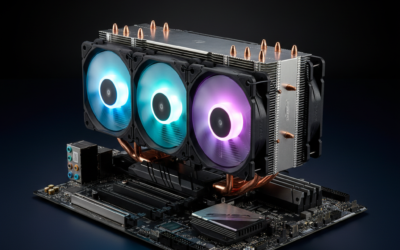
Thermalright’s whole appeal is performance you can’t believe at the price. Its dual-tower air coolers rival coolers costing two or three times more, handling mainstream and even many high-end CPUs without breaking a sweat. Air cooling brings its own perks: no pump to fail, near-silent operation with good fans, and a simpler install with fewer things to go wrong. For value-focused builders, Thermalright has become the default recommendation for a reason.
The tradeoffs are modest but real. You typically skip RGB and software integration, and a big air tower can crowd tall RAM or block a top radiator mount. There’s also a ceiling where the most extreme high-heat overclocks favor a large liquid cooler. Regardless of which cooler you choose, the thermal paste between chip and cooler matters, and a high-conductivity option like Thermal Grizzly Duronaut, at $24.99 with a 4.4-star rating and included cleaning wipes, helps any cooler hit its full potential.

Pros
- Non-conductive chemistry safer for novices repasting near exposed CPU or GPU capacitors.
- 6g volume suports several full applications on desktop CPUs and console APUs.
- Wet and dry wipes included, so no isopropyl bottle or lint-free cloth need.
Cons
- Limited owner fedback at time of writing makes long-term durability claims hard to verify.
- Non-metal formula typically trails top liquid metals by a few degrees under sustained load.
- Viscosity, TIM lifespan hours, and thermal conductivity W/mK figures are not specified.
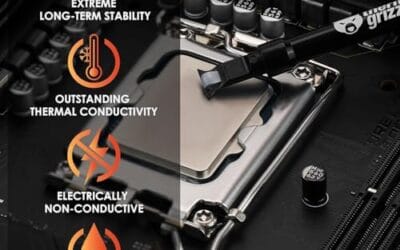
Duronaut is Thermal Grizzly's non-conductive thermal paste positioned as a mid-tier daily driver, shipping in a 6g syringe with 6 wet and 6 dry cleaning wipes. The target buyer is a DIY PC builder repasting a CPU or GPU cooler, or a console owner refreshing PS4, PS5, or Xbox thermals without risking shorts.
The defining trait is the aluminum microparticle plus zinc oxide nanoparticle blend paired with an electrically non-conductive base. Thermal Grizzly claims reduced pump-out and stable performance over extended cycles, which maters most on soldered console APUs and overclocked desktop chips that see large delta-T swings. Exact W/mK conductivity is not specified in the source.
Trade-offs are typical for non-conductive pastes at this tier. Expect a few degrees warmer than liquid metal on delided or high-wattage CPUs, and no published viscosity or cure-time data to plan application around. Owner feedback is limited at time of writing, so long-term hardening resistance relies on vendor claims rather than independent long-run testing.
Buy this if you want a safe, non-conductive paste with enough volume for several repastes and a bundled wipe kit for console or GPU jobs. Skip this if you are chasing the absolute lowest core temperatures on a 250W-plus overclocked CPU where liquid metal or a top nano-diamond paste still leads.
Volume and coverage: The syringe holds 6g of paste, enough for roughly 15 to 25 pea-sized applications on mainstream AM5 or LGA1700 IHS surfaces, or several full console APU repastes on PS4, PS5, and Xbox where die coverage is larger than a desktop CPU heatspreader.
Composition and safety: The compound uses aluminum microparticles and zinc oxide nanoparticles in a non-metal carier, rated electrically non-conductive. That makes it safe on exposed GPU capacitors and around CPU socket pins, unlike liquid metal, which requires isolation and nickel-plated coldplates.
Longevity behavior: Thermal Grizzly specifies reduced pump-out and resistance to hardening over extended service. Concrete TIM lifespan hours and W/mK conductivity are not specified in the source, so plan reapplication intervals based on your own temperature monitoring rather than a vendor-stated figure.
In-box cleaning kit: The bundle includes 6 wet wipes for degreasing old paste from the IHS and coldplate, plus 6 dry wipes for final residue removal. Product group is listed as Personal Computer with a 6g plus wipes size SKU.
Real-world scenarios
Building a quiet everyday PC
For a mainstream office or gaming machine, a Thermalright air cooler is the smart call. It runs quiet, costs little, and cools a typical CPU with room to spare, no pump noise involved. A Corsair AIO would work too, but you’d pay a premium for cooling capacity this kind of build never uses. Save the money for a better GPU or more storage.
A high-heat overclocking rig
Push a hot, overclocked flagship chip hard and Corsair’s liquid cooling earns its price. A large radiator dissipates sustained heat better than most air towers at the extreme end, keeping clocks stable during long, punishing loads. This is the scenario where the premium makes sense, since the extra thermal headroom directly protects your performance under the heaviest conditions.
A showpiece build behind glass
If aesthetics drive the build, Corsair’s RGB and iCUE integration give you a coordinated, glowing centerpiece that air coolers rarely match. A clean AIO with lit fans looks the part behind tempered glass. Thermalright focuses its budget on performance, not lighting, so builders who want the visual polish will lean Corsair here despite the higher spend.
Reviving an older or office PC
For a basic older machine on an Intel socket 1150 through 1156, the humble stock-style cooler still does the job. The Intel E97379-003 cooler at $15.99 with its aluminum heatsink and 3.5-inch fan handles a low-power office CPU fine. It won’t cool a modern flagship, but for reviving a simple build or replacing a lost cooler, it’s cheap and functional.
Pricing and availability
Corsair coolers occupy the premium shelf, with AIO liquid units commonly running from around $100 to well past $180 depending on radiator size and lighting. Thermalright sits far below, with acclaimed air coolers frequently in the $35 to $70 range, which is the entire basis of its reputation. Both brands are widely stocked at major retailers, and Thermalright’s value models sell out during sales precisely because the price-to-performance is so strong.
The reference parts here are budget-friendly staples. The Intel stock cooler at $15.99 with a 4.1-star rating is a functional basic option for compatible older sockets, and Thermal Grizzly Duronaut paste at $24.99 with a 4.4-star rating is an accessory that pairs with either brand. Whatever cooler you pick, factor in quality thermal paste, since it’s a small cost that measurably affects how well any cooler performs.
Which to buy
For most builders, Thermalright is the value winner. Its air coolers deliver the large majority of the cooling performance that matters at a fraction of Corsair’s price, with no pump to fail and quiet operation. Unless you’re chasing extreme overclocks or building a showpiece, a well-reviewed Thermalright tower cools your CPU beautifully and leaves more budget for the parts that drive frame rates.
Choose Corsair when the premium buys something you actually want: maximum liquid-cooling headroom for a hot, overclocked chip, or the RGB and iCUE integration for a coordinated glass-panel build. Both are quality brands; the decision is about priorities. And no matter which cooler you land on, don’t skimp on the interface material. A high-conductivity paste like Thermal Grizzly Duronaut ensures your cooler, Corsair or Thermalright, performs as well as it possibly can. Reviving a basic older system instead? A simple stock-style cooler like the Intel E97379-003 covers low-power chips on compatible sockets for pocket change.

Pros
- Native LGA 1150, 1155, and 1156 socket support covers three legacy Intel generations
- 4-pin PWM connector enables proper fan curve control via BIOS
- OEM-style aluminum heatsink footprint keps RAM and VRM clearance predictable
- Push-pin mount installs without removing the motherboard from the case
Cons
- Zero owner fedback available at time of writing, real-world thermals unverified
- Aluminum-only heatsink with no heatpipes struggles with overclocked or unlocked K-series CPUs
- Restricted to obsolete Intel sockets, no path forward to LGA 1200, 1700, or AM5
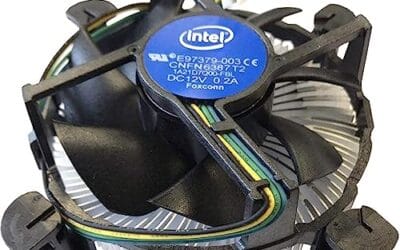
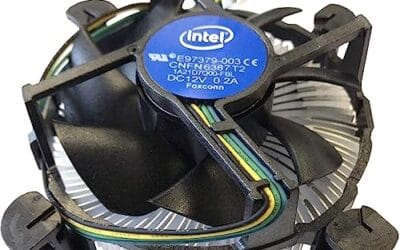
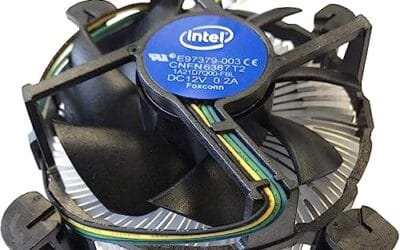
The Intel E97379-003 is an OEM-style stock CPU cooler built for LGA 1150, 1155, and 1156 boards, covering Core i3, i5, and i7 chips from the Sandy Bridge through Haswell era. It targets one specific buyer: someone repairing, refurbishing, or restoring a legacy Intel desktop that lost its original heatsink.
The defining feature is compatibility, not performance. A 3.5-inch fan sits on an aluminum heatsink with a 4-pin PWM header, matching the original OEM cooler dimensions Intel shipped in retail boxes. Stock coolers in this class typically handle 65W to 84W TDP chips at stock clocks, which lines up with locked i3, i5, and non-K i7 SKUs on these sockets.
Trade-offs are typical for a boxed-style cooler. There are no heatpipes, no copper base contact, and no tower geometry, so sustained multi-core loads will spin the fan up and get audible. Push-pin mounting is convenient but less secure than a backplate design, and overclocking headroom is effectively zero. Owner feedback is not available at time of writing.
Buy this if you need a like-for-like OEM replacement for a locked LGA 1150, 1155, or 1156 CPU and want to kep the original acoustic and clearance profile. Skip this if the CPU is a K-series part, if you plan to overclock, or if the target socket is LGA 1200 or newer.
Socket coverage: Native mounting for LGA 150, 1155, and 1156 only. That spans 2nd, 3rd, and 4th generation Core i3, i5, and i7 desktop chips. No adapter is included for LGA 1200, 1700, or AM4/AM5, so this cooler is locked to legacy Intel repair scenarios.
Heatsink and fan: Aluminum radial-fin heatsink with a 3.5-inch axial fan on a 4-pin PWM connector. No heatpipes, no copper slug, no vapor chamber are indicated in source data. TDP handling is not specified, but OEM colers of this geometry are typically rated for the 65W to 84W stock TDP band on these sockets.
Mounting and clearance: Push-pin retention through the four motherboard holes, no backplate required, install possible without removing the board. Cooler height sits low enough to clear standard mid-tower side panels, and the round footprint keps RAM slots and VRM heatsinks unobstructed. Exact height in mm is not specified.
Acoustics and headroom: Noise level in dBA is not specified. Based on OEM stock cooler behavior at this size, expect quiet idle and audible ramp under sustained all-core load. Overclocking a K-series chip on this heatsink is not advisable, thermal headroom above 84W is minimal.
Common questions
Is Thermalright air cooling as good as Corsair liquid cooling?
For most CPUs, yes. Thermalright’s dual-tower air coolers match or approach the performance of pricier liquid coolers on mainstream and many high-end chips. Corsair’s liquid coolers pull ahead mainly on extreme, sustained high-heat loads like heavy overclocking. For a typical gaming or productivity build, a good Thermalright air cooler cools just as effectively while costing far less and eliminating the pump.
Do I need liquid cooling for a gaming PC?
Not usually. A quality air cooler from a brand like Thermalright handles most gaming CPUs comfortably, staying quiet and cool under load. Liquid cooling becomes worthwhile for very hot, overclocked flagship chips or when you want the aesthetics of an AIO in a glass-panel build. For the majority of gamers, air cooling is cheaper, reliable, and completely sufficient for the job.
Does thermal paste quality actually matter?
It matters more than many people expect. A high-conductivity paste like Thermal Grizzly Duronaut improves heat transfer between the chip and cooler, which can shave a few degrees off your temperatures. That’s a small, inexpensive upgrade that helps any cooler perform closer to its potential. It won’t turn a weak cooler into a great one, but it’s cheap insurance for a build you care about.
Will a big air cooler fit in my case?
Check clearances first. Large dual-tower air coolers from Thermalright are tall and can conflict with tall RAM heat spreaders or a case’s side panel. Every cooler lists a maximum height, and every case lists its CPU cooler clearance, so compare the two before buying. If space is tight, a liquid cooler or a lower-profile air model may fit better in a compact build.
Can I use the stock cooler that came with my CPU?
For low-power and older chips, sure. A basic cooler like the Intel E97379-003 handles modest office CPUs on compatible sockets without issue. But for modern gaming or high-performance processors, a stock cooler often can’t keep temperatures in check under load, which leads to throttling. In that case, an affordable Thermalright air tower is a worthwhile and inexpensive upgrade.










Write Your Review
No reviews yet. Be the first to share your experience!