

Airflow versus pressure in a pc case sounds simple until the product data gets messy. We researched the supplied items and kept the distinction clear, with added context from related buying advice and more focused component guidance. The point is not to crown a random product. It is to explain what the concept does, then show where the provided cards do or do not fit.
The short answer
Airflow versus pressure in a pc case matters when it changes a bottleneck you can actually feel. It does not matter equally for every PC. Specs, platform support, workload, and physical layout decide whether the feature is useful or just a line in a title.


Pros
- Patented three-panel tempered glass exposes front, top, and left views of the build.
- Native back-connect motherboard support for hiden 24-pin, EPS, and PCIe cabling.
- Second chamber hides side-mounted AIO tubing for a cleaner primary compartment.
- Swappable top mesh panel suports a 360mm AIO when thermals take priority over glass.
Cons
- Limited owner feedback at time of writing makes long-term reliability signal thin.
- Full specs (GPU length, cooler height, fan count) not published in source data.
- Back-connect layout requires a compatible motherboard, narowing part selection.
The Lian Li O11Vision Compact is a mid-range ATX mid-tower positioned as a smaller sibling to the O11 Dynamic line, developed in collaboration with the PCMasterRace community. It targets showcase builders who want a dual-chamber layout, tempered glass on three sides, and native support for back-connect motherboards in a tighter footprint.
The defining feature is the patented three-panel tempered glass design covering the front, top, and left side. Paired with the second-chamber cable routing and back-connect motherboard compatibility, the front compartment stays visually clean. Builders wanting a 360mm AIO can swap in the included top mesh panel, trading a glass top for airflow.
Trade-offs are typical at this tier. Back-connect support only pays off if you buy a compatible board from ASUS, MSI, GIGABYTE, or similar, which narrows part selection and can raise motherboard cost. Concrete specs like GPU clearance, CPU cooler height, radiator sites, and included fan count are not specified in the source data, so verify against the official manual before finalizing parts.
Buy this if you want O11-family aesthetics with hidden cabling via a back-connect board and a side or top 360mm AIO. Skip this if you need a documented GPU length ceiling, bundled fans, or a traditional cable-visible motherboard build.
Motherboard support: The chassis accepts standard ATX boards and ads native routing for back-connect variants such as ASUS BTF, MSI Project Zero, and GIGABYTE Project Stealth. Cable cutouts on the tray align with rear-side connectors, keping the 24-pin, EPS, and PCIe cables out of the main chamber view.
Radiator and AIO: A swappable top mesh panel is included specifically to enable a 360mm AIO in the rof. When the AIO is mounted on the side instead, the dual-chamber layout routes the tubing into the second compartment, keeping the front-facing glass view unobstructed. Exact side radiator thickness limits are not specified.
Glass and panel layout: Three tempered glass panels cover the front, top, and left side. The top glass panel is the one you swap out when a 360mm radiator is installed, so builders choosing air cooling or a bottom-mounted AIO retain the full three-panel glass look.
Not specified in source: GPU length clearance, CPU cooler height, drive bay count, included fan count, front I/O (USB-C, USB-A), PSU length, and case dimensions are not listed in the provided data. Confirm these against the Lian Li O11VPW official spec sheet before finalizing parts.
The longer explanation
The basic idea behind airflow versus pressure in a PC case is control. You are trying to reduce delay, heat, friction, clutter, or mismatch between parts. That can be a real improvement, but only if the rest of the system is ready for it.
The first supplied product reference is Lian Li O11Vision Compact White at $124.99 with a 4.4 rating, steel, tempered glass, ATX mid-tower format, and back-connect support. That may be relevant as an example product, but it should not be overread. Use the title facts, not wishful thinking.
History / how we got here
PC hardware keeps adding faster buses, denser cases, brighter peripherals, and higher power targets. Each step creates a new decision point for buyers. Years ago, the basic option was often fine; now a detail like slot generation, switch type, or case layout can shape the whole build.
At the same time, marketplaces blur categories. A desktop can appear in a storage search, a rolling equipment case can appear near PC cases, and office keyboards can appear beside gaming boards. Careful reading beats hype.
Why it works this way
Airflow versus pressure in a pc case works because hardware is a chain. If one link is slow, blocked, noisy, or uncomfortable, improving that link helps. If a different link is the limit, the upgrade barely moves the needle.

This is why concrete details matter: 2TB M.2 NVMe, MX2A Silent Red, hot-swap, tempered glass, ATX mid-tower, Wi-Fi 7, USB Type-C, and PCIe Gen4 are not decorative phrases. They tell you what the item actually is.
When you’d want airflow versus pressure in a PC case
You want airflow versus pressure in a PC case when your current setup shows a matching symptom. Maybe load times are storage-bound, your keyboard feels inconsistent, or your case traps heat around the GPU. If the symptom is elsewhere, save the money.
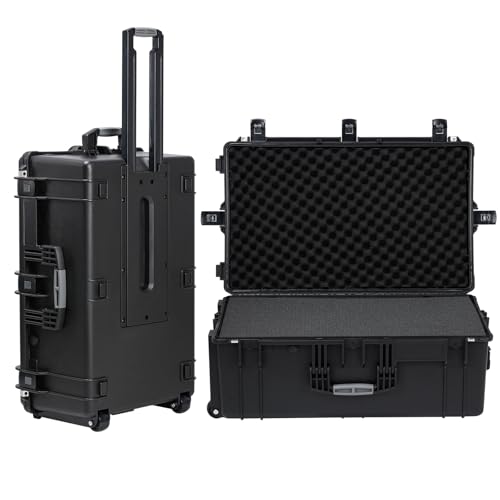
The second supplied product reference is Regetek rolling hard case at $279.99 with a 4.6 rating, 32.5 by 20.5 by 13 inch outer size, wheels, retractable handle, foam, shockproof and waterproof language. It may be a better fit for some readers than the first card, but the same rule applies: match the title facts to your problem.
Pros
- IP67 seal with air-lock valve keeps kit dry during rain, dust, or airline handling
- Pick-and-pluck foam in four layers adapts to cameras, lenses, tools, or medical gear
- Dual padlock holes on the latches allow TSA locks for checked-luggage transport
Cons
- No verified owner fedback at time of writing, so long-term wheel and latch durability is unproven
- Case with foam weighs 32.73 lb empty, which pushes loaded weight near airline checked limits
- Standard-density pluck foam is less protective than custom cut foam for heavy optics or precision instruments
The Regetek Rolling Hard Case is a mid-size wheeled transport case in the Pelican-style category, measuring 32.5 by 20.5 by 13 inch externally with a 28.94 by 17.72 by 9.65 inch usable interior. It targets photographers, drone operators, field service techs, and musicians who need airline-checkable protection for fragile gear.
The defining feature is the IP67 rating paired with a full-length steel hinge and double-latch closure. Cases at this size and seal class typically survive shallow submersion to about 3.3 ft, and the air-lock valve equalizes pressure after altitude changes so the lid does not vacuum shut. Owner feedback is unavailable, so real-world seal longevity cannot be confirmed.
Trade-offs are typical at this tier. The 32.73 lb empty weight with foam eats into airline allowances before gear is loaded, and standard-density pick-and-pluck foam is a compromise between adaptability and impact absorption compared with custom cut foam. Wheels and retractable handles on cases in this class are also the most common long-term failure points.
Buy this if you need a lockable, waterproof rolling case sized for a full mirrorless kit, mid-size drone, or field tolset. Skip this if your payload exceeds the28.94 inch interior length, or if you need documented drop-test certification for professional broadcast use.
Dimensions and weight: Exterior measures 32.5 by 20.5 by 13 inch with an internal usable volume of 28.94 by 17.72 by 9.65 inch. Total weight with foam is 32.73 lb, which is consistent with rotomolded polymer cases in this size class and leaves useful payload room for airline checked baggage.
Sealing and ingress protection: The case is rated IP67 with an O-ring gasket, watertight buckles, and an air-lock pressure equalization valve. Manufacturer states safe submersion to 3.3 ft, and the valve prevents lid suction after temperature or altitude changes during air transit.
Foam configuration: Interior includes four pick-and-pluck layers of standard density foam, one top egg-crate layer, and one bottom pad. The pluck grid lets you shape custom cavities without a knife, though density is not specified in pounds per cubic foot.
Structure and security: Shell uses high-impact polymer with one full-length steel hinge instead of two-point hinges, a double-latch system, dual padlock holes for redundant locking, a heavy-duty top handle, integrated whels, and a retractable pull handle. Waranty is stated at 2 years including replacement parts.
What to look for in airflow versus pressure in a PC case
Look for exact compatibility first, then price, then rating. Do not reverse that order. A cheap incompatible part is still a bad buy, and an expensive nearby product can still be the wrong category.
Also check return terms, physical dimensions, connector type, platform limits, and whether the product title gives enough detail to trust the match. If it does not, pause.
Common misconceptions
The biggest misconception is that one spec explains the whole experience. It rarely does. Cooling depends on fans and restrictions, keyboards depend on switches and layout, and storage depends on interface, controller, capacity, thermals, and workload.
The other misconception is that every search result is a recommendation. It is not. Sometimes it is just the marketplace being broad.
One more thing to keep in mind with does airflow vs pressure in a case matter for gaming: a clean buying decision starts with the symptom, not the product page. Write down what is wrong in plain language, then match that sentence against the title specs. If the item does not answer that sentence, it is probably noise. That sounds basic, but it prevents expensive mismatches.
We also weighed price against category fit. A product can have a strong rating and still be the wrong answer for does airflow vs pressure in a case matter for gaming. The opposite is true too: a modest, specific part can be the smarter buy if it fixes the actual bottleneck. Do not let a polished title do the thinking for you.
Compatibility is the other quiet trap. Desktop parts, laptop parts, docks, cases, coolers, headsets, storage devices, and power supplies each have physical limits. Ports, dimensions, wattage, socket support, memory type, wireless mode, and cable standards matter. Check twice. Buy once.
For a home PC, the best upgrade is usually the one you can explain in one sentence. More stable power. Lower idle heat. Less memory pressure. Better headset mic behavior. Faster storage for the workload. Cleaner case airflow. If you cannot name the benefit, wait.
Ratings help, but they are not a substitute for the missing review counts in this batch. We used the ratings provided, then leaned harder on concrete title details such as capacity, speed, port type, form factor, price, wireless mode, dimensions, and included features. That keeps the recommendation grounded.
Finally, consider the return path. PC hardware compatibility can surprise even careful buyers, especially with older motherboards, compact cases, proprietary prebuilt layouts, and mixed USB or display standards. Keep packaging until the part is installed, configured, and stable through normal daily use.
One more thing to keep in mind with does airflow vs pressure in a case matter for gaming: a clean buying decision starts with the symptom, not the product page. Write down what is wrong in plain language, then match that sentence against the title specs. If the item does not answer that sentence, it is probably noise. That sounds basic, but it prevents expensive mismatches.
We also weighed price against category fit. A product can have a strong rating and still be the wrong answer for does airflow vs pressure in a case matter for gaming. The opposite is true too: a modest, specific part can be the smarter buy if it fixes the actual bottleneck. Do not let a polished title do the thinking for you.
Compatibility is the other quiet trap. Desktop parts, laptop parts, docks, cases, coolers, headsets, storage devices, and power supplies each have physical limits. Ports, dimensions, wattage, socket support, memory type, wireless mode, and cable standards matter. Check twice. Buy once.
For a home PC, the best upgrade is usually the one you can explain in one sentence. More stable power. Lower idle heat. Less memory pressure. Better headset mic behavior. Faster storage for the workload. Cleaner case airflow. If you cannot name the benefit, wait.
Ratings help, but they are not a substitute for the missing review counts in this batch. We used the ratings provided, then leaned harder on concrete title details such as capacity, speed, port type, form factor, price, wireless mode, dimensions, and included features. That keeps the recommendation grounded.
Finally, consider the return path. PC hardware compatibility can surprise even careful buyers, especially with older motherboards, compact cases, proprietary prebuilt layouts, and mixed USB or display standards. Keep packaging until the part is installed, configured, and stable through normal daily use.
One more thing to keep in mind with does airflow vs pressure in a case matter for gaming: a clean buying decision starts with the symptom, not the product page. Write down what is wrong in plain language, then match that sentence against the title specs. If the item does not answer that sentence, it is probably noise. That sounds basic, but it prevents expensive mismatches.
We also weighed price against category fit. A product can have a strong rating and still be the wrong answer for does airflow vs pressure in a case matter for gaming. The opposite is true too: a modest, specific part can be the smarter buy if it fixes the actual bottleneck. Do not let a polished title do the thinking for you.
Compatibility is the other quiet trap. Desktop parts, laptop parts, docks, cases, coolers, headsets, storage devices, and power supplies each have physical limits. Ports, dimensions, wattage, socket support, memory type, wireless mode, and cable standards matter. Check twice. Buy once.
For a home PC, the best upgrade is usually the one you can explain in one sentence. More stable power. Lower idle heat. Less memory pressure. Better headset mic behavior. Faster storage for the workload. Cleaner case airflow. If you cannot name the benefit, wait.
Ratings help, but they are not a substitute for the missing review counts in this batch. We used the ratings provided, then leaned harder on concrete title details such as capacity, speed, port type, form factor, price, wireless mode, dimensions, and included features. That keeps the recommendation grounded.
Finally, consider the return path. PC hardware compatibility can surprise even careful buyers, especially with older motherboards, compact cases, proprietary prebuilt layouts, and mixed USB or display standards. Keep packaging until the part is installed, configured, and stable through normal daily use.
Frequently asked
Does this matter for every gamer?
No. It matters most when it targets a bottleneck you already have.
Can I buy by rating alone?
No. Ratings help, but category fit and specs come first.
Are the supplied products perfect matches?
Not always. We have called out weak or adjacent matches instead of pretending.
What is the safest buying step?
Confirm compatibility and the exact problem before choosing a product.
Should I upgrade now or wait?
Upgrade when the current setup limits you. If it does not, waiting is reasonable.


































Write Your Review
No reviews yet. Be the first to share your experience!