

What is radiator support in a PC case? It is the mounting area, bracket pattern, and clearance zone that lets you bolt a liquid-cooling radiator to the chassis without blocking the motherboard, memory, graphics card, fans, or power cables. The name sounds like an automotive part, but in PC building it usually means the top, front, side, bottom, or rear section of a case that can hold a 120 mm, 240 mm, 280 mm, 360 mm, or larger radiator.
If you’re choosing a case for an AIO cooler or a custom loop, radiator support matters as much as airflow. A case can look roomy and still fight you with a thick radiator, tall RAM, or a long GPU. That’s why guides like best mid tower case 2026, best PC case for airflow 2026, and best budget PC case for airflow focus on fan layout and clearance, not just glass panels and lighting.
The short answer
Radiator support is the case’s official allowance for installing a radiator in a specific position and size. If a case lists top 360 mm support, it should have screw slots and internal space for a 360 mm radiator, usually with three 120 mm fans. If it lists front 280 mm support, it should fit a radiator designed for two 140 mm fans. Simple idea. Lots of gotchas.
The key detail is that support does not always mean every radiator will fit. A slim 27 mm radiator with standard 25 mm fans needs about 52 mm of stack depth before you count screw heads, cable bulge, or motherboard heatsinks. A thicker 38 mm radiator with fans needs roughly 63 mm. That’s where builders get surprised, especially at the top of compact mid towers.

Pros
- Patented three-panel tempered glass exposes front, top, and left views of the build.
- Native back-connect motherboard support for hiden 24-pin, EPS, and PCIe cabling.
- Second chamber hides side-mounted AIO tubing for a cleaner primary compartment.
- Swappable top mesh panel suports a 360mm AIO when thermals take priority over glass.
Cons
- Limited owner feedback at time of writing makes long-term reliability signal thin.
- Full specs (GPU length, cooler height, fan count) not published in source data.
- Back-connect layout requires a compatible motherboard, narowing part selection.
The Lian Li O11Vision Compact is a mid-range ATX mid-tower positioned as a smaller sibling to the O11 Dynamic line, developed in collaboration with the PCMasterRace community. It targets showcase builders who want a dual-chamber layout, tempered glass on three sides, and native support for back-connect motherboards in a tighter footprint.
The defining feature is the patented three-panel tempered glass design covering the front, top, and left side. Paired with the second-chamber cable routing and back-connect motherboard compatibility, the front compartment stays visually clean. Builders wanting a 360mm AIO can swap in the included top mesh panel, trading a glass top for airflow.
Trade-offs are typical at this tier. Back-connect support only pays off if you buy a compatible board from ASUS, MSI, GIGABYTE, or similar, which narrows part selection and can raise motherboard cost. Concrete specs like GPU clearance, CPU cooler height, radiator sites, and included fan count are not specified in the source data, so verify against the official manual before finalizing parts.
Buy this if you want O11-family aesthetics with hidden cabling via a back-connect board and a side or top 360mm AIO. Skip this if you need a documented GPU length ceiling, bundled fans, or a traditional cable-visible motherboard build.
Motherboard support: The chassis accepts standard ATX boards and ads native routing for back-connect variants such as ASUS BTF, MSI Project Zero, and GIGABYTE Project Stealth. Cable cutouts on the tray align with rear-side connectors, keping the 24-pin, EPS, and PCIe cables out of the main chamber view.
Radiator and AIO: A swappable top mesh panel is included specifically to enable a 360mm AIO in the rof. When the AIO is mounted on the side instead, the dual-chamber layout routes the tubing into the second compartment, keeping the front-facing glass view unobstructed. Exact side radiator thickness limits are not specified.
Glass and panel layout: Three tempered glass panels cover the front, top, and left side. The top glass panel is the one you swap out when a 360mm radiator is installed, so builders choosing air cooling or a bottom-mounted AIO retain the full three-panel glass look.
Not specified in source: GPU length clearance, CPU cooler height, drive bay count, included fan count, front I/O (USB-C, USB-A), PSU length, and case dimensions are not listed in the provided data. Confirm these against the Lian Li O11VPW official spec sheet before finalizing parts.
The longer explanation
A PC radiator is a heat exchanger. In an AIO liquid cooler, heat moves from the CPU block into coolant, then through tubes to the radiator, where fans push or pull air through the fins. The radiator support area is the part of the case that holds that assembly in the right place. It needs screw holes spaced for 120 mm or 140 mm fans, enough length for the radiator body, enough thickness clearance, and a path for airflow.
Case makers usually describe support by fan size and location: top 240 mm, front 360 mm, side 280 mm, rear 120 mm, and so on. A 240 mm radiator normally pairs with two 120 mm fans. A 280 mm radiator pairs with two 140 mm fans. A 360 mm radiator pairs with three 120 mm fans. But radiator bodies are longer than the fan area because they include end tanks, fittings, and tube exits. That’s why a 360 mm radiator isn’t exactly 360 mm long. Many are closer to 394 to 405 mm.
History / how we got here
Older enthusiast cases were built around air cooling, optical drives, and hard-drive cages. A front panel might have held two 120 mm fans, but the space behind it was often blocked by 3.5 inch drive bays. Liquid cooling existed, yet it was mostly a custom-loop hobby with drilled panels, external radiators, and large full towers. Not exactly plug-and-play.
AIO coolers changed the expectation. Once 120 mm and 240 mm sealed coolers became common, cases started adding slotted mounts, removable brackets, offset top rails, and front panels with enough depth for radiators. Today, even a $80 to $130 case may list 240 mm or 360 mm support, while showcase cases often add side mounts and back-connect motherboard clearance. The Lian Li O11 Vision Compact, for example, is a $124.99 ATX mid tower with white steel, tempered glass, and back-connect support, and it’s rated 4.4. That product title tells you the case is built around modern layouts, not just a single rear exhaust fan.
Why it works this way
Radiator support is a geometry problem. The case has to line up three things at once: screw positions, physical volume, and airflow path. Screw slots can be generous, but they don’t solve a radiator that bumps into EPS power cables at the top edge of the motherboard. Extra front depth helps, but it can shorten GPU clearance. Side-mounted radiators look clean, but tubing length and bend radius still matter.
Fan size also changes the decision. A 280 mm radiator can cool very well because two 140 mm fans move air efficiently at lower RPM, but it needs wider mounting rails than a 240 mm unit. A 360 mm radiator uses three 120 mm fans, so it’s longer, more common in case spec sheets, and often easier to match with top or front mounts. Bigger isn’t always cleaner. Not in every chassis.
When you’d want this
You want strong radiator support if you’re cooling a high-power CPU, planning a quiet build, or using a compact case where heat has fewer escape routes. A 240 mm radiator is often enough for mainstream Ryzen 5, Ryzen 7, Core i5, and many Core i7 builds. A 280 mm or 360 mm radiator makes more sense when you’re trying to keep fan speeds lower during long renders, heavy game sessions, or sustained all-core workloads.
You also want to check radiator support if the PC will travel. A heavy radiator and fan stack adds weight to the panel it’s mounted on, and the case has to protect that assembly from bumps. If you’re moving expensive camera gear, tools, or a compact PC setup separately, the Regetek Rolling Hard Case is a $279.99 option rated 4.6 with a 32.5 x 20.5 x 13 inch outer size, foam, wheels, a retractable handle, shockproof construction, waterproofing, and a 28.94 x 17.72 x 9.65 inch inner space. It’s not a PC chassis, but it’s relevant to transport protection when hardware needs to arrive intact.
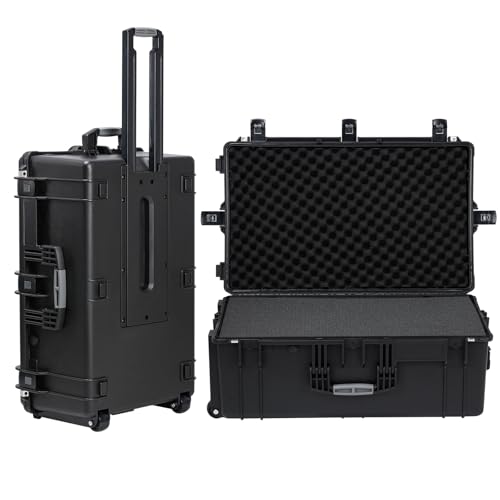
Pros
- IP67 seal with air-lock valve keeps kit dry during rain, dust, or airline handling
- Pick-and-pluck foam in four layers adapts to cameras, lenses, tools, or medical gear
- Dual padlock holes on the latches allow TSA locks for checked-luggage transport
Cons
- No verified owner fedback at time of writing, so long-term wheel and latch durability is unproven
- Case with foam weighs 32.73 lb empty, which pushes loaded weight near airline checked limits
- Standard-density pluck foam is less protective than custom cut foam for heavy optics or precision instruments
The Regetek Rolling Hard Case is a mid-size wheeled transport case in the Pelican-style category, measuring 32.5 by 20.5 by 13 inch externally with a 28.94 by 17.72 by 9.65 inch usable interior. It targets photographers, drone operators, field service techs, and musicians who need airline-checkable protection for fragile gear.
The defining feature is the IP67 rating paired with a full-length steel hinge and double-latch closure. Cases at this size and seal class typically survive shallow submersion to about 3.3 ft, and the air-lock valve equalizes pressure after altitude changes so the lid does not vacuum shut. Owner feedback is unavailable, so real-world seal longevity cannot be confirmed.
Trade-offs are typical at this tier. The 32.73 lb empty weight with foam eats into airline allowances before gear is loaded, and standard-density pick-and-pluck foam is a compromise between adaptability and impact absorption compared with custom cut foam. Wheels and retractable handles on cases in this class are also the most common long-term failure points.
Buy this if you need a lockable, waterproof rolling case sized for a full mirrorless kit, mid-size drone, or field tolset. Skip this if your payload exceeds the28.94 inch interior length, or if you need documented drop-test certification for professional broadcast use.
Dimensions and weight: Exterior measures 32.5 by 20.5 by 13 inch with an internal usable volume of 28.94 by 17.72 by 9.65 inch. Total weight with foam is 32.73 lb, which is consistent with rotomolded polymer cases in this size class and leaves useful payload room for airline checked baggage.
Sealing and ingress protection: The case is rated IP67 with an O-ring gasket, watertight buckles, and an air-lock pressure equalization valve. Manufacturer states safe submersion to 3.3 ft, and the valve prevents lid suction after temperature or altitude changes during air transit.
Foam configuration: Interior includes four pick-and-pluck layers of standard density foam, one top egg-crate layer, and one bottom pad. The pluck grid lets you shape custom cavities without a knife, though density is not specified in pounds per cubic foot.
Structure and security: Shell uses high-impact polymer with one full-length steel hinge instead of two-point hinges, a double-latch system, dual padlock holes for redundant locking, a heavy-duty top handle, integrated whels, and a retractable pull handle. Waranty is stated at 2 years including replacement parts.
What to look for in radiator support
Start with the radiator location. Top mounting is usually tidy because tubes stay away from the GPU and front intake can feed the case with fresh air. The downside is motherboard clearance. If your board has tall VRM heatsinks or your RAM has high heat spreaders, a top radiator can collide with them. Front mounting often gives more depth, but it can warm intake air before it reaches the GPU. Side mounting can look fantastic in dual-chamber cases, but you’ll need to check tube routing carefully.
Next, check radiator thickness, fan thickness, and case clearance as one stack. Don’t assume a case that supports 360 mm at the top supports every 360 mm radiator. Look for notes such as 55 mm top clearance, 65 mm side clearance, or removable fan brackets. If a spec sheet lists GPU clearance with front fans only, subtract another 25 to 40 mm when you add a front radiator. For a long graphics card, that subtraction can be the difference between easy and impossible.
Finally, consider airflow direction. A radiator can be intake or exhaust, but the whole case still needs balance. Front intake plus top exhaust is common. Side intake plus rear and top exhaust works well in many showcase cases. Bottom intake helps GPUs in some layouts. What you don’t want is a sealed glass front with fans trying to pull air through tiny side gaps. Quiet builds need open paths, not just more fan slots.
Common misconceptions
The first misconception is that radiator support equals cooling performance. It doesn’t. A case may support a 360 mm radiator but still perform poorly if the front panel is restrictive or the fans are starved for air. The second misconception is that top mounting is always best. It’s often neat and safe for pump placement, but a thick top radiator can be worse than a front mount if it blocks the motherboard area or forces cramped cable routing.
Another misconception is that AIO tubes can bend any way you need. They can’t. Tube length, stiffness, fitting angle, and pump-block orientation all limit clean routing. Also, radiator size names are shorthand, not exact measurements. A 240 mm radiator needs more than 240 mm of internal length. Check the manufacturer’s drawing if the build is tight. Measure twice. Then measure again.
Frequently asked
Is radiator support only for liquid cooling?
Mostly, yes. In PC case specs, radiator support refers to mounting liquid-cooling radiators for AIO coolers or custom loops. The same screw slots may also hold normal case fans, but the term matters because a radiator is thicker, longer, and harder to route than a fan by itself.
Can I install a smaller radiator in a larger supported mount?
Usually, yes. A case that supports a 360 mm radiator at the front will often support 240 mm and 120 mm radiators in the same area. Still, check the slot pattern and tube exit room. Some brackets are flexible, while others are shaped around specific fan positions.
Is a 280 mm radiator better than a 360 mm radiator?
Not automatically. A 280 mm radiator has two 140 mm fans, which can be quiet and efficient. A 360 mm radiator has more fan positions and more length, so it may handle higher heat loads better. Fan quality, radiator thickness, fin density, and case airflow all affect the result.
Should the radiator be intake or exhaust?
Either can work. Intake can feed the radiator cooler outside air, which helps CPU temperatures, but it may send warmer air into the case. Exhaust can keep GPU intake air cooler, but CPU temperatures may rise a little. For most gaming PCs, a balanced front or side intake with top or rear exhaust is a safe starting point.
What happens if my case says it supports 360 mm but my cooler doesn’t fit?
That usually means another clearance limit is in play. The radiator may be too thick, the tubes may hit the frame, the GPU may be too long, or the motherboard heatsinks may block a top mount. Case support is a starting point, not a full compatibility guarantee. Before buying, compare the case clearance chart with the radiator’s exact length, width, and thickness.




















Write Your Review
No reviews yet. Be the first to share your experience!