

You put your headphones on, hit play, and only one ear delivers sound. The other side sits dead quiet, or it fades in and out when you wiggle the cable. It’s one of the most common audio problems out there, and it’s frustrating because the fix ranges from a two-second setting toggle to a soldering iron. The good news? Most cases trace back to a short list of causes, and you can rule them out in order without spending a dime up front. A dead ear rarely means a dead headset, so resist the urge to toss the pair before you’ve worked the checklist.
This guide walks through why one side cuts out, from the obvious stuff to the harder failures, and what to do at each step. We researched the common failure points reported by owners across wired and wireless models, and we’ll flag when a repair is worth your time versus when a replacement makes more sense. If you already suspect your pair is done, our roundup of the best gaming headset options is a decent next stop, and audiophiles chasing a soundstage upgrade can browse the best open-back headphones for gaming 2026 picks. For now, let’s diagnose. Start at the top and work down, because skipping ahead to the hard fixes is how people replace a headset that only needed a slider nudged.
First check the obvious (the 30-second check)
Before you blame the hardware, rule out software. On Windows, open Sound settings, click your headphones, and check the balance sliders for left and right. It’s shockingly easy to knock one channel to zero, and a stray slider explains a surprising number of “dead ear” complaints. On a phone, dig into Accessibility settings, where an audio balance option can sit shifted fully to one side after an update. Some apps carry their own balance control too, so a channel that works in one program but not another points straight at a software setting, not the headphones.
Next, swap the source. Plug the headphones into a different phone, laptop, or console. If both sides work on device B, your problem is the first device’s jack, driver, or Bluetooth stack, not the headphones. Then flip the plug or try the other USB port. Thirty seconds of swapping saves you from tearing apart a perfectly good pair. Quick and boring, but it works. While you’re at it, restart the original device once, because a hung audio service can silence a channel until the driver reloads.
Cause #1: A damaged cable or frayed wire near the plug
For wired headphones, the number-one killer is a broken conductor inside the cable, almost always right where the wire meets the 3.5mm plug or where it enters the earcup. These are the flex points that take the most stress every time you coil the cord or yank the plug by the cable instead of the connector. Over months the copper strands fatigue and snap, and since the left and right channels run as separate conductors, one side dies while the other keeps playing. Inline mic-and-remote modules are another weak point, since the cable gets soldered to a tiny board there and the joint cracks with repeated bending.
You can confirm this without tools. Play audio, then gently bend and rotate the cable near the plug while listening to the dead side. If sound crackles back in at a certain angle, you’ve found a break. A detachable cable is the easy win here, because you just buy a replacement cord and you’re done. Fixed cables need the plug re-terminated or the wire spliced, which means a soldering iron and heat shrink. If you don’t solder and the cable is captive, this is often the point where a new headset beats the repair. A multimeter set to continuity confirms it in seconds: touch the probes to the plug tip and the matching driver terminal, then flex the cable and watch the reading drop out.
Cause #2: A dirty or worn headphone jack
The 3.5mm jack, on the headphones or the device, collects pocket lint, dust, and oxidation. A partially inserted or gunked-up plug makes contact on some rings but not others, and the ring that controls one channel loses connection. That’s why a headset can sound fine one moment and drop a side the next when you shift in your chair. The problem is mechanical, so it comes and goes with the smallest movement, which fools people into blaming the drivers.
Grab a wooden toothpick or a can of compressed air and clear the jack on your phone or laptop. Then wipe the metal plug with a little isopropyl alcohol on a cloth to strip oxidation off the contacts. Push the plug in fully; some phone cases block the last millimeter of travel, which leaves a ring floating. If cleaning restores both channels, great. If the jack itself is physically loose or wobbly inside the device, the internal solder joints on the port may have cracked, and that’s a board-level repair. On a laptop or desktop that’s out of warranty, a USB DAC dongle sidesteps a failing onboard jack entirely and often sounds better than the built-in audio anyway.
Cause #3: A failed driver or a Bluetooth pairing glitch
Sometimes the speaker driver, the little transducer inside the cup, simply dies from age, moisture, or a blown voice coil. When that happens, no amount of cable-wiggling helps, because the wire’s fine and the speaker isn’t. Overdriving cheap headphones at max volume for long stretches is a common way to cook a driver, and one earcup taking the brunt of that abuse fails first. If one side is totally silent regardless of source, cable angle, or balance settings, a dead driver is the likely verdict, and drivers are rarely worth replacing on consumer pairs.
Wireless pairs have their own gremlin. Bluetooth headphones can drop to mono or lose one earbud when the two sides fall out of sync, especially on true-wireless models where one bud is the primary. Reset the pairing: delete the device from your phone’s Bluetooth list, factory-reset the headset per its manual, and re-pair from scratch. Low battery in one bud, or a dirty charging contact that leaves one side undercharged, also mimics a hardware fault. A firmware update through the companion app fixes more sync bugs than people expect, so check that before you give up. If you’ve reached this point and the pair is a budget model, a fresh wireless set is often cheaper than the diagnosis. Something like the Picun G2 covers PC, PS5, and Switch with 2.4GHz and Bluetooth 5.4 for $59.99, rated 4.5 stars, and its 100-hour battery and wired fallback mode give you three ways to connect if one path acts up.

Pros
- Three connection modes on a single headset: 2.4GHz dongle, Bluetooth 5.4, and 3.5mm wired fallback.
- Vendor-rated 5ms 2.4GHz latency keps audio synced in competitive shooter scenarios.
- Long rated runtime, up to 100 hours in Bluetooth with RGB disabled for travel use.
- RetractableENC microphone tucks away, useful when switching between gaming and general listening.
Cons
- Limited owner feedback at time of writing, real-world reliability and QC signal is unverified.
- 7.1 surround is virtual DSP, not true multi-driver, so positional accuracy varies by title andear.
- RGB lighting materially cuts battery life, cited100-hour figure requires lighting turned off.
The Picun G2 is a budget-tier wireless gaming headset built around 40mm drivers, virtual 7.1 surround, and tri-mode connectivity across2.4GHz, Bluetooth 5.4, and 3.5m wired. Target buyer is a multi-platform player rotating between PC, PS5, PS4, and Switch who wants low-latency wireless without moving up to established brand pricing.
The defining feature is the tri-mode radio stack. The 2.4GHz USB-A or Type-C dongle is rated at 5ms latency, which is competitive for the tier and adequate for most FPS titles, while Bluetooth 5.4 handles phones and tablets. Headsets in this class typically deliver serviceable rather than reference-grade imaging, and virtual 7.1 leans on DSP rather than discrete drivers.
Trade-offs are typical at this tier. Battery figures are optimistic: 100 hours assumes Bluetooth with RGB off, and 2.4GHz drops the number to 42 to 45 hours. Driver material, impedance, frequency response, clamp force, and weight are not specified, so tonal balance and long-session comfort cannot be verified from source data alone.
Buy this if you want one headset that jumps between a PS5, a Switch dock, and a work laptop over Bluetooth, and you accept spec-sheet-only marketing. Skip this if you rely on measured frequency response, discrete suround, or detachable bom mics with broadcast-grade pickup for streaming.
Drivers and tuning: Picun specifies 40mm dynamic drivers paired with virtual 7.1 surround processing. Impedance, sensitivity, and frequency response are not specified, so bass extension and treble air cannot be quantified from source. Virtual 7.1 is DSP-based positional widening, useful for FPS cues but not equivalent to true multi-driver surround.
Connectivity and latency: Three modes are covered: 2.4GHz via USB-A or USB-C dongle, Bluetooth 5.4, and 3.5mm analog. The 2.4GHz link is rated at 5ms latency. Bluetooth codec support (SBC, AAC, aptX) is not specified, which maters for wireless music quality on phones and tablets.
Battery and power: Rated up to 100 hours on Bluetooth with RGB off, and 42 to 45 hours on 2.4GHz wireless. Play-while-charging is supported, so a USB cable can extend sessions past the rated ceiling. Charge time and battery capacity in mAh are not specified.
Microphone: Retractable omnidirectional bom with ENC noise reduction. Sample rate, bit depth, and pickup pattern beyond omni are not specified.ENC filtering targets background noise on the transmit side, adequate for party chat but below dedicated USB mic quality.
Preventive maintenance
Most one-side failures are avoidable. Unplug by gripping the connector, never the cord, so you stop stressing the solder joint at the plug. Coil cables loosely in wide loops instead of tight wraps around your fingers, which is what fatigues the copper. Keep sweat and rain off the drivers during workouts, since moisture corrodes voice coils fast. A headset stand keeps the cable off the floor and out from under chair wheels, and that alone prevents a lot of the crush damage that kills wired pairs. Store the headphones somewhere dry, and blow out the earcup mesh with compressed air every few weeks to keep dust from working into the drivers. For wireless pairs, wipe the charging contacts monthly and don’t let a bud sit fully drained for weeks, because that’s rough on the tiny cells inside.
When it’s not fixable: what to replace
If you’ve confirmed a dead driver, a cracked internal jack, or a captive cable break you can’t solder, the math usually favors replacement over repair. Sending a $70 headset to a shop for a $60 soldering job doesn’t add up, and DIY driver swaps require exact-match parts that manufacturers rarely sell. Buy new when the repair cost, in parts or time, creeps past half the price of a comparable pair. Save the old set for parts if you tinker; the earcups and headband padding can rescue another unit later, and a working driver from a dead pair is a handy spare.
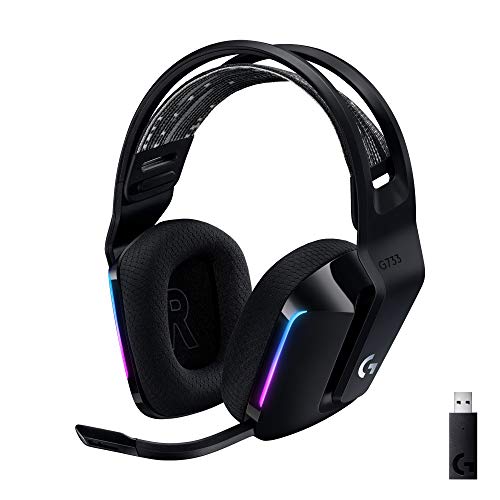
If you want a wireless replacement that leans premium without a huge jump, the Logitech G733 Lightspeed runs $124.92 and carries a 4-star rating. It uses Lightspeed wireless with the Blue VO!CE mic processing and PRO-G audio drivers, and the suspension headband spreads weight so long sessions don’t clamp your skull. It’s a sensible landing spot if a dead ear pushed you to upgrade rather than repair. The move to a detachable-cable or fully wireless design also sidesteps the exact failure that started this whole mess, since there’s no captive cord flexing itself to death at the plug.
Pros
- Lightspeed wireless with 20 meter range handles typical living room and desk distances
- Up to 29 hours battery life covers multi-day use between charges
- Blue VO!CE mic processing in G HUB improves clarity for Discord and streaming
- Suspension headband and low mass design reduce clamp fatigue during long sessions
- Dual-zone Lightsync RGB with 16.8M colors is customizable through G HUB
Cons
- PS4 output limited to stereo, no suround on older PlayStation hardware
- Driver size, frequency response, and mic pattern not specified in source data
The Logitech G733 is a mid-tier wireless gaming headset targeting PC, PS5, PS4, and Nintendo Switch users who want a lightweight all-day fit. It leans on Lightspeed 2.4GHz wireless, PRO-G drivers, Blue VO!CE mic processing, and a reversible suspension headband, aimed at multi-hour gamers and streamers.
The defining feature is the combination of Lightspeed wireless with a quoted 20 meter range and up to 29 hours of battery. In practice this covers full workdays plus evening sessions without a charge cycle. PRO-G drivers, per Logitech, reduce distortion, and headsets in this tier typically deliver a mildly V-shaped tuning suited to positional FPS cues.
Trade-offs are typical at this price point. PS4 users are locked to stereo output with no virtual surround. Driver diameter, impedance, and frequency response are not published in the source data, so absolute output quality is hard to benchmark against wired competitors. There is no Bluetooth fallback listed, so mobile pairing is not supported.
Buy this if you want a light, long-battery 2.4GHz wireless headset for PC or PS5 with a usable broadcast-style mic. Skip this if you need wired low-latency USB, Bluetooth multipoint, or vendor-published driver and frequency response specs before purchase.
Drivers and tuning: Logitech lists PRO-G drivers tuned for reduced distortion, though exact driver diameter and frequency response are not specified in the source. Headsets in this tier typically ship with 40 to 50mm dynamic drivers and a mildly V-shaped response suited to explosions and footstep cues in FPS gameplay.
Connection and latency: Lightspeed 2.4GHz wireless with a stated 20 meter range covers desk and living room use. Compatibility is confirmed for PC, PS5, PS4 (stereo only), and Nintendo Switch. Bluetooth and wired 3.5mm fallback are not listed in the source, so single-dongle 2.4GHz is the only documented path.
Battery life: Rated up to 29 hours per charge, enough for roughly three to four full evening sessions before recharging. Exact charge time and USB-C versus micro-USB charging port are not specified in the source data.
Microphone: Detachable mic with Blue VO!CE filters configured in G HUB, providing EQ, noise reduction, and de-eser presets useful for Discord and Twitch chat. Mic polar pattern, sensitivity, and frequency range are not disclosed in the source specifications.
Tools and parts needed
For the DIY route, keep it simple. You’ll want isopropyl alcohol (90 percent or higher), cotton swabs, a wooden toothpick, and a can of compressed air for cleaning. For cable repairs you’ll need a soldering iron, rosin-core solder, heat-shrink tubing, and a multimeter to trace which conductor lost continuity. A replacement 3.5mm plug or a whole aftermarket cable rounds out the kit for wired pairs with a captive cord. None of it is exotic, and the multimeter pays for itself the next time any small electronic acts up. Add a plastic pry tool if you need to crack open a glued earcup without gouging the plastic. That’s the whole list.
A few more questions
Why does one side work only when I hold the cable a certain way?
That’s a classic sign of a broken conductor inside the cable, usually near the plug. Bending the cord temporarily reconnects the snapped copper strands, so sound returns at that angle. It won’t heal on its own. Either replace a detachable cable or re-terminate the plug if the cord is captive. A dab of solder on the broken joint is the permanent fix if you’re comfortable with an iron.
Can I fix a dead speaker driver myself?
Rarely, and it’s usually not worth it. Drivers are matched to the earcup and rarely sold as spare parts, so sourcing an exact replacement is the hard part. If the coil is blown, you’d be swapping the whole transducer, which costs more in time and parts than most consumer headphones are worth. Replacement is the practical call. High-end, repairable models are the exception, since some brands sell replacement drivers as a service.
Does the same fix order work for wireless earbuds?
Mostly. Skip the cable checks and start with pairing: reset the buds, clean the charging contacts, and confirm both sides hold a charge. A single quiet bud often traces to a dirty contact leaving it undercharged, or to the two buds losing sync. If a reset and clean don’t restore the side, the internal battery or driver in that bud has likely failed. At that point a warranty claim beats a repair, since sealed earbuds aren’t built to be opened.








Write Your Review
No reviews yet. Be the first to share your experience!