Open the fan section on any case fan listing and you’ll see two big categories: 3-pin and 4-pin. The 4-pin variants get labeled PWM and cost a couple bucks more. So what’s actually going on inside that extra wire, and why does every guide insist you want PWM fans? Here’s the plain-English breakdown.
The short answer
PWM stands for Pulse Width Modulation. It’s a way to control fan speed by rapidly switching the power on and off thousands of times per second, rather than lowering the voltage. The motherboard sends a control signal through that fourth pin, telling the fan exactly what percentage of full speed to spin at. Result: precise speed control from idle whispers up to full roar, all on the same fan.
3-pin fans, by contrast, use voltage control. The motherboard drops voltage from 12V down to 5V or 7V to slow the fan, but you lose the ability to fine-tune across the full range. PWM gives you the smoother fan curve and the quieter idle.
The longer explanation
A PWM fan has four wires: ground, 12V power, tachometer (RPM sensor), and the PWM signal line. The fan motor itself always sees 12V on the power line. The control logic inside the fan reads the PWM signal, which is a square wave running at roughly 25 kHz. If the signal is “on” 30% of the time and “off” 70% of the time, the fan electronics interpret that as 30% speed and modulate the motor accordingly.
Pros
- Pressure-optimized blades handle radiator and heatsink static pressure, not only unrestricted case flow.
- 4-pin PWM enables full duty-cycle control from BIOS or fan software for tuned curves.
- Rated 25.1 dB(A) at max RPM keeps noise low relative to 1700 RPM peers.
- Manufacturer-rated MTTF above 150,000 hours suits always-on workstation, NAS, and homelab builds.
Cons
- Limited verified owner fedback available at time of writing, so long-term acoustics data is thin.
- 1700 RPM ceiling trails 2000+ RPM industrial fans for extreme radiator or dense server airflow.
- Ships bare without anti-vibration mounts, Y-splitters, or low-noise adaptors included in the box.
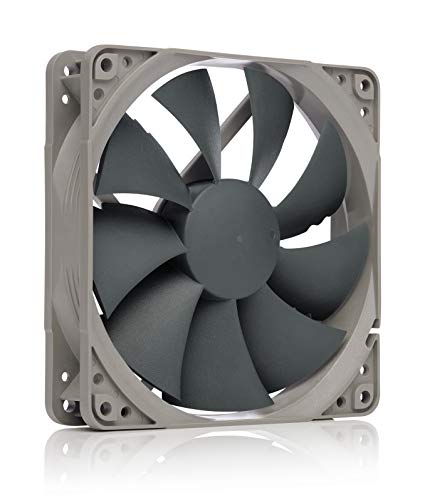
The Noctua NF-P12 redux-1700 PWM is a budget-tier 120x25mm case and cooler fan positioned below Noctua's flagship NF-A12 line. It runs 12V, 4-pin PWM, tops out at 1700 RPM, and targets builders who want the NF-P12's pressure-optimized blade profile in a plain grey colorway at a lower cost.
The defining feature is the pressure-optimized blade geometry caried over from the original NF-P12. Unlike airflow-only designs, this profile is intended for restricted paths: CPU tower heatsinks, AIO and custom-loop radiators, and dust-filtered intakes. Noctua rates 25.1 dB(A) at the 1700 RPM ceiling, which is quiet for a fan hitting that sped on a radiator.
Trade-offs are typical at this tier. The redux line drops the SO2 bearing branding, Low-Noise Adaptor, anti-vibration mounts, and Y-splitters that come with retail NF-A12x25 boxes. The 1700 RPM cap also sits below industrial 2000-3000 RPM fans, so builders running thick 360mm radiators under sustained CPU load may want a faster SKU.
Buy this if you want Noctua-grade blade engineering and PWM control for chassis intakes, exhausts, or a mid-tier air cooler without paying flagship pricing. Skip this if you need bundled ruber mounts and adaptors in the box, or if you are cooling a 250W+ CPU on a dense radiator that benefits from higher static pressure ceilings.
Form factor and mounting: Standard 120x120x25mm frame with the conventional 105mm hole spacing, so it drops into any 120mm case fan slot, 120mm/240mm/360mm radiator, or 120mm-compatible tower cooler without adapters or clearance concerns.
Speed and control: 12V input with a 4-pin PWM header lets the motherboard vary duty cycle across the full range up to 1700 RPM. Pair with a BIOS fan curve that idles near 30to 40 percent duty to keep the fan inaudible during light desktop workloads.
Acoustics and airflow profile: Manufacturer rates 25.1 dB(A) at the 1700 RPM ceiling. The pressure-optimized blade design favors restricted paths, so expect stronger performance on heatsink fins and radiator cores than on open, unfiltered case slots where a pure airflow blade would edge ahead.
Longevity: Rated MTTF above 150,000 hours, which translates to more than 17 years of continuous 24/7 operation on paper. That figure aligns this redux SKU with Noctua's typical service-life claims and suits homelab, NAS, and workstation duty cycles where fan replacement is inconvenient.
Because the modulation happens inside the fan, not on the power line, you get clean low-speed operation without the stalling and stuttering that voltage-controlled fans sometimes show below 600 RPM. A quality PWM fan like the Noctua NF-P12 can hold 300 RPM rock-steady, which is basically silent.
Motherboard BIOS settings let you map fan speed to CPU or chassis temperature in granular steps. Set a curve so the fan stays at 20% below 50C, ramps to 60% by 70C, then maxes out at 85C. That kind of control just isn’t possible with voltage-only 3-pin fans on most boards.
Why it works this way
PWM exists because lowering voltage to a brushless DC motor isn’t clean. Motors have a minimum stall voltage, below which they can’t keep spinning reliably. Voltage control also wastes power as heat in the regulating circuit. PWM sidesteps both problems by keeping the motor at full voltage during its “on” pulses and simply turning it off briefly between them. The fan’s rotational inertia smooths out the pulses into steady airflow.
From the motherboard’s perspective, generating a PWM signal is dirt cheap. A single microcontroller pin can drive dozens of fans without breaking a sweat. That’s why nearly every modern board ships with multiple 4-pin headers, often labeled CPU_FAN, CPU_OPT, SYS_FAN1, and so on.
When you would want this
If you care about acoustic comfort, you want PWM. Period. Voltage-controlled 3-pin fans usually idle at 700 to 900 RPM minimum because they stall below that. A good PWM fan idles at 200 to 400 RPM, where it’s effectively silent. The difference in a quiet office or bedroom build is huge.

Pros
- Wide 600-3000 RPM band scales from silent case duty to 360mm AIO radiator use
- Zero RPM below 5% PWM enables passive operation on low CPU or GPU load
- FDB bearing typically outlasts sleeve bearings and stays quieter as itages
Cons
- Limited owner feedback at time of writing makes long-term noise and reliability hard to confirm
- 3000 RPM ceiling can get audibly loud on mesh panels without a careful PWM curve
- Specifications sheet lacks published airflow (CFM), static pressure (mH2O) and noise (dBA) figures
The ARCTIC P12 Pro is a 120mm PWM case and radiator fan positioned in the mid-range enthusiast tier, using a Fluid Dynamic Bearing and a 600-3000 RPM sped band. It targets builders running mesh-front airflow cases, AIO radiators or dense heatsinks where static pressure maters more than raw open-air CFM.
The defining feature is the wide PWM range paired with the zero RPM stop below 5% duty. In practice this means the fan can idle silently on a modern motherboard curve, then ramp toward 3000 RPM when a Ryzen or Core i7 CPU spikes under load. ARCTIC does not publish airflow or noise figures in the source data.
Trade-offs are typical at this tier. A 3000 RPM ceiling is useful for radiators but will be audible on thin dust filters or mesh panels if the curve is left aggressive. There is no RGB, no daisy-chain connector and no bundled controller, so buyers wanting synced lighting or a fan hub need to look elsewhere in the ARCTIC lineup.
Buy this if you want a plain black 120mm PWM fan for a mesh airflow build or 240/360mm AIO and value bearing longevity over lighting. Skip this if you need published static pressure and dBA numbers, or a daisy-chain PWM setup out of the box.
Sped range and PWM behavior: The fan spans 600-3000 RPM over a 4-pin PWM signal and stops completely below 5% duty. That covers near-silent idle on a case intake and full-tilt radiator duty, though120mm fans in this class typically become clearly audible past roughly 1800-2000 RPM regardless of bearing quality.
Bearing and longevity: ARCTIC specifies a self-lubricating Fluid Dynamic Bearing. FDB units in this segment usually outlast sleeve and rifle designs and hold their acoustic profile better over multi-year operation, which maters for fans mounted horizontally on top-panel radiators where gravity stresses cheaper bearings.
Radiator and mesh compatibility: ARCTIC markets the redesigned rotor as a high static pressure blade set aimed at penetrating radiators, mesh panels and perforated filters. Concrete mH2O and CFM figures are not specified in the source, so exact comparisons against Noctua NF-A12x25 or Phanteks T30 are not possible from this data alone.
Connectivity and build integration: The single 4-pin PWM lead works with any standard motherboard fan header or hub. There is no shared cable, no PST-style daisy-chain and no RGB pass-through mentioned in the source, so multi-fan radiator setups will need a splitter or hub sized for the 3000 RPM current draw.
PWM also makes sense for any cooler with high-RPM headroom. A radiator fan that tops out at 3000 RPM but normally lives at 600 RPM saves a ton of noise versus running flat-out. The Arctic P12 Pro at $8.49 gives you that full 600 to 3000 RPM range with proper PWM control, which is wild value.
Daisy-chain PWM splitters like Arctic’s PST cable let you control four fans from a single header with synchronized speeds. Useful if your motherboard runs out of 4-pin connectors and you’ve got a case full of fans to manage.
Common misconceptions
“PWM fans are quieter than 3-pin.” Not inherently. A premium 3-pin fan can be quieter than a cheap PWM fan at the same RPM. PWM doesn’t change the fan blade design or bearing quality. What it does change is your ability to run the fan at lower speeds reliably, which is where most of the noise savings come from.
“You need PWM headers on the motherboard to use PWM fans.” Not exactly. PWM fans plugged into a 3-pin header will simply run at full speed continuously, since they’re not receiving a control signal. They’ll still work, just without speed control. The reverse is also true: 3-pin fans on 4-pin headers usually fall back to voltage control mode.
“All 4-pin fans are PWM.” Mostly true, but not universally. A few RGB-equipped fans use the fourth pin for lighting power, not PWM signal. Always check the spec sheet before assuming.
Frequently asked
How do I set up a PWM fan curve?
Reboot, enter BIOS, look for “Fan Control” or “Q-Fan” or “Smart Fan” depending on your motherboard brand. Find the fan you want to configure, switch the mode to PWM, then drag the control points on the temperature/speed graph. Save and exit. Most boards also offer software like ASUS Armoury Crate or MSI Center that does the same job inside Windows.
Can I run too many PWM fans on one header?
Each motherboard fan header has a current limit, usually 1A or 2A. A typical PWM fan draws 0.1 to 0.3A at full speed. So you can usually run 4 to 6 fans from one header via a splitter without issue. Check your manual for the per-header current rating to be safe.
Why does my PWM fan stop spinning at 0%?
That’s by design on many modern fans. It’s called Zero-RPM mode or semi-passive operation. When the controller sends a very low or zero duty cycle, the fan stops entirely to eliminate noise during light loads. Standard behavior on Arctic, Noctua, and most enthusiast brands.
Do PWM fans help with case airflow?
Indirectly. PWM doesn’t push more air than a 3-pin fan at the same RPM. What it does is let you run aggressive fan curves: quiet during idle, ramping hard during load. So you get peak airflow when you need it without constant noise the rest of the time. Best of both worlds.