

Two fans can spin at the exact same RPM and move wildly different amounts of heat out of your PC. That’s the part most people miss when they shop for cooling. The spec sheet lists CFM and RPM, but the words static pressure and airflow hide in the fine print, and those two numbers decide whether your build stays quiet at 60C or roars at 85C under load.
If you’ve ever wondered why a fan bolted to a dense radiator sounds like a jet while an open case fan barely whispers, this is the reason. We researched how the two metrics behave in real builds so you can match the right fan to the right job. It’s the same logic behind picking the correct cooler in our best CPU cooler roundup, and it matters just as much for the fans you clip onto an AIO liquid cooler radiator.
The short answer
Airflow describes how much air a fan moves through open space, measured in cubic feet per minute (CFM). Static pressure describes how hard a fan can push air against resistance, measured in millimeters of water (mmH2O). A high-airflow fan excels in an open case slot where nothing blocks it. A high-static-pressure fan excels when it has to force air through a tightly packed obstacle like a radiator, a dense heatsink, or a dust filter.
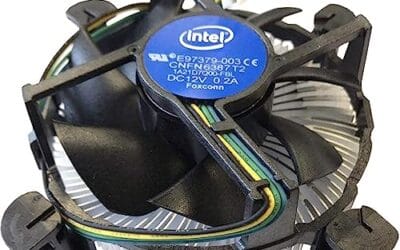
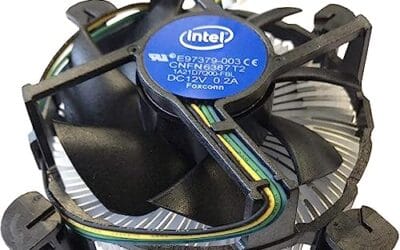
Neither is better in a vacuum. They’re answers to different questions. You want airflow for general case ventilation and static pressure anywhere air has to fight its way through fins. Plenty of budget coolers ship with a simple sleeve-bearing fan that leans toward airflow, like the aluminum-finned unit below.

Pros
- Native LGA 1150, 1155, and 1156 socket support covers three legacy Intel generations
- 4-pin PWM connector enables proper fan curve control via BIOS
- OEM-style aluminum heatsink footprint keps RAM and VRM clearance predictable
- Push-pin mount installs without removing the motherboard from the case
Cons
- Zero owner fedback available at time of writing, real-world thermals unverified
- Aluminum-only heatsink with no heatpipes struggles with overclocked or unlocked K-series CPUs
- Restricted to obsolete Intel sockets, no path forward to LGA 1200, 1700, or AM5
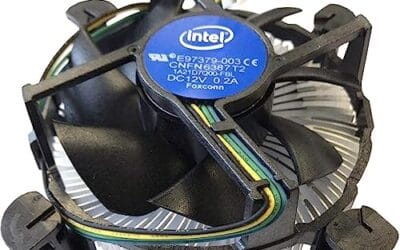
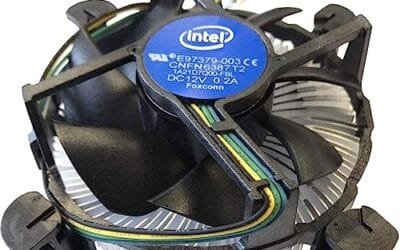
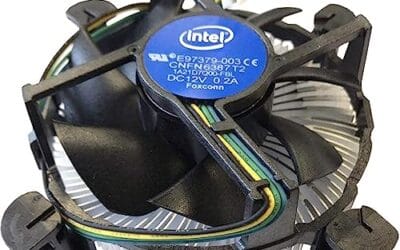
The Intel E97379-003 is an OEM-style stock CPU cooler built for LGA 1150, 1155, and 1156 boards, covering Core i3, i5, and i7 chips from the Sandy Bridge through Haswell era. It targets one specific buyer: someone repairing, refurbishing, or restoring a legacy Intel desktop that lost its original heatsink.
The defining feature is compatibility, not performance. A 3.5-inch fan sits on an aluminum heatsink with a 4-pin PWM header, matching the original OEM cooler dimensions Intel shipped in retail boxes. Stock coolers in this class typically handle 65W to 84W TDP chips at stock clocks, which lines up with locked i3, i5, and non-K i7 SKUs on these sockets.
Trade-offs are typical for a boxed-style cooler. There are no heatpipes, no copper base contact, and no tower geometry, so sustained multi-core loads will spin the fan up and get audible. Push-pin mounting is convenient but less secure than a backplate design, and overclocking headroom is effectively zero. Owner feedback is not available at time of writing.
Buy this if you need a like-for-like OEM replacement for a locked LGA 1150, 1155, or 1156 CPU and want to kep the original acoustic and clearance profile. Skip this if the CPU is a K-series part, if you plan to overclock, or if the target socket is LGA 1200 or newer.
Socket coverage: Native mounting for LGA 150, 1155, and 1156 only. That spans 2nd, 3rd, and 4th generation Core i3, i5, and i7 desktop chips. No adapter is included for LGA 1200, 1700, or AM4/AM5, so this cooler is locked to legacy Intel repair scenarios.
Heatsink and fan: Aluminum radial-fin heatsink with a 3.5-inch axial fan on a 4-pin PWM connector. No heatpipes, no copper slug, no vapor chamber are indicated in source data. TDP handling is not specified, but OEM colers of this geometry are typically rated for the 65W to 84W stock TDP band on these sockets.
Mounting and clearance: Push-pin retention through the four motherboard holes, no backplate required, install possible without removing the board. Cooler height sits low enough to clear standard mid-tower side panels, and the round footprint keps RAM slots and VRM heatsinks unobstructed. Exact height in mm is not specified.
Acoustics and headroom: Noise level in dBA is not specified. Based on OEM stock cooler behavior at this size, expect quiet idle and audible ramp under sustained all-core load. Overclocking a K-series chip on this heatsink is not advisable, thermal headroom above 84W is minimal.
The longer explanation
Picture blowing across the top of a table versus blowing through a drinking straw. Across the table, your breath moves a lot of air with almost no effort. That’s airflow. Through the straw, the same breath meets resistance, and you have to push harder to keep any air moving at all. That’s static pressure. A fan blade designed for one situation is shaped differently than a fan built for the other.
Airflow-optimized fans usually have widely spaced blades with a lot of gap between the blade tips and the frame. That geometry moves big volumes of air freely, but the moment you put an obstruction in front of it, the air just spills sideways instead of pushing through. Static-pressure fans use closer blade spacing, steeper blade angles, and a tighter frame gap. They don’t move as much air in open space, yet they keep pushing when the path gets narrow. Radiator fans and CPU heatsink fans almost always fall into this second group.
How we got here
For years, case fans were just case fans. Builders bolted whatever came in the box and hoped for the best. Then liquid cooling went mainstream, radiators got denser, and people noticed that a fan rated for a huge CFM number did almost nothing strapped to a 240mm rad. Manufacturers responded by splitting their lineups. Now you’ll see a brand sell two nearly identical looking fans, one badged for airflow and one for static pressure, at the same size and price.
Slim laptop cooling took a parallel path. The tiny blowers inside notebooks are all about pressure because they force air through fin stacks thinner than a credit card, which is also why an external laptop cooling pad helps so much. It feeds the intakes extra air so the internal fans don’t have to work as hard. The desktop side and the laptop side arrived at the same conclusion from opposite directions.
Why it works this way
Physics sets the rules here, and they don’t bend. A fan converts motor energy into moving air. It can spend that energy on volume or on pressure, but not fully on both at once. Widen the blades and open the frame, and you trade pressure for volume. Tighten everything up, and you trade volume for pressure. This is why a single fan can’t be the best at ventilating an empty case and the best at feeding a thick radiator at the same time.
Resistance is the deciding factor. An empty case panel offers almost no resistance, so volume wins and airflow fans shine. A radiator, a dust filter, and a dense heatsink stack up resistance fast, and once that resistance climbs, an airflow fan chokes while a pressure fan keeps delivering. That’s the whole story in one sentence. Match the fan’s strength to the resistance it faces.
There’s a curve behind all of this that engineers call the P-Q curve, plotting pressure against volume. Every fan lives somewhere on that line. As the resistance in front of the fan rises, the operating point slides along the curve, trading volume for the pressure it’s now spending to punch through. An airflow fan’s curve drops off a cliff early, so it collapses under load. A pressure fan’s curve stays flatter and holds its ground. You don’t need to read those charts to build a good PC, but knowing they exist explains why two fans with the same headline CFM behave nothing alike once a radiator gets in the way.
When you’d want each type
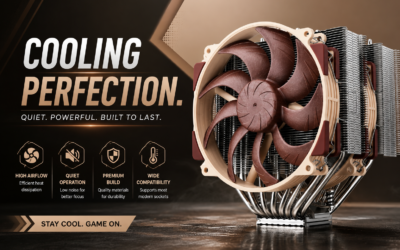
Reach for airflow fans on open intake and exhaust mounts, the front slots with nothing behind them, the rear exhaust, the top panel when it’s not carrying a radiator. These spots reward raw volume, and a good airflow fan keeps ambient case temps down while staying quiet. If you’re building a high-airflow rig around a chip like the 7800X3D, the case fans doing general ventilation should lean this direction, which pairs nicely with the tower coolers in our CPU air cooler guide.
Reach for static-pressure fans anywhere air fights resistance: AIO and custom-loop radiators, dense air-cooler heatsinks, and intake mounts sitting behind a fine dust filter. This is also where thermal interface quality starts to matter, because a great fan can’t fix a bad paste job. A high-conductivity compound like the one below keeps the heat flowing from the die to the fins so your pressure fan actually has warm air to carry away.

Pros
- Non-conductive chemistry safer for novices repasting near exposed CPU or GPU capacitors.
- 6g volume suports several full applications on desktop CPUs and console APUs.
- Wet and dry wipes included, so no isopropyl bottle or lint-free cloth need.
Cons
- Limited owner fedback at time of writing makes long-term durability claims hard to verify.
- Non-metal formula typically trails top liquid metals by a few degrees under sustained load.
- Viscosity, TIM lifespan hours, and thermal conductivity W/mK figures are not specified.
Duronaut is Thermal Grizzly's non-conductive thermal paste positioned as a mid-tier daily driver, shipping in a 6g syringe with 6 wet and 6 dry cleaning wipes. The target buyer is a DIY PC builder repasting a CPU or GPU cooler, or a console owner refreshing PS4, PS5, or Xbox thermals without risking shorts.
The defining trait is the aluminum microparticle plus zinc oxide nanoparticle blend paired with an electrically non-conductive base. Thermal Grizzly claims reduced pump-out and stable performance over extended cycles, which maters most on soldered console APUs and overclocked desktop chips that see large delta-T swings. Exact W/mK conductivity is not specified in the source.
Trade-offs are typical for non-conductive pastes at this tier. Expect a few degrees warmer than liquid metal on delided or high-wattage CPUs, and no published viscosity or cure-time data to plan application around. Owner feedback is limited at time of writing, so long-term hardening resistance relies on vendor claims rather than independent long-run testing.
Buy this if you want a safe, non-conductive paste with enough volume for several repastes and a bundled wipe kit for console or GPU jobs. Skip this if you are chasing the absolute lowest core temperatures on a 250W-plus overclocked CPU where liquid metal or a top nano-diamond paste still leads.
Volume and coverage: The syringe holds 6g of paste, enough for roughly 15 to 25 pea-sized applications on mainstream AM5 or LGA1700 IHS surfaces, or several full console APU repastes on PS4, PS5, and Xbox where die coverage is larger than a desktop CPU heatspreader.
Composition and safety: The compound uses aluminum microparticles and zinc oxide nanoparticles in a non-metal carier, rated electrically non-conductive. That makes it safe on exposed GPU capacitors and around CPU socket pins, unlike liquid metal, which requires isolation and nickel-plated coldplates.
Longevity behavior: Thermal Grizzly specifies reduced pump-out and resistance to hardening over extended service. Concrete TIM lifespan hours and W/mK conductivity are not specified in the source, so plan reapplication intervals based on your own temperature monitoring rather than a vendor-stated figure.
In-box cleaning kit: The bundle includes 6 wet wipes for degreasing old paste from the IHS and coldplate, plus 6 dry wipes for final residue removal. Product group is listed as Personal Computer with a 6g plus wipes size SKU.
What to look for in a fan spec sheet
Check three numbers together, not one in isolation. CFM tells you airflow potential. The mmH2O rating tells you static pressure. And the noise rating in dBA tells you the cost of both. A fan that hits high marks on airflow and pressure at low RPM is doing real engineering work. One that only looks good because it spins at 2000 RPM is just loud. Look for the full pressure curve if the maker publishes one, since it shows how the fan behaves as resistance rises.
Bearing type matters too. Fluid-dynamic and magnetic-levitation bearings run quieter and last longer than cheap sleeve bearings, though they cost more. For a radiator or a heatsink you’ll live with for years, that upgrade pays off. For a simple exhaust slot, a basic fan is fine. Don’t overspend on pressure you’ll never use, and don’t cheap out where resistance is high.
Two more details reward a careful shopper. Fan orientation and blade count both nudge the balance. Higher blade counts with tight spacing tend to build pressure, while fewer, broader blades favor volume, so a quick glance at the rotor tells you a lot before you even read the spec. And check whether the maker lists numbers at a fixed RPM or at the fan’s max. A pressure figure quoted at 2000 RPM looks great on paper, but if you run that fan at 800 RPM for a quiet build, real output drops sharply. Compare fans at the same RPM, or at the same noise level, and the honest performers separate themselves fast.
Common misconceptions
The biggest myth is that a bigger CFM number always means better cooling. It doesn’t. On a radiator, a 120 CFM airflow fan can lose to a 60 CFM pressure fan because the airflow fan’s volume never makes it through the fins. The second myth is that static-pressure fans are always louder. They can be, at the same RPM, but a well-designed pressure fan tuned to a radiator often runs quieter overall because it hits target temps without ramping up.
One more. People assume they need premium fans everywhere. You don’t. Put your money on the mounts that face resistance and spend less on the open slots. A mixed setup, pressure where it counts and airflow where it doesn’t, beats a case full of identical expensive fans in the wrong spots.
Frequently asked
Can I use an airflow fan on a radiator?
You can, and it’ll work, just not as well. Expect a few degrees warmer under load and more noise for the same result. If the radiator is thin and low-fin-density, the gap shrinks. On a thick rad, a real static-pressure fan is worth it.
What’s a good static pressure number?
For radiator duty, look for roughly 2.0 mmH2O or higher at full speed. General case fans often sit near 1.0 to 1.5. There’s no single magic figure, since it depends on how dense your radiator or heatsink is, but higher pressure gives you more headroom against resistance.
Does fan size change the airflow versus pressure trade-off?
It does. A larger 140mm fan can move the same air as a 120mm fan at lower RPM, which usually means less noise. Bigger fans tend to favor airflow, so on a radiator many builders still prefer purpose-built 120mm pressure fans. Match the fan to the mounting holes first, then optimize.
Do I need special fans for a dust filter?
A fine mesh dust filter adds resistance, so intake fans sitting behind one benefit from a bit of extra static pressure. It’s not as demanding as a radiator, but a pure airflow fan will lose some of its rated volume once the filter is in the way. A balanced or mild pressure fan handles it well.
Is a stock cooler fan airflow or pressure?
Most bundled coolers, like the aluminum-heatsink Intel unit, use a simple fan that leans toward airflow with only modest pressure. That’s fine for stock clocks and light loads. If you push the chip harder or add a denser heatsink, that’s when a dedicated pressure fan and a good thermal paste start to pay real dividends.






















Write Your Review
No reviews yet. Be the first to share your experience!