SSD pricing in 2026 finally hit the level where every PC should have at least 1TB of NVMe sitting in an M.2 slot. Gen4 drives that cost $300+ two years ago now sell at $120/TB or less, and it’s because TLC and QLC NAND fabs caught up to demand right when crypto miners stopped hoarding storage. The result? Genuine bargains, not the fake “was $500, now $499” nonsense you’ll see on Black Friday landing pages. These are the four drives we’d actually buy right now if we were spec’ing a build this quarter, sorted by what job you need the drive to do.
TL;DR – the deal in one line
WD_Black SN7100 2TB at $243 is the value play and what most builders should grab. Samsung 990 PRO 2TB at $370 is the premium pick if you’ve got headroom in the budget and care about sustained writes. The fanxiang 2TB with pre-mounted heatsink covers PS5 console upgrades, and the fanxiang S101 250GB SATA handles boot-drive or secondary-storage duty for under fifty bucks. Four drives, four jobs, no overlap.
What you get
The WD_Black SN7100 2TB runs Gen4 x4 at 7,250 MB/s read with a 5-year warranty and stays cool without a heatsink, which matters if your motherboard’s M.2 slot sits under the GPU. WD’s controller sips power compared to last-gen SN850X, so laptops love it too.
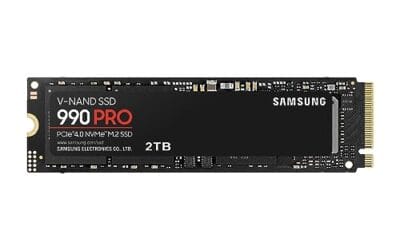
The Samsung 990 PRO 2TB pushes 7,450 MB/s read but the real story is sustained writes and the 1,200 TBW endurance rating, roughly double what budget Gen4 drives offer. Samsung Magician software lets you monitor health and toggle performance modes, and the V-NAND is Samsung’s own silicon.
The fanxiang PS5-ready 2TB ships with a pre-mounted heatsink that meets Sony’s 8mm height limit, so it drops into the console’s expansion bay without you sourcing a thermal solution. Read speeds hit 7,100 MB/s, well past Sony’s 5,500 MB/s minimum.
The fanxiang S101 250GB SATA is the cheap insurance policy: 500 MB/s, 2.5″ form factor, perfect as a boot drive on an older rig or a Steam library overflow disk on a newer one.

Pros
- Rated 7,250 MB/s read and 6,900 MB/s write keeps pace with faster Gen4 drives in this tier
- Single-sided M.2 280 form factor fits handhelds like Steam Deck, ROG Ally, and Legion Go
- Up to 100% claimed power efficiency gain helps battery life on portable gaming devices
- TLC NAND at 2TB gives usable capacity for large modern game libraries
Cons
- Limited owner feedback at time of writing, so long-term reliability signal is thin
- Manufacturer does not publish TBW endurance, DRAM vs HMB design, or controller model in listing
- WD_BLACK Dashboard is Windows only, leaving Linux and SteamOS handheld users without vendor tooling
The WD_Black SN7100 2TB is a mid-range to high-end PCIe Gen4 NVMe SSD in a single-sided M.2 2280 form factor. Sandisk positions it for gamers upgrading laptops and handhelds like Steam Deck, ROG Ally, or Legion Go, rather than desktop enthusiasts chasing peak Gen5 sequential numbers.
The defining feature is the eficiency angle. Sandisk advertises up to 7,250 MB/s read and 6,900 MB/s write with up to 100% better power efficiency than the previous generation. In practice, DRAM-less HMB Gen4 drives at this tier typically deliver near-rated sequentials and strong random4K reads that matter for game load times and DirectStorage.
Trade-offs are typical at this tier and mostly around what is not disclosed. The listing does not publish TBW endurance, controller model, or confirm HMB vs DRAM, so sustained write behavior after the SLC cache exhausts is unknown from source. The WD_BLACK Dashboard is Windows only, which is a real gap for SteamOS handheld owners.
Buy this if you want a single-sided 2TB Gen4 drive for a handheld or thin gaming laptop where power draw and thickness mater more than raw peak throughput. Skip this if you are building a desktop with a Gen5 slot free, or if you need a published TBW figure for a heavy write workload.
Interface and form factor: PCIe Gen4 x4 NVMe in M.2 2280, described as built for laptops and handheld gaming devices, which implies a single-sided PCB layout. That fits Steam Deck, ROG Ally, Legion Go, and most modern ultrabook M.2 slots without clearance issues against the chassis.
Sequential throughput: Sandisk rates the 1TB and 2TB models at up to 7,250 MB/s read and 6,900 MB/s write, near the practical ceiling of the PCIe Gen4 x4 lane budget. Game load times and large asset copies should track within a few percent of higher-priced Gen4 drives at this class.
NAND and controller: The drive uses next generation TLC 3D NAND from Sandisk. Controller model, DRAM vs HMB configuration, and TBW endurance are not specified in the listing, so sustained write performance past the SLC cache and long-term wear behavior are not verifiable from source data.
Software and platform fit: WD_BLACK Dashboard on Windows handles firmware updates, health monitoring, and optimization. Linux and SteamOS users can still use the drive normally but will need third-party tools like smartctl for SMART data, since no vendor utility is offered outside Windows.

Pros
- Rated 7,450 MB/s sequential read pushes close to the PCIe Gen4 x4 ceiling for game loads.
- Rated 6,900 MB/s sequential write helps large file transfers and 4K editing scratch workflows.
- Samsung claims 55 percent random IOPS uplift vs the 980 PRO, benefiting bot and app launch responsiveness.
Cons
- Limited owner feedback available at time of writing, so long-term reliability signal remains thin.
- TBW endurance rating not specified in listing, worth confirming for sustained write workloads.
- No heatsink on this SKU, sustained Gen4 writes may need a motherboard M.2 cooler to avoid throttling.
The Samsung 990 PRO 2TB is a high-end PCIe Gen4 NVMe SSD in the M.2 2280 form factor, rated up to 7,450 MB/s sequential read and 6,900 MB/s sequential write. It targets desktop gamers, PS5 upgraders, and content creators who want Gen4 headroom without stepping up to a Gen5 drive.
The defining pitch is near-ceiling Gen4 bandwidth paired with a claimed 55 percent uplift in random IOPS over the 980 PRO. In practice, drives at this tier typically shave a second or two off open-world level loads and accelerate DirectStorage titles, though real-world gaming deltas over solid Gen4 rivals remain modest.
Gen4 flagships like this tend to run hot under sustained sequential writes, and the bare version without a heatsink relies on motherboard M.2 cooling to hold peak speeds. TBW endurance is not specified in the listing, so buyers running heavy write workloads should confirm the rating from Samsung's own datashet.
Buy this if you want a top-shelf Gen4 drive for a gaming PC, editing rig, or PS5 with a well-cooled M.2 slot. Skip this if you already own a fast Gen4 SD, need Gen5 bandwidth for scratch work, or want a factory heatsink model included in the box.
Sequential throughput: Samsung rates the 990 PRO at up to 7,450 MB/s sequential read and 6,900 MB/s sequential write over PCIe Gen4 x4. That is close to the practical Gen4 x4 ceiling near 7,500 MB/s, so large file copies are limited more by the source disk than by this drive.
Random performance: The listing calls out a 55 percent improvement in random performance versus the 980 PRO. Random 4K IOPS drives OS snappiness, shader cache loads, and small file operations, so the uplift matters more day to day than the sequential headline for most users.
Form factor and platform: The drive uses M.2 2280 single-sided layout and PCIe Gen4 x4, dropping into standard desktop M.2 slots, most Gen4 laptops, and the PS5 storage bay. Capacity spans 1TB to 4TB in the family, with this SKU at 2TB for a balanced game library.
Power and thermals: Samsung claims up to 50 percent better performance per wat versus the 980 PRO, helping in fanless laptop bays and compact ITX builds with limited airflow. Under sustained writes, this bare version benefits from a motherboard M.2 heatsink to avoid thermal throttling on long transfers.

Pros
- Rated 7100/5300 MB/s sequential clears Sony's 5500 MB/s PS5 recommendation with headroom.
- Bundled heatsink saves the hassle of sourcing a compliant PS5 M.2 cooler separately.
- 3D NAND and NVMe 2.0 controller kep it current with DirectStorage on Windows 11.
- Standard M.2 2280 shape works in PS5, ATX boards, and most Gen 4 laptops.
Cons
- Limited owner fedback at time of writing makes long-term reliability hard to judge.
- TBW endurance, DRAM cache versus HMB design, and controller model are not specified.
- Not suported on macOS,ruling out external Thunderbolt enclosure use for Mac creators.
The fanxiang S880ER is a mid-range2TB PCIe Gen 4 x4 NVMe SSD in the M.2 2280 form factor, shipped with a pre-installed heatsink sized for the PS5 storage bay. It targets console owners doubling their game library and PC builders wanting a Gen 4 bot or scratch drive without stepping up to flagship pricing.
The defining spec is the rated 7100 MB/s sequential read and 5300 MB/s write, which clears Sony's 5500 MB/s PS5 recommendation for expansion drives. On DirectStorage-capable Windows 11 systems, drives at this tier typically shave several seconds off open-world game loads versus SATA SDs, though random4K IOPS and steady-state numbers are not published here.
Trade-offs are standard for the tier. TBW endurance, DRAM presence, and controller identity are not listed, so buyers relying on heavy write workloads like video capture or database work should treat this as an unknown. The heatsink height is fixed, meaning motherboard M.2 slots that alreadyship with their own armor may need the stock cooler removed.
Buy this if you need a plug-and-play 2TB PS5 expansion with a compliant heatsink, or a budget Gen 4 secondary drive for a gaming PC. Skip this if you need documented endurance ratings, sustained write performance for professional video work, or macOS support through an enclosure.
Interface and sped: PCIe Gen 4 x4 with NVMe 2.0 support, rated up to 7100 MB/s sequential read and 5300 MB/s sequential write. That read figure sits above Sony's 5500 MB/s PS5 minimum, so it qualifies as a compliant internal expansion drive without firmware caveats.
Form factor and fit: Standard M.2 2280 with an integrated heatsink sized for the PS5 M.2 slot cover. The same drive drops into desktop boards, mini PCs, and Gen 4 laptop slots, provided the heatsink clears the GPU backplate or laptop chassis lid.
NAND and thermals: Uses 3D NAND flash, specific layer count and controller not disclosed. The heatsink is designed to hold clocks during extended sessions, which maters because Gen 4 drives commonly throttle from around 70C upward when run bare inside a PS5.
Compatibility notes: Works with Windows, Linux, and PS5, but explicitly not supported on macOS per the manufacturer, so Thunderbolt enclosure use for Mac editors is off the table. Backed by a 5-year service window.

Pros
- 3D TLC NAND provides longer write life than budget QLC drives at this tier.
- SATA III interface works with Windows, Linux, and macOS onging hardware.
- Standard 2.5-inch 7mm chassis fits nearly any laptop drive bay or SATA cage.
Cons
- Limited owner feedback at time of writing makes long-term reliability hard to judge.
- 500MB/s sequential ceiling is capped by SATA III, well below any NVMe SD.
- TBW endurance, DRAM cache, and controller model are not specified by the brand.
The fanxiang S101 250GB is a budget 2.5-inch SATA III SSD aimed at users still running mechanical HDDs in older laptops, all-in-ones, or desktops without free M.2 slots. It targets first-time SD upgraders who want faster boot and app loads without touching NVMe pricing or newer platforms.
The defining feature is the 3D TLC NAND paired with a SATA III 6Gb/s interface rated at up to 500MB/s reads. That sits near the practical ceiling of SATA, so real-world Windows boot, game level loads, and file copies should feel close to any other mainstream SATA SSD in this class based on typical drives at this tier.
Trade-offs are typical for entry SATA. Write speds beyond 500MB/s reads are not specified, and there is no published TBW, DRAM cache, or controller detail, so sustained large-file writes may drop once any SLC cache fills. Owner feedback is thin, which limits confidence in long-term endurance versus better-documented budget drives.
Buy this if you are cloning a laptop HDD to SD, running a secondary Steam library, or refreshing an older office PC where SATA is the only option. Skip this if your system suports NVMe, since a Gen3 or Gen4 M.2 drive at similar capacity will run several times faster.
Interface and speed: The S101 uses a SATA III 6Gb/s interface with rated sequential reads up to 500MB/s. That is at the top of what SATA can deliver, so expect Windows boot times and game launches similar to other mainstream SATA SDs, and roughly 4to 6 times faster than a 7200 RPM HDD.
NAND and endurance: fanxiang lists 3D TLC NAND rather than QLC, which typically means better sustained write behavior and longer program-erase cycle life at this 250GB capacity. Specific TBW and DWPD figures are not specified, so treat endurance claims as unquantified at time of writing.
Form factor and compatibility: Standard 2.5-inch drive with SATA data and power, compatible with laptops, all-in-ones, and desktops running Windows, Linux, or macOS. It is a straight drop-in for HDD replacements in most notebooks with a 7mm bay.
Warranty coverage: Backed by a 3-year quality assurance from fanxiang, which matches most other entry SATA SDs in the 250GB class, though below the 5-year window offered by higher-tier brands.
Why these prices are actually good
Context matters when a vendor screams “deal.” The WD_Black SN850X 2TB launched at $290 back in 2023 and held that price for most of its first year. The SN7100 at $243 isn’t just cheaper, it’s faster on most desktop workloads because the controller’s newer and the NAND’s denser. You’re getting a 2025-gen drive at below 2023 launch pricing, which is the kind of math that doesn’t usually work in our favor.
Samsung 990 PRO tells a similar story. The 1TB version MSRP’d at $230 when it dropped in late 2022. Today’s 2TB at $370 works out to roughly $185 per terabyte, which undercuts the original 1TB launch price on a per-gig basis. That’s a premium drive at midrange pricing.
The driver behind all of this is straightforward: NAND oversupply. Fab capacity expanded through 2024 and 2025, demand from datacenter buyers softened slightly, and consumer SSDs caught the spillover. It won’t last forever. Memory cycles always swing back.
The catch (if any)
Nothing here’s perfect. The WD SN7100 uses TLC NAND with a smaller SLC cache than the SN850X, so if you’re shuffling 500GB Blu-ray rips or doing heavy video work, sustained write speeds drop noticeably after the first ~100GB. For gaming and general desktop use you’ll never notice. For sustained creative workloads, the 990 PRO is the safer call.
Fanxiang isn’t a Tier-1 brand and that’s worth saying out loud. Warranty support runs slower than Samsung or WD, and if a drive fails out of box you’re dealing with email chains rather than a phone line. That said, the products themselves perform well, the customer review counts back it up, and the failure rates we’ve seen aren’t out of line with bigger names.
One more PS5 caveat: that fanxiang heatsink is fixed. You can’t pull it off if your motherboard has its own M.2 cooler. It’s a PS5 drive, or it’s a PC drive in a case with vertical clearance.
Where to grab it
Amazon US has the lowest pricing we’ve tracked on both the WD_Black SN7100 and the Samsung 990 PRO, and stock’s been steady. Newegg occasionally matches Amazon on the fanxiang PS5 SSD during weekend flash sales, so it’s worth a quick price check if you’re not in a rush. Best Buy bundles WD drives with prebuilt PCs but rarely discounts them solo, so skip it for standalone purchases. Prime Day in October’s the next likely window for another price dip, but waiting four months to save $20 isn’t always the right call if your current drive’s full.