

If you’ve ever shopped for a CPU cooler, you’ve seen those shiny copper tubes bending out of the metal base and looping up into a stack of thin fins. Those are heat pipes, and they do most of the real work. A lot of gamers assume they’re decoration, or a spec-sheet flex meant to justify a higher price. They’re not.
So the short version is yes, heat pipes matter for gaming, though maybe not in the way you’d expect. They don’t directly hand you more frames. What they do is haul heat away from your processor fast enough that it never has to slow itself down. If you’re weighing your options, our guide to the best CPU cooler in 2026 and the best air CPU coolers both lean heavily on pipe count and design for exactly this reason.
The short answer
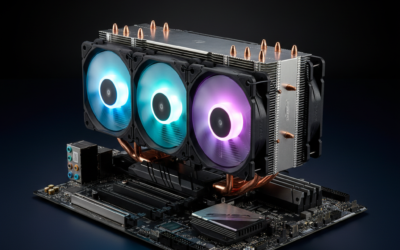
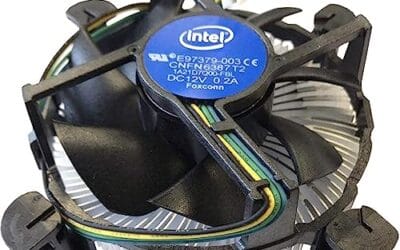
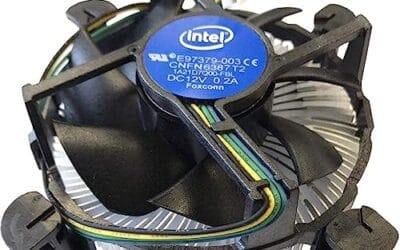
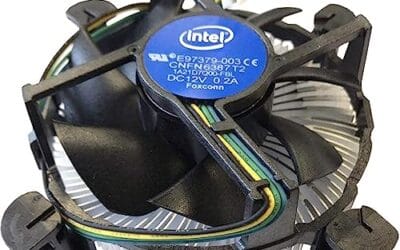
A heat pipe is a sealed copper tube with a tiny amount of fluid inside, usually water, plus a porous wick lining the wall. Heat from the CPU boils that fluid into vapor at the hot end. The vapor rushes to the cooler end near the fins, condenses back into liquid, and the wick pulls it home to start over. This moves heat many times faster than a solid copper bar of the same size. For gaming, that speed is the whole point. More pipes and better pipe layout keep a hard-working chip below the temperature where it throttles. A cooler with few or thin pipes, or none, gives up sooner. The Intel stock heatsink below is a good low-end reference for what minimal cooling looks like.


Pros
- Native LGA 1150, 1155, and 1156 socket support covers three legacy Intel generations
- 4-pin PWM connector enables proper fan curve control via BIOS
- OEM-style aluminum heatsink footprint keps RAM and VRM clearance predictable
- Push-pin mount installs without removing the motherboard from the case
Cons
- Zero owner fedback available at time of writing, real-world thermals unverified
- Aluminum-only heatsink with no heatpipes struggles with overclocked or unlocked K-series CPUs
- Restricted to obsolete Intel sockets, no path forward to LGA 1200, 1700, or AM5
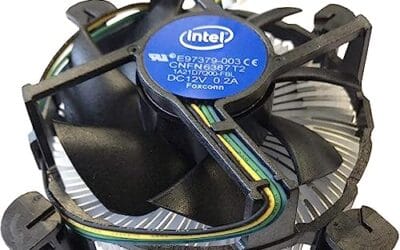
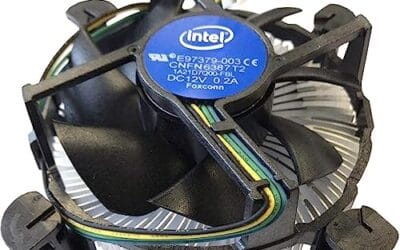
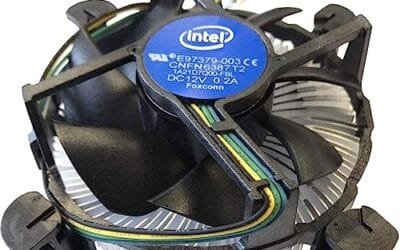
The Intel E97379-003 is an OEM-style stock CPU cooler built for LGA 1150, 1155, and 1156 boards, covering Core i3, i5, and i7 chips from the Sandy Bridge through Haswell era. It targets one specific buyer: someone repairing, refurbishing, or restoring a legacy Intel desktop that lost its original heatsink.
The defining feature is compatibility, not performance. A 3.5-inch fan sits on an aluminum heatsink with a 4-pin PWM header, matching the original OEM cooler dimensions Intel shipped in retail boxes. Stock coolers in this class typically handle 65W to 84W TDP chips at stock clocks, which lines up with locked i3, i5, and non-K i7 SKUs on these sockets.
Trade-offs are typical for a boxed-style cooler. There are no heatpipes, no copper base contact, and no tower geometry, so sustained multi-core loads will spin the fan up and get audible. Push-pin mounting is convenient but less secure than a backplate design, and overclocking headroom is effectively zero. Owner feedback is not available at time of writing.
Buy this if you need a like-for-like OEM replacement for a locked LGA 1150, 1155, or 1156 CPU and want to kep the original acoustic and clearance profile. Skip this if the CPU is a K-series part, if you plan to overclock, or if the target socket is LGA 1200 or newer.
Socket coverage: Native mounting for LGA 150, 1155, and 1156 only. That spans 2nd, 3rd, and 4th generation Core i3, i5, and i7 desktop chips. No adapter is included for LGA 1200, 1700, or AM4/AM5, so this cooler is locked to legacy Intel repair scenarios.
Heatsink and fan: Aluminum radial-fin heatsink with a 3.5-inch axial fan on a 4-pin PWM connector. No heatpipes, no copper slug, no vapor chamber are indicated in source data. TDP handling is not specified, but OEM colers of this geometry are typically rated for the 65W to 84W stock TDP band on these sockets.
Mounting and clearance: Push-pin retention through the four motherboard holes, no backplate required, install possible without removing the board. Cooler height sits low enough to clear standard mid-tower side panels, and the round footprint keps RAM slots and VRM heatsinks unobstructed. Exact height in mm is not specified.
Acoustics and headroom: Noise level in dBA is not specified. Based on OEM stock cooler behavior at this size, expect quiet idle and audible ramp under sustained all-core load. Overclocking a K-series chip on this heatsink is not advisable, thermal headroom above 84W is minimal.
The longer explanation
Think about what happens during a long gaming session. Your CPU boosts its clock speed, dumps a steady 60 to 150 watts of heat into a chunk of metal the size of a postage stamp, and holds that load for hours. The base of your cooler has to grab that heat and spread it out over a much larger surface, where a fan can blow it into the case and out the back. Solid metal alone can’t move heat quickly enough across that distance. Copper conducts well, but not well enough on its own for a tall tower.
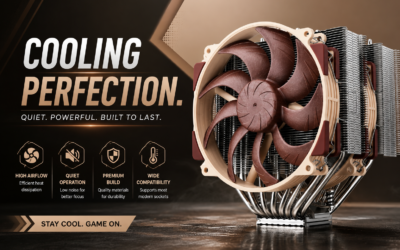
That’s the gap heat pipes fill. A single 6mm pipe can shuttle far more heat per second than a solid copper rod of the same width, because it’s using a phase change instead of plain conduction. Bundle four, five, or six of them together, fan them out through a big fin stack, and you’ve got a cooler that keeps a modern gaming CPU comfortable while staying quiet. That’s why the difference between a $15 stock unit and a proper $40 tower isn’t marketing. It’s physics.
How it works
Break the cycle into four steps. At the hot end, sitting against your CPU, the working fluid absorbs heat and evaporates. Evaporation soaks up a huge amount of energy, which is the trick that makes the whole thing efficient. The vapor then travels up the hollow center of the pipe toward the cool end, moving fast because vapor barely resists flow.
At the cool end, buried in the fin stack where the fan is pushing air, the vapor gives its heat to the fins and condenses back into liquid. Then the wick, that porous lining, wicks the liquid back down to the hot end through capillary action, no pump required. The loop runs on its own, silently, millions of times a second. All you supply is a fan to keep the cool end cool. That self-driven cycle is why a passive-looking hunk of copper can outperform something twice its weight in solid metal.
Why it works this way
The reason comes down to latent heat. Boiling a liquid into vapor stores enormous energy in that vapor, and releasing it when the vapor condenses dumps all of that energy right back out at the fins. So a heat pipe isn’t really “conducting” heat the way copper does, it’s carrying it as cargo and dropping it off. That’s dramatically faster over any real distance. Engineers pick water as the fluid because it changes phase near the temperatures a CPU actually runs at, and they tune the internal pressure so boiling happens at the right point. Cheap coolers skip pipes to save cost, which is fine for a chip sipping 35 watts. Push a gaming load through that same heatsink and it saturates, temps climb, and the CPU protects itself by clocking down.

When you’d want this
You want a real heat-pipe tower any time you’re gaming on a mid-range or better CPU. If your processor draws more than about 65 watts under load, and most gaming chips do, the stock cooler in the box will run hot and loud, and it may throttle during long sessions. Owner reports consistently show boxed coolers hitting 90C-plus on demanding titles while a $35 to $50 tower holds the same chip 15 to 20 degrees lower and stays whisper-quiet doing it. That temperature headroom is what lets your CPU hold its boost clocks longer.
The other reason is noise. A small stock fan spins loud to move enough air; a big tower with fat pipes moves the same heat with a slower, quieter fan. If you own something toasty like a Ryzen 7 7800X3D, the payoff is even bigger, which is why our best cooler for the 7800X3D picks all run serious pipe counts. And no matter which cooler you buy, the paste between the chip and the base matters too. Good thermal compound like the tube below fills the microscopic gaps so the pipes can actually grab the heat they’re built to move.

Pros
- Non-conductive chemistry safer for novices repasting near exposed CPU or GPU capacitors.
- 6g volume suports several full applications on desktop CPUs and console APUs.
- Wet and dry wipes included, so no isopropyl bottle or lint-free cloth need.
Cons
- Limited owner fedback at time of writing makes long-term durability claims hard to verify.
- Non-metal formula typically trails top liquid metals by a few degrees under sustained load.
- Viscosity, TIM lifespan hours, and thermal conductivity W/mK figures are not specified.
Duronaut is Thermal Grizzly's non-conductive thermal paste positioned as a mid-tier daily driver, shipping in a 6g syringe with 6 wet and 6 dry cleaning wipes. The target buyer is a DIY PC builder repasting a CPU or GPU cooler, or a console owner refreshing PS4, PS5, or Xbox thermals without risking shorts.
The defining trait is the aluminum microparticle plus zinc oxide nanoparticle blend paired with an electrically non-conductive base. Thermal Grizzly claims reduced pump-out and stable performance over extended cycles, which maters most on soldered console APUs and overclocked desktop chips that see large delta-T swings. Exact W/mK conductivity is not specified in the source.
Trade-offs are typical for non-conductive pastes at this tier. Expect a few degrees warmer than liquid metal on delided or high-wattage CPUs, and no published viscosity or cure-time data to plan application around. Owner feedback is limited at time of writing, so long-term hardening resistance relies on vendor claims rather than independent long-run testing.
Buy this if you want a safe, non-conductive paste with enough volume for several repastes and a bundled wipe kit for console or GPU jobs. Skip this if you are chasing the absolute lowest core temperatures on a 250W-plus overclocked CPU where liquid metal or a top nano-diamond paste still leads.
Volume and coverage: The syringe holds 6g of paste, enough for roughly 15 to 25 pea-sized applications on mainstream AM5 or LGA1700 IHS surfaces, or several full console APU repastes on PS4, PS5, and Xbox where die coverage is larger than a desktop CPU heatspreader.
Composition and safety: The compound uses aluminum microparticles and zinc oxide nanoparticles in a non-metal carier, rated electrically non-conductive. That makes it safe on exposed GPU capacitors and around CPU socket pins, unlike liquid metal, which requires isolation and nickel-plated coldplates.
Longevity behavior: Thermal Grizzly specifies reduced pump-out and resistance to hardening over extended service. Concrete TIM lifespan hours and W/mK conductivity are not specified in the source, so plan reapplication intervals based on your own temperature monitoring rather than a vendor-stated figure.
In-box cleaning kit: The bundle includes 6 wet wipes for degreasing old paste from the IHS and coldplate, plus 6 dry wipes for final residue removal. Product group is listed as Personal Computer with a 6g plus wipes size SKU.
What to look for in a CPU cooler
Start with pipe count and thickness. Four 6mm pipes is a decent baseline for a mainstream gaming build; five or six pushes you into high-end territory that can tame a hot chip. Next, look at the base. A direct-touch design puts the pipes flat against your CPU for a shorter heat path, while a nickel-plated copper base spreads heat more evenly first. Both work well, so don’t overthink it. Fin surface area and fan quality round it out, since all that transferred heat still needs air to carry it away. Clearance matters too, tall towers can block RAM or bump the side panel. If you’d rather skip the sizing puzzle, an AIO loop moves the radiator away from the socket, and our best AIO liquid cooler guide covers those. Same core physics, different plumbing.
Common misconceptions
The biggest myth is that heat pipes boost your frame rate. They don’t, at least not directly. FPS comes from your GPU and CPU horsepower; a cooler only helps by preventing thermal throttling, so the chip can hold its rated clocks. If your CPU never gets hot enough to throttle, a fancier cooler won’t add a single frame. Another myth is that liquid cooling always beats air. A good six-pipe tower matches or edges out many entry AIOs, and it can’t spring a leak. People also assume more pipes always wins. Past a point, fin area and fan airflow become the limit, not pipe count. And no, you can’t feel a heat pipe working, there are no moving parts inside. It’s just fluid quietly boiling and condensing, over and over.
Frequently asked
Do heat pipes increase FPS in games?
Not directly. Your frame rate comes from the GPU and CPU doing the work. Heat pipes help indirectly by keeping the CPU cool enough to avoid thermal throttling, which lets it hold higher boost clocks under a long gaming load. If your chip was already running cool, you won’t see extra frames from a better cooler.
How many heat pipes do I need for gaming?
Four 6mm pipes handle most mainstream gaming CPUs just fine. If you’ve got a hotter high-core chip or you’re pushing an overclock, step up to a five or six-pipe tower for the extra headroom. Beyond six, gains shrink because fan airflow and fin area start to matter more than pipe count.
Is a stock cooler good enough for gaming?
It depends on the chip. A basic boxed heatsink, like the Intel E97379 aluminum unit, is fine for a low-power CPU doing light work at around $16. Under a sustained gaming load on a 65-watt-plus processor, it tends to run hot and loud and can throttle. A budget heat-pipe tower for $30 to $40 usually pays for itself in temps and quiet.
Does thermal paste matter as much as the cooler?
Paste won’t make a weak cooler great, but it’s the bridge between the chip and the pipes, so bad or dried-out paste hurts even the best tower. A quality compound, like Thermal Grizzly Duronaut at $24.99 with a 4.4 rating and cleaning wipes included, fills the microscopic gaps and shaves a few degrees. It’s a cheap upgrade that lets your heat pipes do their job.
Do AIO liquid coolers use heat pipes too?
Not inside the loop, no. An AIO uses a pump to push liquid through tubes to a radiator, then a fan cools that radiator. But it relies on the exact same principle of moving heat away from the chip to a large surface with lots of airflow. Air towers just do it with sealed pipes and capillary action instead of a pump.

















Write Your Review
No reviews yet. Be the first to share your experience!