

A 240mm AIO and a 360mm AIO can be separated by only one fan, yet the fit, noise, and heat headroom can feel very different once they’re mounted in a real case. If you’re comparing a 2 fan vs 3 fan AIO for a Ryzen 9 or Core i9 build, the useful question isn’t just radiator size. It’s whether your case, CPU power limits, fan curve, and budget can make use of the extra 120mm of radiator.
We’ve researched the tradeoffs using common 240mm and 360mm layouts, plus related cooling parts that matter when an install gets messy. For more product-specific shopping, see our best 240mm AIO guide, our Intel i9 240mm AIO picks, and our best 360mm AIO roundup.
Matchup at a glance
A 2 fan AIO usually means a 240mm radiator with two 120mm fans. A 3 fan AIO means a 360mm radiator with three 120mm fans. That’s the comparison most builders want.
The 240mm option wins on case compatibility, easier top mounting, and lower upfront cost. It’s often enough for mainstream CPUs, locked power limits, and gaming loads that don’t pin all cores for long stretches. The 360mm option wins on sustained heat capacity. More radiator surface lets the fans run slower for the same thermal target. Simple math. More metal, more coolant path, more airflow area.
That doesn’t make 360mm automatically better. If your case front panel is restrictive, if the tubes barely reach, or if you have to mount the radiator as front intake, the theoretical advantage shrinks. A clean 240mm top exhaust can be calmer than a cramped 360mm behind a solid front panel.
Spec sheet showdown
| Factor | 2 fan AIO | 3 fan AIO | Best fit | Watch-out |
|---|---|---|---|---|
| Typical radiator | 240mm, two 120mm fans | 360mm, three 120mm fans | 240mm for mid towers and smaller builds | Measure top clearance before buying |
| Cooling headroom | Good for many 65W to 125W CPUs | Better for high boost power and long all-core loads | 360mm for hot unlocked CPUs | Bad airflow can erase the gap |
| Noise potential | May need higher fan speed under long loads | Can often hold lower fan speed | 360mm for quiet heavy work | Pump noise still matters |
| Case fit | Fits more top panels and compact cases | Needs 360mm radiator support | 240mm for small form factor planning | RAM and motherboard heatsinks can conflict |
| Maintenance parts | Thermal paste and mounting pressure still matter | Thermal paste and mounting pressure still matter | Both need careful installation | A bad mount can mimic a weak cooler |
2 fan AIO strengths
The best argument for a 2 fan AIO is not that it’s the strongest cooler. It’s that it fits more builds without turning the case layout into a puzzle. A 240mm radiator can often sit at the top of an ATX mid tower as exhaust, leaving the front intake fans to feed the GPU with cooler air. That’s a tidy setup, and it reduces tube routing drama too.
For gaming, a 240mm AIO can make a lot of sense. Many games spike a few cores rather than loading every thread at maximum power for 30 minutes. With reasonable CPU power settings, the cooler doesn’t have to absorb workstation-level heat forever. You’ll still want decent case airflow, but you won’t always need the largest radiator your chassis can accept.
A smaller radiator can also mean fewer fan bearings, fewer cables, and less RGB clutter if you’re building clean. If you’re working in a small form factor case, our 240mm AIO small form factor guide is the lane that usually matters. A 360mm radiator may sound nice, but many compact cases don’t support it without serious compromises.
The tradeoff is sustained load headroom. If you’re running a high-end CPU with raised power limits, long renders, shader compilation, or heavy encoding, the 240mm unit has less radiator area to dump heat. Fans can spin faster to compensate, but then the build gets louder. Physics doesn’t negotiate.
3 fan AIO strengths
A 3 fan AIO is about thermal buffer. With a 360mm radiator, you get 50 percent more 120mm fan positions than a 240mm layout, plus the extra radiator length that goes with them. That helps during long CPU loads where coolant temperature keeps rising over time. For unlocked Core i7, Core i9, Ryzen 9, and heavy productivity rigs, that extra surface area can be the difference between a calm fan curve and a noisy one.
It’s also useful when you care about noise more than peak temperature. A larger radiator can move the same heat with slower fans, assuming the case lets it breathe. That’s the real appeal for a silent build. Not magic, just lower RPM for a given heat load. If silence is your priority, our silent 240mm AIO guide is still worth reading, but a good 360mm mount gives you more room to tune.
The catch is installation. A 360mm radiator often lives in the front of the case, especially in mid towers where top clearance is limited. Front mounting can feed the radiator cooler outside air, which helps CPU temperature, but it can also raise internal case temperature for the GPU. Top mounting avoids that, yet it needs enough clearance above the motherboard. Check the case manual, not just the product page.
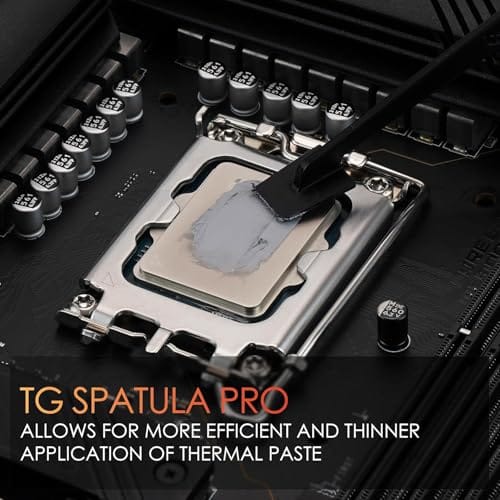
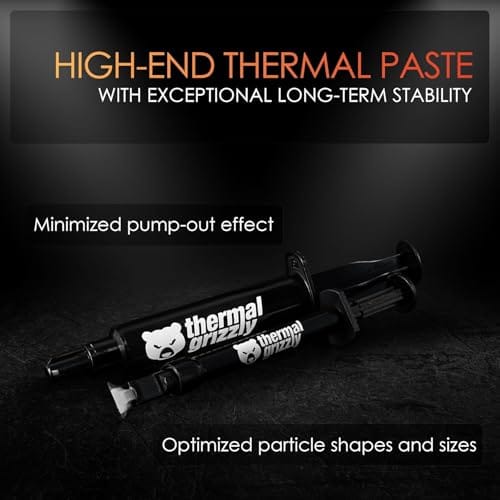
If you’re chasing lower temperatures and you’ve already got the radiator size handled, mounting quality still matters. Thermal Grizzly Duronaut costs $24.99, carries a 4.4 rating, and includes 6 grams of paste with 12 cleaning wipes, 6 wet and 6 dry. That’s relevant because uneven paste or old residue can make either AIO look worse than it is.

Pros
- Non-conductive chemistry safer for novices repasting near exposed CPU or GPU capacitors.
- 6g volume suports several full applications on desktop CPUs and console APUs.
- Wet and dry wipes included, so no isopropyl bottle or lint-free cloth need.
Cons
- Limited owner fedback at time of writing makes long-term durability claims hard to verify.
- Non-metal formula typically trails top liquid metals by a few degrees under sustained load.
- Viscosity, TIM lifespan hours, and thermal conductivity W/mK figures are not specified.
Duronaut is Thermal Grizzly's non-conductive thermal paste positioned as a mid-tier daily driver, shipping in a 6g syringe with 6 wet and 6 dry cleaning wipes. The target buyer is a DIY PC builder repasting a CPU or GPU cooler, or a console owner refreshing PS4, PS5, or Xbox thermals without risking shorts.
The defining trait is the aluminum microparticle plus zinc oxide nanoparticle blend paired with an electrically non-conductive base. Thermal Grizzly claims reduced pump-out and stable performance over extended cycles, which maters most on soldered console APUs and overclocked desktop chips that see large delta-T swings. Exact W/mK conductivity is not specified in the source.
Trade-offs are typical for non-conductive pastes at this tier. Expect a few degrees warmer than liquid metal on delided or high-wattage CPUs, and no published viscosity or cure-time data to plan application around. Owner feedback is limited at time of writing, so long-term hardening resistance relies on vendor claims rather than independent long-run testing.
Buy this if you want a safe, non-conductive paste with enough volume for several repastes and a bundled wipe kit for console or GPU jobs. Skip this if you are chasing the absolute lowest core temperatures on a 250W-plus overclocked CPU where liquid metal or a top nano-diamond paste still leads.
Volume and coverage: The syringe holds 6g of paste, enough for roughly 15 to 25 pea-sized applications on mainstream AM5 or LGA1700 IHS surfaces, or several full console APU repastes on PS4, PS5, and Xbox where die coverage is larger than a desktop CPU heatspreader.
Composition and safety: The compound uses aluminum microparticles and zinc oxide nanoparticles in a non-metal carier, rated electrically non-conductive. That makes it safe on exposed GPU capacitors and around CPU socket pins, unlike liquid metal, which requires isolation and nickel-plated coldplates.
Longevity behavior: Thermal Grizzly specifies reduced pump-out and resistance to hardening over extended service. Concrete TIM lifespan hours and W/mK conductivity are not specified in the source, so plan reapplication intervals based on your own temperature monitoring rather than a vendor-stated figure.
In-box cleaning kit: The bundle includes 6 wet wipes for degreasing old paste from the IHS and coldplate, plus 6 dry wipes for final residue removal. Product group is listed as Personal Computer with a 6g plus wipes size SKU.
Real-world scenarios
Scenario 1: Gaming on a mainstream CPU
For a Ryzen 5, Ryzen 7, Core i5, or locked Core i7 gaming box, a 240mm AIO is usually the cleaner buy if the case has good intake. You’ll get a neat top mount, fewer clearance issues, and enough cooling for typical gaming behavior. If your CPU package power stays modest during play, the 360mm unit may spend most of its life underused. Nice to have. Not required.
Scenario 2: Long all-core production loads
Rendering, encoding, compiling, and simulation workloads change the equation because the CPU can hold high package power for much longer. Here, a 360mm AIO earns its space. The extra radiator area gives coolant more room to stabilize, so fans don’t have to ramp as aggressively after the first 10 minutes. If you’re already paying for a high-end CPU, the larger cooler is easier to justify.
Scenario 3: Small case, tight top panel, tall RAM
Case geometry can overrule preference. A 240mm radiator that fits properly is better than a 360mm radiator that forces bent tubes, blocked fan screws, or a front-panel airflow penalty. Measure radiator thickness, fan thickness, motherboard heatsink height, and RAM height. Then measure again. The boring part saves the build.
Scenario 4: Fixing an older cooler setup
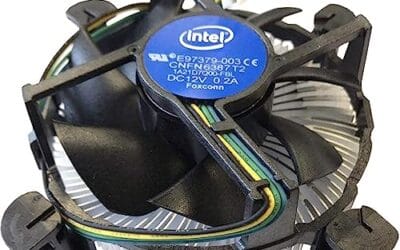
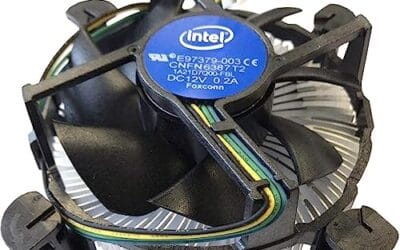
Sometimes the right answer is neither new AIO size. If an older system uses a basic air cooler and the CPU is a lower-power Intel chip on socket 1150, 1155, or 1156, a simple replacement may solve a broken fan or missing mount. The Intel E97379-003 cooler is $15.99, has a 4.1 rating, and lists a 4-pin connector, aluminum heatsink, and 3.5-inch fan. It’s not an AIO competitor, but it is a real fix for older compatible desktops.
Pricing and availability
A 240mm AIO generally costs less than a comparable 360mm model from the same brand family. You save on the radiator, the third fan, and sometimes the case needed to fit it. The build price can shift fast if a 360mm cooler forces a larger chassis. That’s why the cheaper cooler can also be the cheaper platform choice.
A 360mm AIO starts making more sense when the CPU itself is expensive, power-hungry, and likely to run sustained workloads. Spending extra to keep a $400 to $600 processor quieter is easier to defend than overspending on cooling for a budget gaming CPU. Availability also swings with color, LCD pump tops, and RGB packages, so compare the plain performance version first.
Which to buy
Buy the 2 fan AIO if you want the easier fit, you’re building in a normal mid tower or compact case, and your workload is mostly gaming, school, office, or light creation. It’s the less dramatic choice, and that’s a compliment. It keeps the front of the case free for intake, it gives the GPU cleaner air, and it avoids a lot of radiator clearance traps.
Buy the 3 fan AIO if you’re cooling a high-power CPU, you run long all-core workloads, or you’re trying to keep fan noise low under sustained heat. Make sure your case supports a 360mm radiator in the position you actually want, not just somewhere on the spec sheet. Also budget for careful installation because paste, pressure, and radiator orientation can swing the result.
If you’re refreshing an older compatible Intel desktop rather than buying an AIO, the Intel E97379-003 is the more grounded part to consider. At $15.99 with a 4.1 rating, its socket 1150, 1155, and 1156 support and 4-pin 3.5-inch fan make it a basic repair part, not a luxury cooling upgrade.

Pros
- Native LGA 1150, 1155, and 1156 socket support covers three legacy Intel generations
- 4-pin PWM connector enables proper fan curve control via BIOS
- OEM-style aluminum heatsink footprint keps RAM and VRM clearance predictable
- Push-pin mount installs without removing the motherboard from the case
Cons
- Zero owner fedback available at time of writing, real-world thermals unverified
- Aluminum-only heatsink with no heatpipes struggles with overclocked or unlocked K-series CPUs
- Restricted to obsolete Intel sockets, no path forward to LGA 1200, 1700, or AM5
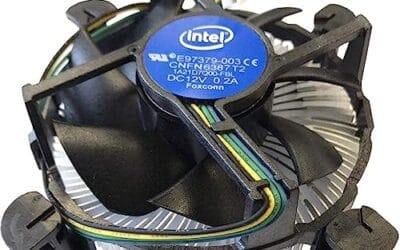
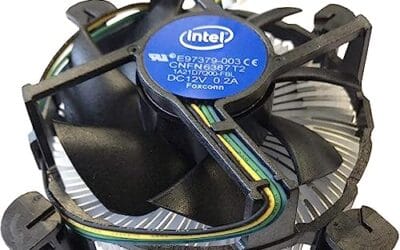
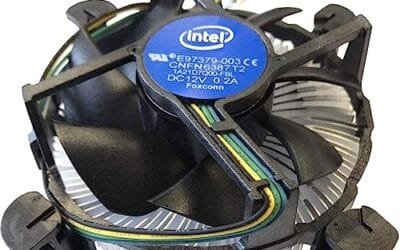
The Intel E97379-003 is an OEM-style stock CPU cooler built for LGA 1150, 1155, and 1156 boards, covering Core i3, i5, and i7 chips from the Sandy Bridge through Haswell era. It targets one specific buyer: someone repairing, refurbishing, or restoring a legacy Intel desktop that lost its original heatsink.
The defining feature is compatibility, not performance. A 3.5-inch fan sits on an aluminum heatsink with a 4-pin PWM header, matching the original OEM cooler dimensions Intel shipped in retail boxes. Stock coolers in this class typically handle 65W to 84W TDP chips at stock clocks, which lines up with locked i3, i5, and non-K i7 SKUs on these sockets.
Trade-offs are typical for a boxed-style cooler. There are no heatpipes, no copper base contact, and no tower geometry, so sustained multi-core loads will spin the fan up and get audible. Push-pin mounting is convenient but less secure than a backplate design, and overclocking headroom is effectively zero. Owner feedback is not available at time of writing.
Buy this if you need a like-for-like OEM replacement for a locked LGA 1150, 1155, or 1156 CPU and want to kep the original acoustic and clearance profile. Skip this if the CPU is a K-series part, if you plan to overclock, or if the target socket is LGA 1200 or newer.
Socket coverage: Native mounting for LGA 150, 1155, and 1156 only. That spans 2nd, 3rd, and 4th generation Core i3, i5, and i7 desktop chips. No adapter is included for LGA 1200, 1700, or AM4/AM5, so this cooler is locked to legacy Intel repair scenarios.
Heatsink and fan: Aluminum radial-fin heatsink with a 3.5-inch axial fan on a 4-pin PWM connector. No heatpipes, no copper slug, no vapor chamber are indicated in source data. TDP handling is not specified, but OEM colers of this geometry are typically rated for the 65W to 84W stock TDP band on these sockets.
Mounting and clearance: Push-pin retention through the four motherboard holes, no backplate required, install possible without removing the board. Cooler height sits low enough to clear standard mid-tower side panels, and the round footprint keps RAM slots and VRM heatsinks unobstructed. Exact height in mm is not specified.
Acoustics and headroom: Noise level in dBA is not specified. Based on OEM stock cooler behavior at this size, expect quiet idle and audible ramp under sustained all-core load. Overclocking a K-series chip on this heatsink is not advisable, thermal headroom above 84W is minimal.
Common questions
Is a 3 fan AIO always cooler than a 2 fan AIO?
Usually it has more cooling potential, but the case layout decides how much of that potential you see. A restricted front panel, poor exhaust, or bad mount can narrow the gap. A clean 240mm top mount can beat a poorly placed 360mm setup in daily use.
Is 240mm enough for a Core i9?
It can be enough with sensible power limits, especially for gaming. For sustained all-core work, a 360mm AIO is safer and often quieter. If you’re pairing an i9 with unlocked power limits, don’t treat radiator size as an afterthought.
Does a 360mm AIO make the GPU hotter?
It can if the radiator is mounted as front intake because warmed radiator air enters the case. The CPU may run cooler while the GPU sees warmer intake air. Top exhaust avoids that tradeoff, but only if the case has clearance.
Should I choose 280mm instead?
A 280mm AIO with two 140mm fans can be excellent, sometimes landing between 240mm and 360mm behavior. It depends on case support because 140mm fan spacing is less universal. If your case supports top 280mm cleanly, it’s worth comparing.
Can thermal paste matter as much as radiator size?
Thermal paste won’t turn a weak cooler into a flagship cooler, but a poor paste job can hurt either size. Uneven pressure, dried paste, or plastic film left on the cold plate can cause high temperatures fast. Small mistake. Big headache.









Write Your Review
No reviews yet. Be the first to share your experience!