

An AIO cooler is a sealed liquid CPU cooler that combines a pump, cold plate, tubes, radiator, fans, and coolant into one ready-to-install unit. You don’t fill it, cut tubing, or build a custom loop. You bolt the pump block to the CPU, mount the radiator to the case, plug in the pump and fans, and let the cooler move heat away from the processor.
AIOs are popular because they can move heat to a larger radiator mounted at the top, front, or side of the case. That helps high-wattage CPUs, compact layouts, and showcase builds where a large air tower may block RAM or dominate the motherboard area. If you’re comparing options, our AIO liquid cooler guide and air CPU cooler picks are useful companion reads.
The short answer
An AIO cooler, short for all-in-one cooler, is a closed-loop liquid cooler for your CPU. The pump sits in or near the CPU block, the coolant carries heat through tubes, and the radiator fans push that heat into the air. It’s liquid cooling without the maintenance and planning of a custom water loop.
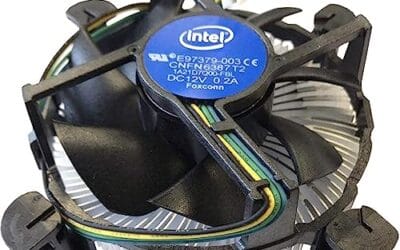
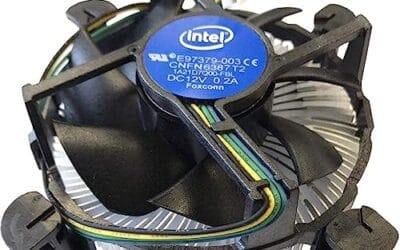
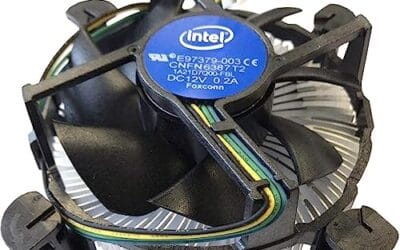
The idea is easiest to understand by comparing it with a basic stock cooler. Intel’s E97379-003, priced at $15.99 with a 4.1 rating, is a traditional air cooler for older Socket 1150, 1155, and 1156 Core i3, i5, and i7 chips. It uses an aluminum heatsink and a 3.5-inch fan. An AIO performs the same job, CPU heat removal, but relocates much of the heat exchange to a radiator mounted elsewhere in the case.

Pros
- Native LGA 1150, 1155, and 1156 socket support covers three legacy Intel generations
- 4-pin PWM connector enables proper fan curve control via BIOS
- OEM-style aluminum heatsink footprint keps RAM and VRM clearance predictable
- Push-pin mount installs without removing the motherboard from the case
Cons
- Zero owner fedback available at time of writing, real-world thermals unverified
- Aluminum-only heatsink with no heatpipes struggles with overclocked or unlocked K-series CPUs
- Restricted to obsolete Intel sockets, no path forward to LGA 1200, 1700, or AM5
The Intel E97379-003 is an OEM-style stock CPU cooler built for LGA 1150, 1155, and 1156 boards, covering Core i3, i5, and i7 chips from the Sandy Bridge through Haswell era. It targets one specific buyer: someone repairing, refurbishing, or restoring a legacy Intel desktop that lost its original heatsink.
The defining feature is compatibility, not performance. A 3.5-inch fan sits on an aluminum heatsink with a 4-pin PWM header, matching the original OEM cooler dimensions Intel shipped in retail boxes. Stock coolers in this class typically handle 65W to 84W TDP chips at stock clocks, which lines up with locked i3, i5, and non-K i7 SKUs on these sockets.
Trade-offs are typical for a boxed-style cooler. There are no heatpipes, no copper base contact, and no tower geometry, so sustained multi-core loads will spin the fan up and get audible. Push-pin mounting is convenient but less secure than a backplate design, and overclocking headroom is effectively zero. Owner feedback is not available at time of writing.
Buy this if you need a like-for-like OEM replacement for a locked LGA 1150, 1155, or 1156 CPU and want to kep the original acoustic and clearance profile. Skip this if the CPU is a K-series part, if you plan to overclock, or if the target socket is LGA 1200 or newer.
Socket coverage: Native mounting for LGA 150, 1155, and 1156 only. That spans 2nd, 3rd, and 4th generation Core i3, i5, and i7 desktop chips. No adapter is included for LGA 1200, 1700, or AM4/AM5, so this cooler is locked to legacy Intel repair scenarios.
Heatsink and fan: Aluminum radial-fin heatsink with a 3.5-inch axial fan on a 4-pin PWM connector. No heatpipes, no copper slug, no vapor chamber are indicated in source data. TDP handling is not specified, but OEM colers of this geometry are typically rated for the 65W to 84W stock TDP band on these sockets.
Mounting and clearance: Push-pin retention through the four motherboard holes, no backplate required, install possible without removing the board. Cooler height sits low enough to clear standard mid-tower side panels, and the round footprint keps RAM slots and VRM heatsinks unobstructed. Exact height in mm is not specified.
Acoustics and headroom: Noise level in dBA is not specified. Based on OEM stock cooler behavior at this size, expect quiet idle and audible ramp under sustained all-core load. Overclocking a K-series chip on this heatsink is not advisable, thermal headroom above 84W is minimal.
The longer explanation
A CPU cooler has one job: move heat off the processor fast enough that it can maintain stable boost clocks without reaching its thermal limit. An air cooler uses a metal base, heat pipes, fin stacks, and fans. An AIO uses a cold plate on the CPU, liquid coolant, a small pump, flexible tubing, a radiator, and fans. Both depend on surface area and airflow. The route is different.
Inside an AIO, heat moves from the CPU’s heat spreader into the cold plate, then into the coolant. The pump circulates that warmed coolant to the radiator, where thin channels and fins spread the heat across a larger area. Fans push air through those fins. The cooled liquid then returns to the CPU block. Round and round. Quiet when tuned well, noisy when the pump or fans are poorly managed.
The key advantage is placement. A big air tower has to keep most of its fin mass beside the CPU socket, so it can conflict with tall memory, side-panel clearance, or motherboard heatsinks. An AIO moves the large heat exchanger to a radiator mount. That can make the center of the motherboard cleaner and give the case fans a more organized airflow path, as long as the radiator mount isn’t choking for air.
History / how we got here
Liquid cooling used to be mainly for enthusiasts building custom loops with separate pumps, reservoirs, blocks, fittings, tubing, and radiators. Those setups could cool very well, but they required planning, leak checks, maintenance, and a willingness to troubleshoot. Great for hobbyists. A lot for everyone else.
AIOs became the mainstream version because they packaged the loop at the factory. The buyer didn’t need to fill coolant or choose fittings. Over time, 120mm radiators gave way to more common 240mm, 280mm, 360mm, and even larger models. Modern CPUs also boosted more aggressively, which made radiator capacity and case airflow more important for builders using chips like Intel Core i9 or Ryzen 9. Our Intel i9 AIO guide focuses on that higher-heat scenario.
Why it works this way
An AIO works because liquid can transfer heat from a tight CPU socket area to a radiator with more surface area. The radiator doesn’t create cold air; it just gives the fans a larger fin stack to work with. A 240mm radiator has room for two 120mm fans, while a 360mm radiator uses three. More radiator area can mean lower fan speeds for the same heat load, assuming the case has enough ventilation.
Mounting matters too. A top-mounted radiator often exhausts warm air out of the case and keeps tubing tidy, while a front-mounted radiator can feed the CPU cooler cooler outside air at the cost of warming the air entering the case. Pump noise, fan curve, tube orientation, and radiator thickness all affect the result. You can’t judge the whole setup by liquid versus air alone.
The pump is another reason AIOs feel different from air coolers. Air coolers mostly have fan noise, while AIOs add a small mechanical pump that should run smoothly at a stable speed. If the pump header is set incorrectly or the radiator traps air near the pump, cooling can suffer and the system may sound rough. Simple setup choices matter more than the product photo suggests.
When you’d want this
You’d want an AIO cooler when your CPU produces enough heat that a small stock cooler feels inadequate, or when your case layout favors a radiator over a tall air tower. It’s also attractive in builds with tall RGB memory, glass side panels, or motherboard areas you don’t want hidden behind a massive heatsink. Clean look. More room around the socket.
AIOs also make sense if you’re tuning a hot chip, running long CPU-heavy workloads, or building in a case designed around top or side radiator mounts. Thermal paste still matters during installation, and Thermal Grizzly Duronaut is a related maintenance item at $24.99 with a 4.4 rating. Its 6-gram tube and included wet and dry cleaning wipes are useful details if you’re reseating a cooler or moving from an older heatsink to a new AIO.

Pros
- Non-conductive chemistry safer for novices repasting near exposed CPU or GPU capacitors.
- 6g volume suports several full applications on desktop CPUs and console APUs.
- Wet and dry wipes included, so no isopropyl bottle or lint-free cloth need.
Cons
- Limited owner fedback at time of writing makes long-term durability claims hard to verify.
- Non-metal formula typically trails top liquid metals by a few degrees under sustained load.
- Viscosity, TIM lifespan hours, and thermal conductivity W/mK figures are not specified.
Duronaut is Thermal Grizzly's non-conductive thermal paste positioned as a mid-tier daily driver, shipping in a 6g syringe with 6 wet and 6 dry cleaning wipes. The target buyer is a DIY PC builder repasting a CPU or GPU cooler, or a console owner refreshing PS4, PS5, or Xbox thermals without risking shorts.
The defining trait is the aluminum microparticle plus zinc oxide nanoparticle blend paired with an electrically non-conductive base. Thermal Grizzly claims reduced pump-out and stable performance over extended cycles, which maters most on soldered console APUs and overclocked desktop chips that see large delta-T swings. Exact W/mK conductivity is not specified in the source.
Trade-offs are typical for non-conductive pastes at this tier. Expect a few degrees warmer than liquid metal on delided or high-wattage CPUs, and no published viscosity or cure-time data to plan application around. Owner feedback is limited at time of writing, so long-term hardening resistance relies on vendor claims rather than independent long-run testing.
Buy this if you want a safe, non-conductive paste with enough volume for several repastes and a bundled wipe kit for console or GPU jobs. Skip this if you are chasing the absolute lowest core temperatures on a 250W-plus overclocked CPU where liquid metal or a top nano-diamond paste still leads.
Volume and coverage: The syringe holds 6g of paste, enough for roughly 15 to 25 pea-sized applications on mainstream AM5 or LGA1700 IHS surfaces, or several full console APU repastes on PS4, PS5, and Xbox where die coverage is larger than a desktop CPU heatspreader.
Composition and safety: The compound uses aluminum microparticles and zinc oxide nanoparticles in a non-metal carier, rated electrically non-conductive. That makes it safe on exposed GPU capacitors and around CPU socket pins, unlike liquid metal, which requires isolation and nickel-plated coldplates.
Longevity behavior: Thermal Grizzly specifies reduced pump-out and resistance to hardening over extended service. Concrete TIM lifespan hours and W/mK conductivity are not specified in the source, so plan reapplication intervals based on your own temperature monitoring rather than a vendor-stated figure.
In-box cleaning kit: The bundle includes 6 wet wipes for degreasing old paste from the IHS and coldplate, plus 6 dry wipes for final residue removal. Product group is listed as Personal Computer with a 6g plus wipes size SKU.
What to look for in an AIO cooler
Start with radiator size and case support. A 240mm AIO is a common baseline for midrange CPUs, a 280mm model can be excellent if your case supports 140mm fan spacing, and a 360mm unit is popular for hotter CPUs and quiet high-end builds. Check thickness, clearance near the motherboard heatsinks, and whether the tubes can reach without sharp bends.
Next, look at socket compatibility, pump control, fan quality, noise ratings, warranty, and software requirements. Some coolers run happily from motherboard headers, while others depend on USB control hubs and vendor software for lighting or fan curves. If your priority is silence, our silent build AIO guide is the more targeted path. If your case is compact, confirm radiator placement before buying anything.
Also think about service access. A front radiator can make the inside of the case tighter when you’re routing GPU power cables, while a top radiator can conflict with tall motherboard heatsinks or memory in smaller towers. You’ll want enough slack in the tubes to mount the block without twisting it. Dry-fit first. It’s boring, and it saves frustration.
Common misconceptions
The first misconception is that liquid cooling is always better than air cooling. It isn’t. A strong air cooler can beat a weak 120mm AIO, and it has fewer moving parts. A large AIO earns its keep when radiator area, fan tuning, and CPU heat output line up.
Another misconception is that AIOs are maintenance-free forever. They’re sealed and don’t need coolant refills, but pumps can wear, fans collect dust, and coolant can slowly permeate through tubing over years. Watch temperatures, clean radiator fins, and listen for new pump grinding or bubbling. Small changes. Worth noticing.
Frequently asked
Is an AIO cooler safe for a PC?
Yes, a reputable AIO cooler is generally safe when installed correctly. The loop is sealed at the factory, so you don’t handle coolant during normal installation. The bigger everyday issues are incorrect mounting pressure, a forgotten pump cable, or poor radiator placement.
How long does an AIO cooler last?
Many AIO coolers run for several years, but lifespan depends on pump quality, fan quality, heat load, and operating hours. A failing unit may show rising CPU temperatures, new pump noise, or intermittent cooling behavior. If the pump stops, replace the cooler rather than trying to repair the sealed loop.
Do I need a 360mm AIO?
Not for every CPU. A 360mm AIO is useful for high-wattage processors, quieter fan curves, and cases with good top or front radiator support. For many midrange CPUs, a good 240mm or 280mm model is enough.
Is an AIO better than a stock cooler?
For many gaming and productivity builds, yes, a decent AIO offers more cooling capacity than a small stock cooler. Stock coolers are built for basic operation, older sockets, or lower-power chips. An AIO is the upgrade path when heat, noise, or boost behavior becomes a concern.
Can I install an AIO in any case?
No. Your case needs the right radiator mount, fan spacing, clearance, and tube path. Check whether it supports 240mm, 280mm, or 360mm radiators at the top, front, or side. Also confirm that the radiator won’t collide with tall RAM, motherboard heatsinks, or the GPU.
Mounting position matters too. A front-mounted radiator can feed the CPU cooler with cooler outside air, while a top mount usually dumps less warm air into the case after the loop does its work. Neither layout is automatically right. The better choice depends on GPU heat, case airflow, and whether the pump stays below part of the radiator so air bubbles do not collect inside it.















Write Your Review
No reviews yet. Be the first to share your experience!