

AM5 has matured in 2026, AGESA updates have stabilized memory training, and Ryzen 7 7800X3D remains a standout for gaming. Cooling still matters because X3D boost behavior is sensitive to temperature, and marketing claims around TDP ratings, heat pipe counts, and fan RPM can be confusing. This guide explains how to size and select a cooler for a 7800X3D build, what to prioritize for noise and thermals, and which fit pitfalls to avoid. Use the product list below for models, then apply the framework to match your case, workload, and acoustic goals. Worth reading alongside this: our guide to the 120mm vs 200mm case fan.
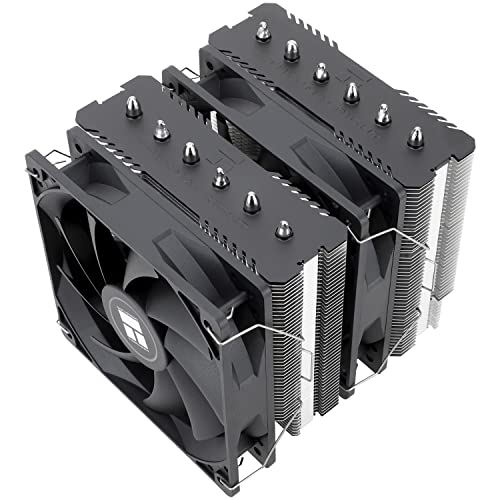
Pros
- 6 pure copper sintered heat pipes with AGHP technique handle inverse gravity mounting orientations
- Dual 120mm PWM fans push 66.17 CFM max at≤25.6 dB(A) rated ceiling
- Wide socket coverage across current AM5, LGA1700 and legacy LGA115X, LGA1200 platforms
Cons
- Limited owner feedback available at time of writing, verify recent long-term thread reports
- 155mm total cooler height requires case CPU clearance check before ordering
- AMD install reuses stock motherboard backplate, which is not included in the box
The Thermalright Peerless Assassin 120 SE is a budget dual-tower air cooler aimed at builders assembling mid-range AM5 or LGA1700 systems. It uses 6 pure copper sintered heat pipes and dual 120mm PWM fans, targeting users who want tower-cooler thermals without stepping up to a 240mm AIO.
The defining spec is the 6 heat pipe AGHP layout paired with fans rated at 66.17 CFM and 1550 RPM. Coolers in this class typically tame 65-125W TDP chips like the Ryzen 7 700 or Core i5-14600K under sustained load, based on owner reports of comparable dual-tower designs at this tier.
Trade-offs are typical at this tier. The 155mm total height rules out slim mini-ITX cases, and AMD installation reuses the motherboard stock backplate, which is not shipped in the box. Owner feedback is limited at time of writing, so verify recent community reports before committing to a high-TDP overclock target.
Buy this if you want a quiet dual-tower cooler for a Ryzen 5/7 or Core i5/i7 build with confirmed 158mm case clearance. Skip this if you plan to push a 250W-class chip like the Core i9-14900K under all-core loads, where a 280mm or 360mm AIO is the safer pairing.
Heat pipe design: 6 pure copper sintered heat pipes at 6mm diameter use AGHP technique, handling inverse gravity mounting in horizontal or open-bench setups. Thermalright specifies a full electroplating reflow welding process at the base, which typically improves contact consistency versus stamped budget coolers in this class.
Fan and airflow: Dual TL-C12C 120mm x 25mm PWM fans spin up to 1550 RPM ±10%, rated at 66.17 CFM max airflow and ≤25.6 dB(A) noise ceiling. The 4-pin PWM header allows BIOS fan curve control, so idle and light gaming loads stay quiet.
Socket and clearance: Mounting supports Intel LGA150, LGA1151, LGA1200, LGA1700 and LGA1851, plus AMD AM4 and AM5. Cooler footprint is 125(L) x 135(W) x 155(H)mm, so confirm case CPU cooler clearance of 158mm or higher and check DIMM height under the front fan.
Install notes: AMD install requires the motherboard stock backplate, which is not shipped in the box. Intel install uses the included metal fastener kit. The 135mm width may crowd the first PCIe slot on compact ITX or micro-ATX boards, verify layout before purchase.

Pros
- Dual Silent Wings PWM fans with fluid-dynamic bearings and 6-pole motors, aimed at lower mechanical noise.
- Two-mode Speed Switch gives a simple, hardware-level way to cap noise or unlock higher RPM.
- Nickel-plated base supports liquid metal compounds, per the listing.
- Clear physical dimensions provided, making case-fit checks straightforward before buying.
Cons
- 168mm height can exceed the CPU cooler clearance of many compact mid-towers and most small-form-factor cases.
- Large dual-tower air coolers commonly interfere with tall RAM or tight first PCIe layouts, and RAM clearance is not specified.
- Socket and bracket compatibility is not stated in the listing, so buyers must confirm platform support before purchase.
The be quiet! Dark Rock Pro 5 (BK036) is a high-end dual-tower CPU air cooler aimed at builders who want workstation-class sustained cooling without resorting to an AIO. It is positioned for overclocked systems and long, heavy CPU loads where fan acoustics and stable temperatures both matter.
The headline hardware is seven copper heat pipes paired with two Silent Wings PWM fans. In real builds, coolers of this size typically handle high package power better than single-tower designs because they spread heat across more fin area and can run the fans at lower RPM for a given temperature.
Its two-fan setup mixes a 120mm front fan and a 135mm middle fan, and the front fan uses a funnel-shaped inlet plus tight blade-to-frame clearance to focus pressure through the fin stack. The fans use fluid-dynamic bearings and 6-pole motors, and the rubberized fan frame is designed to reduce vibration transfer into the heatsink.
A practical differentiator is the physical Speed Switch: Quiet mode limits maximum fan speed to 1500rpm, while Performance mode allows up to 2000rpm. The trade-off is straightforward, lower noise ceiling versus extra cooling headroom, and you can choose based on whether you prioritize silence in daily workloads or lower temperatures under sustained rendering, compiling, or stress testing.
Buy this if you want a large, blacked-out dual-tower cooler with a simple noise versus cooling switch and liquid-metal-compatible nickel base. Skip it if your case has tight CPU cooler clearance, you run very tall RAM, or you cannot confirm socket support from the product listing.
| Type | Dual-tower CPU air cooler |
| Heat pipes | 7 copper heat pipes |
| Fans included | 2x Silent Wings PWM (front 120 x 120 x 25 mm, middle 135 x 135 x 25 mm) |
| Speed modes | Quiet mode up to 1500rpm; Performance mode up to 2000rpm (per listing) |
| Fan bearing / motor | Fluid-dynamic bearings; smooth 6-pole motors (per listing) |
| Heatsink coating | Black coating with ceramic particles (per listing) |
| Base | Nickel-plated, listed as compatible with liquid metal and thermal grease |
| Overall dimensions (L x W x H) | 145 x 136 x 168 mm (without mounting material) |
| Heatsink dimensions (L x W x H) | 119.5 x 136 x 168 mm |
| Top cover | Detachable mesh top cover with integrated middle fan, inserted from above |
| Thermal paste | Included (per title/listing) |
| CPU socket support | Not specified in the listing |
Case clearance: Check your chassis CPU cooler height limit against the listed 168mm cooler height. Many compact cases will not fit a cooler this tall.
RAM and PCIe spacing: This is a wide, dual-tower design, and clearance for tall DIMM heatspreaders is not stated in the listing. If you use very tall RAM, plan for possible front-fan repositioning or fit checks.
Motherboard headers and control: The fans are PWM, so plan on available 4-pin fan headers and set curves in BIOS. The Speed Switch changes the maximum fan speed and PWM behavior, so tune curves per mode.
Thermal compound choices: The nickel-plated base is listed as compatible with liquid metal compounds. If you use liquid metal, apply carefully and isolate surrounding components, since it is electrically conductive.
Platform mounting: The listing describes a black mounting kit and an installation concept with a detachable top cover, but it does not state supported sockets. Confirm your CPU socket compatibility in the product listing before committing.
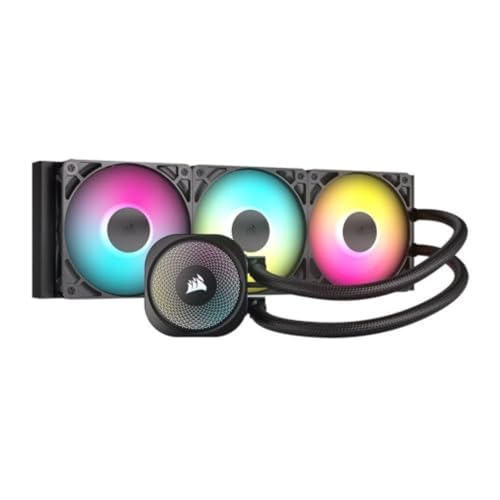
Pros
- Supports Intel LGA1851/LGA1700 and AMD AM5/AM4 in one cooler.
- Motherboard-controlled PWM and 5V ARGB, no included controller required.
- Daisy-chain fan connections simplify wiring for a 360mm setup.
- Pre-applied thermal paste and convex cold plate reduce installation friction.
- Pump noise is listed at 20 dBA for low-noise oriented builds.
Cons
- 360mm radiators require a case with compatible top or front mounts, not ideal for many compact enclosures.
- Full iCUE ecosystem control is optional and requires a separate controller (sold separately).
- Fan speed range, radiator thickness, and tubing length are not specified in the listing.
The CORSAIR Nautilus 360 RS ARGB is a mid-range 360mm all-in-one liquid CPU cooler aimed at builders who want straightforward wiring and motherboard-synced lighting. It targets AM5 and LGA1700/LGA1851 systems where a 360mm radiator is commonly chosen for sustained multi-core workloads and quieter fan curves.
The defining feature is the direct-to-motherboard approach: the fans and ARGB lighting are designed to run from standard headers without a separate controller. In real-world terms, a 360mm AIO class cooler typically gives more thermal headroom than smaller AIOs, which can help maintain boost behavior during long renders, encodes, or heavy compile sessions, depending on CPU power limits and case airflow.
Corsair calls out a slightly convex cold plate with pre-applied thermal paste, which is intended to improve contact across the CPU’s integrated heat spreader and make first-time mounting faster. The included RS120 ARGB fans are positioned as radiator-capable, with AirGuide technology and Magnetic Dome bearings for a balance of focused airflow and controlled noise.
Trade-offs are mostly about fit and ecosystem expectations. A 360mm radiator can force case and layout choices, and your motherboard needs an available 4-pin PWM header and a 5V ARGB header to use the simple wiring path. If you want deeper lighting and device control through iCUE, that is listed as optional and may require additional hardware.
Buy this if you want a 360mm AIO with clean cabling, motherboard-controlled PWM and 5V ARGB, and support for current Intel and AMD sockets. Skip this if your case cannot mount a 360mm radiator or if you want fully specified fan and radiator details before buying.
| Type | All-in-one (AIO) liquid CPU cooler |
| Radiator size class | 360mm |
| Included fans | 3x CORSAIR RS120 ARGB |
| Pump noise | 20 dBA (listed) |
| Lighting | 8 RGB LEDs on the pump head and each fan (listed) |
| Fan control connection | 4-pin PWM (listed) |
| ARGB connection | +5V ARGB header (listed) |
| Wiring | Daisy-chain support for fans (listed) |
| Thermal interface | Pre-applied thermal paste (listed) |
| Cold plate | Slightly convex (listed) |
| CPU socket support | Intel LGA 1851, LGA 1700; AMD AM5, AM4 |
| Color | Black |
| Radiator thickness | Not specified |
| Tubing length | Not specified |
| Fan speed range | Not specified |
CPU and socket: The listing includes mounting support for Intel LGA 1851 and LGA 1700, plus AMD AM5 and AM4. This covers most current mainstream Intel and Ryzen platforms called out in the product data.
Case and radiator placement: Plan around a 360mm radiator mount. If your case only supports 240mm or smaller, this cooler will not be a good physical fit. Common placements are top or front, but the correct choice depends on your case and GPU length.
Headers and wiring: The simple setup expects a standard 4-pin PWM fan header for control and a +5V ARGB header for lighting. If your motherboard lacks a 5V ARGB header, you will need an appropriate alternative controller (the listing notes iCUE control is optional with a controller sold separately).
Fan and cable management: Use the included daisy-chain capability to reduce visible wiring. This is especially helpful in builds with multiple intake and exhaust fans where ARGB leads can otherwise get messy.
Thermals and tuning: With a 360mm class AIO, you can typically run lower fan speeds at a given CPU temperature compared to smaller radiators, assuming your case airflow is not restrictive. Dial your PWM curve in BIOS or motherboard software to match your noise and temperature targets.
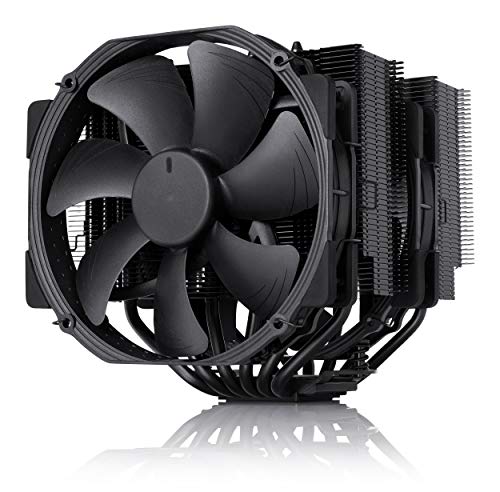
Pros
- Proven dual-tower, 6-heatpipe layout paired with two NF-A15 PWM 140mm fans.
- Broad socket support in-box, including AM5/AM4 and Intel LGA1851/LGA1700 families.
- Strong accessory bundle: NT-H1 paste, PWM Y-cable, and two low-noise adaptors.
- High RAM clearance in single-fan configuration, per listing, up to 64mm.
- 6-year manufacturer’s warranty listed, consistent with Noctua’s long-support positioning.
Cons
- Large cooler footprint and 165mm height can limit case compatibility; verify CPU cooler clearance before buying.
- Dual-fan mode targets standard-height RAM up to 32mm unless you raise the front fan, per listing.
- Not listed as compatible with AMD TR4/SP3/sTRX4/sWRX8 platforms, so it is not a drop-in HEDT option.
- Heavy assembled weight (1320g with fans) is typical for this class but can make installation more fiddly.
The Noctua NH-D15 chromax.black is a flagship, dual-tower air CPU cooler aimed at enthusiasts who want high thermal headroom without leaning on an AIO. It targets overclockers, quiet-PC builders, and anyone running sustained CPU loads like compiling, rendering, or heavy multitasking on current Intel and AMD mainstream sockets.
Its defining hardware is the fine-tuned 6-heatpipe dual-tower heatsink paired with two NF-A15 HS-PWM 140mm fans. Per the product listing, this design is intended to rival many all-in-one liquid coolers while maintaining quiet operation; in real-world terms, this tier of air cooler is typically chosen for high-power CPUs where a smaller single-tower cooler would need louder fan speeds to keep up.
Build and finish are the draw here: a black coated heatsink, black fans with anti-vibration pads, black clips, and black mounting parts for a consistent look. Materials are listed as copper for the base and heatpipes, aluminium cooling fins, soldered joints, and nickel plating, and the package includes NT-H1 thermal compound and the SecuFirm2 mounting system.
The trade-offs are mostly physical. At 165mm tall with fans installed, it demands a case with adequate CPU cooler clearance, and the front fan can conflict with tall memory when using the default dual-fan setup. The assembled mass is also substantial, which is normal for large dual-tower coolers but makes careful installation and transport considerations more important.
Buy this if you want a top-end air cooler with a stealth aesthetic, broad AM5/AM4 and LGA1851/LGA1700 support, and a noise-conscious accessory bundle. Skip this if you run very tall RAM in dual-fan mode, have a narrow case clearance, or need compatibility with platforms not listed (such as TR4/sTRX4).
| Cooler type | Dual-tower air CPU cooler |
| Heatpipes | 6 (per listing) |
| Fans included | 2x NF-A15 HS-PWM chromax.black (140mm class) |
| PWM support | Yes (PWM fans, includes 4-pin PWM Y-cable) |
| Low-noise adaptors | 2x NA-RC7 (L.N.A), included |
| Thermal paste | Noctua NT-H1, included |
| Dimensions (heatsink only) | 160mm (H) x 150mm (W) x 135mm (D) |
| Dimensions (with fans) | 165mm (H) x 150mm (W) x 161mm (D) |
| Weight (heatsink only) | 980g |
| Weight (with fans) | 1320g |
| Materials | Copper (base and heatpipes), aluminium fins, soldered joints, nickel plating |
| RAM clearance | 64mm in single-fan mode; up to 32mm in dual-fan mode (per listing) |
| Socket compatibility (listed) | Intel LGA1851, LGA1700, LGA1200, LGA115x; AMD AM5, AM4; LGA20xx Square ILM with NM-i20xx |
| Not listed as compatible | TR4/SP3/sTRX4/sWRX8, LGA4189, LGA4677, LGA20xx Narrow ILM |
| Fan compatibility (listed) | 140x150x25, 140x140x25, 120x120x25 (with 120mm mounting holes) |
| Warranty | 6-year manufacturer’s warranty (per listing) |
| In the box (listed) | NH-D15 heatsink (black), 2 fans, 2 L.N.A, PWM Y-cable, NT-H1, SecuFirm2 mounting kit, metal case-badge |
CPU and socket: The included SecuFirm2 kit is listed for Intel LGA1851/LGA1700/LGA1200/LGA115x and AMD AM5/AM4. It is not listed for TR4/sTRX4 class sockets, so check platform before ordering.
Case clearance: The cooler is 165mm tall with fans installed. Confirm your case CPU cooler clearance exceeds 165mm, and remember that moving the front fan upward to clear RAM can increase total height.
RAM fitment: If you run tall DIMMs, plan on single-fan mode (listed 64mm clearance) or raising the front fan. In dual-fan mode, the listing recommends standard-height RAM up to 32mm.
Fan control setup: Use the included 4-pin PWM Y-cable to run both NF-A15 fans from one CPU_FAN header for unified control. If your build prioritizes idle acoustics, the included low-noise adaptors can help cap maximum RPM, but verify temperatures under sustained load.
Typical pairing guidance: This class of dual-tower cooler is commonly chosen for higher-power desktop CPUs where sustained boosts or manual tuning increase heat output. If you are chasing very low noise under heavy all-core loads, prioritize a case with strong front-to-back airflow so the cooler can work efficiently at lower fan speeds.

Pros
- Broad socket support in the box, AM5/AM4 and Intel LGA1851/1700/1200/115x via SecuFirm2+.
- Strong accessory set includes NT-H2 paste, AM5 paste guard, PWM splitter, cleaning wipe, and low-noise adapters.
- Copper base and heatpipes with soldered joints and nickel plating, aimed at consistent long-term contact and corrosion resistance.
- High listed user rating, suggesting solid real-world installation and acoustic satisfaction.
Cons
- 168mm height can exclude many mid-towers, and taller RAM can force higher fan placement and extra clearance needs.
- 32mm RAM clearance with both fans is limiting for many RGB DDR4/DDR5 kits unless you run single-fan mode.
- Large 1525g assembled weight is typical of flagship dual-tower coolers, so careful handling during transport is important.
- Cost tends to be a trade-off for top-tier air coolers and Noctua’s accessory-heavy bundles (typical for this segment).
The Noctua NH-D15 G2 chromax.black is an enthusiast-class dual-tower air cooler aimed at builders running high-heat CPUs on AMD AM5/AM4 or Intel LGA1851/LGA1700 platforms. It is the kind of cooler you buy when you want strong sustained cooling without committing to an AIO loop.
The key change in the G2 revision is the heatsink and airflow stack: 8 heatpipes, 20% more surface area, and two NF-A14x25r G2 PWM fans. Per the product listing, it typically lands about 2 to 3°C cooler than the first-generation NH-D15 chromax.black on popular modern AMD and Intel CPUs, which can matter for boost behavior and fan noise under long renders or heavy all-core loads.
Physically, this is a large cooler (168mm tall with fans, 150mm wide, 152mm deep) built from a copper base and heatpipes with aluminum fins, soldered joints, and nickel plating. The all-black chromax finish is aimed at builds that want the NH-D15 layout without the classic Noctua color palette.
The trade-offs are mostly fitment and mass. With both fans installed, RAM clearance is listed at 32mm (59mm in single-fan mode), and the cooler height can increase if you have taller-than-32mm memory and need to raise the front fan. At 1525g with fans, it also demands careful installation and sensible case handling if the system is moved often.
Buy this if you have the case clearance and want a no-nonsense, high-end air cooler with a complete mounting and accessory kit, including NT-H2 paste and an AM5 paste guard. Skip it if your case is tight on CPU cooler height, you run tall RGB RAM you do not want to compromise on, or you prefer the guaranteed socket-area clearance and weight distribution of an AIO.
| Cooler type | Dual-tower air CPU cooler |
| Heatpipes | 8 (per listing) |
| Included fans | 2x NF-A14x25r G2 PWM chromax.black (140mm class) |
| Fan control | PWM; includes 2x NA-RC16 Low-Noise Adaptor; includes NA-YC1 PWM splitter |
| Socket compatibility (in box) | AMD AM5, AM4; Intel LGA1851, LGA1700, LGA1200, LGA115x |
| Mounting system | Black SecuFirm2+ (Torx-based); NM-SD1 Torx T20 screwdriver included |
| Dimensions (with fans) | 168 mm (H) x 150 mm (W) x 152 mm (D) |
| Weight (with fans) | 1525 g |
| Materials | Copper base and heatpipes, aluminum fins, soldered joints, nickel plating |
| RAM clearance (per listing) | 59 mm in single-fan mode; 32 mm with both fans installed |
| PCIe clearance note | Offset design with recessed lower fins clears top PCIe x16 on most current motherboards |
| Included thermal compound | NT-H2 |
| Included AM5 accessory | NA-TPG1 thermal paste guard for AM5 |
| Color | chromax.black (all-black) |
| Fan RPM / airflow / noise | Not specified in the listing |
CPU and socket: In the box, it supports AMD AM5 and AM4 plus Intel LGA1851, LGA1700, LGA1200, and LGA115x. If you are planning an AM5 build with CPUs like Ryzen 7/9 X3D parts or Ryzen 9 non-X3D (examples are cited in the listing), this cooler is sized for sustained boost behavior without requiring liquid cooling.
Case clearance: The cooler is 168mm tall with fans, so your case should allow at least 168mm CPU cooler height. The listing also notes height can increase if your RAM is taller than 32mm and forces you to raise the front fan.
RAM and fan placement: Plan around the stated RAM clearances: 32mm with both fans, or 59mm in single-fan mode. If you use tall RGB memory, consider running a single fan first, then add the second only if your case and RAM height allow.
PCIe slot access: The offset design and recessed lower fins are intended to clear the top PCIe x16 slot on most current motherboards, which helps avoid interference with a primary GPU. Always sanity-check with Noctua’s compatibility information for your specific board and GPU backplate layout.
Install process and maintenance: The Torx-based SecuFirm2+ system includes a T20 screwdriver, and the box includes NT-H2 paste plus the AM5 NA-TPG1 paste guard and a cleaning wipe. If you repaste often, the included guard can help keep paste off the AM5 socket area.
Handling and transport: At 1525g with fans, this is a heavy cooler, typical for flagship dual-tower designs. If the PC will be shipped or carried frequently, handle it carefully and avoid impacts that could stress the motherboard.
Best Coolers for 7800X3D Buying Guide for 2026
The 7800X3D’s 3D V-Cache favors steady, low-variance thermals for consistent boost. Start with platform fit and airflow, then weigh acoustics and reliability. Avoid chasing headline specs in isolation and prioritize case compatibility and control options.
Understand 7800X3D thermal behavior
X3D parts operate with conservative voltage limits, so they rarely dump heat like top non-X3D chips. Lower temperatures still help sustain high clocks and reduce noise. A well-tuned fan curve often matters as much as raw cooler size. If you enable PBO, pair it with a modest negative Curve Optimizer to trim heat while preserving gaming performance. Re-apply a quality thermal paste correctly and check mounting pressure to minimize hotspots on the AM5 IHS.
Air or AIO: which suits your build
High-end air coolers deliver strong thermals with simple installation and excellent long-term reliability, and they add useful VRM airflow. AIOs move heat to the case perimeter, which can help in compact or glass-heavy builds and provides cleaner RAM clearance. For a 7800X3D, flagship air and 240 to 360 mm AIOs often land close under gaming loads, so choose based on case support and noise targets. For example, the Noctua NH-D15 G2 chromax.Black is an easy air choice, while the CORSAIR Nautilus 360 RS ARGB fits RGB-focused, radiator-ready cases. There’s more on this in our look at the best PC cases in 2026.
Case and RAM clearance on AM5
Check three dimensions before buying: cooler height vs side panel, RAM height vs front fan overhang, and motherboard top edge clearance vs radiator and fans. Many mid-towers support tall dual-tower coolers in the 160 to 170 mm range, but verify your chassis spec sheet. On dual-tower designs, you may need to raise the front fan or pick low-profile DIMMs. For AIOs, confirm top or front radiator support, thickness, and hose reach without kinking.
Acoustics and control strategy
Noise depends on fan quality and control, not just size. Use PWM curves tied to CPU and liquid temperatures with gentle ramps and some hysteresis to prevent rapid oscillation. Connect tower fans to CPU_FAN and CPU_OPT, and set AIO_PUMP to a fixed duty if recommended by your vendor. A good baseline is to target quiet operation at typical gaming loads, then allow headroom only when sustained all-core workloads demand it.
Build intent and airflow balance
Match the cooler to your use case. For gaming-heavy rigs, prioritize consistent boost and low noise over extreme burst performance. Content workloads that sustain all-core load benefit from larger fin area or more radiator surface. Ensure the case has balanced intake and exhaust so CPU heat does not recirculate. Briefly, the Thermalright Peerless Assassin 120 SE is a strong value choice, and the be quiet! Dark Rock Pro 5 appeals to silence-focused builders.
Why You Should Trust Us
Our recommendations synthesize manufacturer documentation, verified buyer feedback, and third-party testing consensus. We compare thermals and acoustics at normalized conditions, audit compatibility notes for AM5, and weigh long-term reliability and ease of installation. Pricing and availability shift, so we focus on value per dollar and practical fit instead of spec sheet one-upmanship.
Final Thoughts
For most builders, the Noctua NH-D15 G2 chromax.Black is our top pick thanks to stable thermals, broad compatibility, and low-noise performance. For value, the Thermalright Peerless Assassin 120 SE delivers excellent real-world cooling at an accessible price. If your priority is quiet operation in a refined package, the be quiet! Dark Rock Pro 5 is a strong match. Prefer RGB and radiator-based airflow paths in a compatible case, consider the CORSAIR Nautilus 360 RS ARGB.
FAQs
Is air or AIO better for a 7800X3D build?
Both work well. The 7800X3D’s modest heat output means high-end air coolers can match 240 to 360 mm AIOs in many gaming scenarios. Choose air for simplicity, reliability, and VRM airflow, or an AIO for perimeter heat exhaust, RGB styling, and tighter RAM clearance.
What size cooler should I choose for the 7800X3D?
A premium dual-tower air cooler or a quality 240 to 360 mm AIO is appropriate. The right choice depends on case support and noise goals. If you render or compile often, favor more fin or radiator area. For gaming-first rigs, silence and stable boost take priority.
Will RAM height cause fit issues on AM5?
It can with dual-tower designs where the front fan overhangs DIMM slots. Check your RAM module height and cooler’s stated RAM clearance, or plan to raise the front fan slightly. AIOs avoid this issue around the socket, but you must verify radiator room and hose routing.
Do I need to tweak PBO or Curve Optimizer with a new cooler?
Not required, but worthwhile. After installing a better cooler, use a small negative Curve Optimizer offset to reduce voltage and temperatures while maintaining performance. Validate with stress tests and games, and fine-tune your fan curves for quiet operation at typical loads.
Cooling the Ryzen 7800X3D in Real Use
The Ryzen 7 7800X3D has a 120W TDP and runs notably cooler than the Ryzen 9 7950X or older X chips. This makes cooling selection more flexible than for higher-TDP CPUs. Budget air coolers like Thermalright Phantom Spirit 120SE ($35) and ID-Cooling SE-225-XT ($45) handle the 7800X3D within boost clock during multi-hour gaming sessions. Premium air (Noctua NH-D15 G2, $130) and 360mm AIO ($90-180) deliver marginal temperature improvements but matter most for aesthetic preference and quieter operation. For the 7800X3D specifically, the cooling-budget-to-performance ratio peaks around $35-50.
Common Mistakes to Avoid
The first mistake is buying $100+ premium coolers when the 7800X3D runs cooler than older X-series chips. Thermalright Phantom Spirit 120SE at $35 keeps the 7800X3D within boost clock under multi-hour load, anything more expensive is buying brand premium not cooling capacity. The second mistake is choosing 240mm AIO for the 7800X3D, 240mm liquid runs the chip at similar temperatures to dual-tower air coolers while adding pump-failure risk. 360mm AIO makes sense for aesthetics and Intel high-tier; 240mm AIO is a poor middle ground. The third mistake is overlooking RAM clearance, tall RGB RAM modules conflict with some dual-tower air coolers; verify clearance before purchase.
More Frequently Asked Questions
Does the 7800X3D need premium thermal paste?
Standard thermal paste (Arctic MX-4, $5) performs within 1-2 degrees of premium paste like Thermal Grizzly Kryonaut. Save the $15 for better fans or storage.
Is liquid metal worth using on the 7800X3D?
No, the marginal temperature improvement does not justify the application risk and warranty implications. Reserve liquid metal for Intel chips with thicker IHS plates.
How often should I repaste?
Every 3-4 years of daily use. Quality paste does not dry out for years; reapplication is rarely needed before the build is decommissioned.
CPU Cooler Market in 2026
CPU cooler offerings expanded significantly through 2025-2026 with budget brands like Thermalright and ID-Cooling reaching premium-tier thermal performance at 30-50 percent of Noctua and be quiet! pricing. The 7800X3D specifically runs cool enough that budget air coolers handle it within boost clock, premium coolers buy aesthetics and noise reduction more than thermal headroom. Liquid AIO pricing dropped significantly in 2025-2026 with quality 240mm AIO from Arctic and Cooler Master reaching the $70-80 range and 360mm AIO at $100-130. The reliability advantage of air over liquid compounds over 5+ year builds.
Installing a CPU Cooler on AM5
Apply thermal paste in a pea-sized dot at center of the IHS, spreading is unnecessary, mount pressure handles distribution. Tighten cooler retention screws in cross pattern (top-left, bottom-right, top-right, bottom-left) to even pressure. Use the included Noctua, Thermalright, or be quiet! mounting hardware, never reuse old paste or pads. After installation, run Cinebench R23 for 10 minutes and monitor temperatures with HWiNFO; 7800X3D should sit at 65-78°C under sustained load with quality air cooling. Fan curves should ramp gradually from 30 percent at idle to 70-80 percent under load.
Additional Questions
Air or liquid for the 7800X3D?
Either works. Air for long-term reliability (no pump failure risk). Liquid for cleaner aesthetics and quieter operation at similar temperatures.
Best budget air cooler for 7800X3D?
Thermalright Phantom Spirit 120SE at $35. Handles the 7800X3D within boost clock under multi-hour load, outstanding price-to-performance.
CPU Cooler Pricing The Best Balances
CPU cooler pricing reflects clear value tiers in 2026. Budget air coolers from Thermalright (Phantom Spirit 120SE, Peerless Assassin 120 SE) and ID-Cooling consistently land $30-50 and deliver 240mm AIO-equivalent thermal performance. Mid-tier air from be quiet! Dark Rock Pro 5 and Noctua NH-U12A reaches $80-110 with quieter operation but similar temperatures. Premium air (Noctua NH-D15 G2 chromax.black) commands $130-180 for the brand and finish. Liquid AIO pricing improved with quality 240mm AIO from Arctic and Cooler Master at $70-90 and 360mm AIO at $100-150. The 7800X3D specifically runs cool enough that budget air delivers excellent results.
7800X3D Cooling Owner Reports
Owner experience reports consistent thermal behavior across cooling tiers. Thermalright Phantom Spirit 120SE owners report 65-75°C under sustained Cinebench R23 with 7800X3D; Peerless Assassin similar. Noctua NH-D15 G2 owners report 60-70°C at similar workloads. 360mm AIO owners report 55-65°C with quieter operation. The 7800X3D thermal throttle point sits at 89°C, so all quality coolers maintain comfortable margins. RAM clearance is the most common owner complaint with budget dual-tower air coolers; verify clearance before purchase. Liquid AIO pump noise from Arctic Liquid Freezer III and Lian Li Galahad II runs quieter than premium air; older Corsair iCUE pumps generate measurable noise under load.




























Write Your Review
No reviews yet. Be the first to share your experience!