

Jump from a 240mm radiator to a 360mm one and you’re adding roughly 50 percent more surface area for heat to escape, yet the price gap between the two tiers often sits around $30 to $50. That’s the whole argument in a sentence. A bigger radiator moves more heat, but it only pays off if your CPU actually produces enough of it and your case has the clearance. We researched dozens of loops across both sizes, and the answer isn’t the one most spec sheets push. If you’re weighing your options, our roundups of the best 240mm AIO coolers for 2026 and the best 360mm AIO coolers for 2026 pair well with this breakdown.
Matchup at a glance
The core difference is radiator length. A 240mm unit uses two 120mm fans on a shorter radiator, while a 360mm unit stretches to three 120mm fans. More radiator means more area for the coolant to dump heat before it loops back to the pump. On paper that’s a clean win for the larger size. In practice, the gap narrows fast once you factor in what CPU you own and how hard you push it.
Here’s the part nobody tells you upfront. A mid-tier six or eight-core chip rarely generates enough sustained heat to saturate even a 240mm radiator, so the extra length mostly buys you quieter fans rather than dramatically lower temperatures. Push a high-core-count Ryzen 9 or an overclocked Core i9, though, and the 360mm starts earning its keep. It’s less about raw cooling ceiling and more about where your specific chip sits on the heat curve.
Spec sheet showdown
| Spec | 240mm AIO | 360mm AIO | Why it matters | Edge |
|---|---|---|---|---|
| Radiator length | ~277mm | ~397mm | More area sheds more heat | 360mm |
| Fan count | 2x 120mm | 3x 120mm | More fans move more air, quieter at low RPM | 360mm |
| Typical price | $90 to $130 | $120 to $180 | Budget headroom for other parts | 240mm |
| Case clearance | Fits most mid-towers | Needs full 360mm mount | Compatibility with your case | 240mm |
| Noise under load | Higher RPM to keep up | Lower RPM for same temps | Acoustic comfort | 360mm |
Two rows favor the smaller loop, two favor the larger one, and the noise row is where most buyers actually feel the difference day to day. Keep that split in mind. The spec sheet doesn’t crown a universal winner, and neither should you.
240mm strengths
The 240mm size is the pragmatic pick for the vast majority of builds. It clears almost every mid-tower on the market, mounts easily in the front or top, and rarely fights your RAM or GPU for space. For a Ryzen 7 or a Core i5 running at stock, a good 240mm loop holds a modern gaming chip well under its thermal limit during long sessions. You’ll save money too, and that saved cash can go toward a faster GPU or more storage where you’ll actually notice it.
There’s a quieter benefit here, literally. Because the radiator is smaller, it fits in cases that a 360mm simply can’t, which matters for compact and small-form-factor builds. If you’re eyeing an ITX or micro-ATX chassis, the 240mm is often the biggest loop that’ll physically go in. It won’t win a benchmark chart against a triple-fan monster, but for the machines most people own, it’s plenty. Cheaper, simpler, easier to fit.
360mm strengths
Where the 360mm pulls ahead is sustained heavy load and acoustics. That third fan and the longer radiator let the pump run cooler coolant back to the block, which means the fans don’t have to spin as hard to hit the same temperature. For a Ryzen 9 9950X or an overclocked Core i9, that headroom translates into a few degrees lower under an all-core render, and noticeably less fan noise when the room is quiet. If your workload hammers every core for hours, this is the size that keeps its composure.
The catch is clearance and cost. You need a case rated for a full 360mm mount, and you’ll pay $30 to $50 more than a comparable 240mm. Overclockers get the most from this tier, and good contact between the block and the die matters just as much as radiator length. A quality thermal compound like the Thermal Grizzly Duronaut, a 6-gram tube priced around $24.99 with a 4.4 rating, ships with 12 cleaning wipes and is rated for heavy overclocking on CPU and GPU alike. If you’re chasing every last degree, don’t skip the interface. Our guide to the best 240mm AIOs for overclocking covers the same principle at the smaller size.

Pros
- Non-conductive chemistry safer for novices repasting near exposed CPU or GPU capacitors.
- 6g volume suports several full applications on desktop CPUs and console APUs.
- Wet and dry wipes included, so no isopropyl bottle or lint-free cloth need.
Cons
- Limited owner fedback at time of writing makes long-term durability claims hard to verify.
- Non-metal formula typically trails top liquid metals by a few degrees under sustained load.
- Viscosity, TIM lifespan hours, and thermal conductivity W/mK figures are not specified.
Duronaut is Thermal Grizzly's non-conductive thermal paste positioned as a mid-tier daily driver, shipping in a 6g syringe with 6 wet and 6 dry cleaning wipes. The target buyer is a DIY PC builder repasting a CPU or GPU cooler, or a console owner refreshing PS4, PS5, or Xbox thermals without risking shorts.
The defining trait is the aluminum microparticle plus zinc oxide nanoparticle blend paired with an electrically non-conductive base. Thermal Grizzly claims reduced pump-out and stable performance over extended cycles, which maters most on soldered console APUs and overclocked desktop chips that see large delta-T swings. Exact W/mK conductivity is not specified in the source.
Trade-offs are typical for non-conductive pastes at this tier. Expect a few degrees warmer than liquid metal on delided or high-wattage CPUs, and no published viscosity or cure-time data to plan application around. Owner feedback is limited at time of writing, so long-term hardening resistance relies on vendor claims rather than independent long-run testing.
Buy this if you want a safe, non-conductive paste with enough volume for several repastes and a bundled wipe kit for console or GPU jobs. Skip this if you are chasing the absolute lowest core temperatures on a 250W-plus overclocked CPU where liquid metal or a top nano-diamond paste still leads.
Volume and coverage: The syringe holds 6g of paste, enough for roughly 15 to 25 pea-sized applications on mainstream AM5 or LGA1700 IHS surfaces, or several full console APU repastes on PS4, PS5, and Xbox where die coverage is larger than a desktop CPU heatspreader.
Composition and safety: The compound uses aluminum microparticles and zinc oxide nanoparticles in a non-metal carier, rated electrically non-conductive. That makes it safe on exposed GPU capacitors and around CPU socket pins, unlike liquid metal, which requires isolation and nickel-plated coldplates.
Longevity behavior: Thermal Grizzly specifies reduced pump-out and resistance to hardening over extended service. Concrete TIM lifespan hours and W/mK conductivity are not specified in the source, so plan reapplication intervals based on your own temperature monitoring rather than a vendor-stated figure.
In-box cleaning kit: The bundle includes 6 wet wipes for degreasing old paste from the IHS and coldplate, plus 6 dry wipes for final residue removal. Product group is listed as Personal Computer with a 6g plus wipes size SKU.
Real-world scenarios
Stock mid-range gaming rig
Running a Ryzen 7 or Core i5 at stock for gaming? A 240mm loop is all you need. Games rarely load every core at once, so peak CPU heat stays modest and the smaller radiator handles it without breaking a sweat. Spend the difference elsewhere.
All-core productivity workload
Video encoding, 3D rendering, or heavy compiles push every core to the wall for minutes at a time. This is the 360mm’s home turf. The extra radiator area keeps sustained temperatures a few degrees lower and lets the fans stay quieter, which adds up over an eight-hour workday.
Small-form-factor build
In a compact case, the choice makes itself. A 360mm often won’t fit, so the 240mm becomes the ceiling. The good news is that most SFF chips are chosen with power limits in mind, so a 240mm loop is a sensible match rather than a compromise.
Silent-focused build
If low noise is the priority, the 360mm has a real edge. Three fans spinning slowly move more air than two fans spinning fast, and slower fans are quieter. For a bedroom or office machine, that acoustic gap is the strongest reason to size up.
Pricing and availability
Street prices land around $90 to $130 for a solid 240mm and $120 to $180 for a comparable 360mm, and both sizes are widely stocked from the major brands. The premium for going bigger has shrunk over the past few years, so the decision rarely hinges on budget alone anymore. It hinges on your case and your chip. Availability isn’t the bottleneck. Clearance is.
One quiet cost people forget is the parts around the cooler. Fresh mounting hardware, a clean surface, and quality paste all factor into the final temperature you see, and none of that shows up in the sticker price of the loop itself.
Which to buy
Buy the 240mm if you run a mainstream chip at stock, own a mid-tower or smaller case, or want to steer your budget toward the GPU. Buy the 360mm if you own a high-core-count CPU, plan to overclock, or care deeply about a quiet room under load. That’s the honest split, and it puts most gamers in the 240mm camp and most creators and overclockers in the 360mm one. If you’re on the fence, size to your CPU’s real heat output, not to the biggest number on the box.
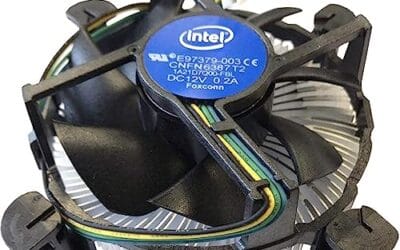
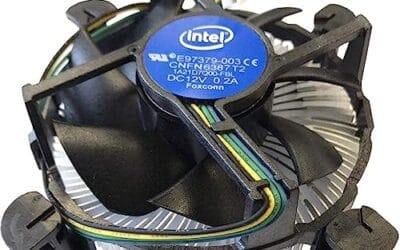
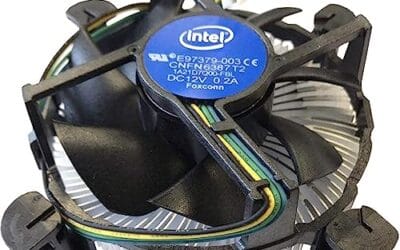
And if you’re not ready for a closed-loop cooler at all, a basic air cooler still keeps a modest chip alive. The Intel E97379-003, a 4-pin stock-style cooler with an aluminum heatsink and a 3.5-inch fan, sells for about $15.99 with a 4.1 rating and fits older Socket 1150, 1155, and 1156 desktops. It’s a stopgap, not a rival to any AIO, but it proves you don’t need a radiator to boot a machine. Start there, then upgrade when your workload demands it.

Pros
- Native LGA 1150, 1155, and 1156 socket support covers three legacy Intel generations
- 4-pin PWM connector enables proper fan curve control via BIOS
- OEM-style aluminum heatsink footprint keps RAM and VRM clearance predictable
- Push-pin mount installs without removing the motherboard from the case
Cons
- Zero owner fedback available at time of writing, real-world thermals unverified
- Aluminum-only heatsink with no heatpipes struggles with overclocked or unlocked K-series CPUs
- Restricted to obsolete Intel sockets, no path forward to LGA 1200, 1700, or AM5
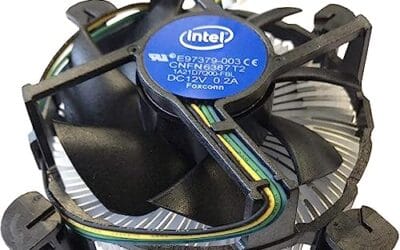
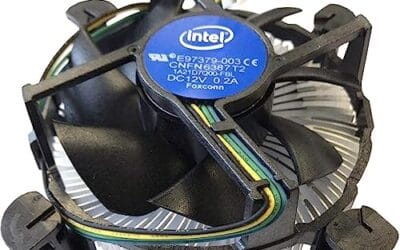
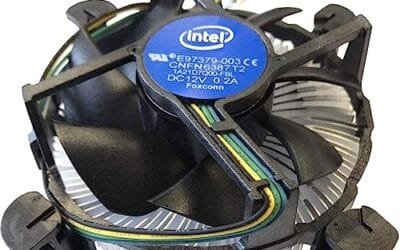
The Intel E97379-003 is an OEM-style stock CPU cooler built for LGA 1150, 1155, and 1156 boards, covering Core i3, i5, and i7 chips from the Sandy Bridge through Haswell era. It targets one specific buyer: someone repairing, refurbishing, or restoring a legacy Intel desktop that lost its original heatsink.
The defining feature is compatibility, not performance. A 3.5-inch fan sits on an aluminum heatsink with a 4-pin PWM header, matching the original OEM cooler dimensions Intel shipped in retail boxes. Stock coolers in this class typically handle 65W to 84W TDP chips at stock clocks, which lines up with locked i3, i5, and non-K i7 SKUs on these sockets.
Trade-offs are typical for a boxed-style cooler. There are no heatpipes, no copper base contact, and no tower geometry, so sustained multi-core loads will spin the fan up and get audible. Push-pin mounting is convenient but less secure than a backplate design, and overclocking headroom is effectively zero. Owner feedback is not available at time of writing.
Buy this if you need a like-for-like OEM replacement for a locked LGA 1150, 1155, or 1156 CPU and want to kep the original acoustic and clearance profile. Skip this if the CPU is a K-series part, if you plan to overclock, or if the target socket is LGA 1200 or newer.
Socket coverage: Native mounting for LGA 150, 1155, and 1156 only. That spans 2nd, 3rd, and 4th generation Core i3, i5, and i7 desktop chips. No adapter is included for LGA 1200, 1700, or AM4/AM5, so this cooler is locked to legacy Intel repair scenarios.
Heatsink and fan: Aluminum radial-fin heatsink with a 3.5-inch axial fan on a 4-pin PWM connector. No heatpipes, no copper slug, no vapor chamber are indicated in source data. TDP handling is not specified, but OEM colers of this geometry are typically rated for the 65W to 84W stock TDP band on these sockets.
Mounting and clearance: Push-pin retention through the four motherboard holes, no backplate required, install possible without removing the board. Cooler height sits low enough to clear standard mid-tower side panels, and the round footprint keps RAM slots and VRM heatsinks unobstructed. Exact height in mm is not specified.
Acoustics and headroom: Noise level in dBA is not specified. Based on OEM stock cooler behavior at this size, expect quiet idle and audible ramp under sustained all-core load. Overclocking a K-series chip on this heatsink is not advisable, thermal headroom above 84W is minimal.
Common questions
Is a 360mm AIO always cooler than a 240mm?
Not always. Under a light or gaming load, a mid-range CPU doesn’t produce enough sustained heat for the extra radiator to show a meaningful gap. The 360mm’s advantage grows as the load and core count climb, so it’s the heavy, all-core work where the difference becomes clear.
Does a bigger radiator mean louder fans?
Usually the opposite. A 360mm has three fans instead of two, so each one can spin slower to move the same volume of air. Slower fans are quieter, which is why silent-build fans often prefer the larger size even when temperatures are similar.
Will a 360mm AIO fit my case?
Check your case spec sheet for a 360mm radiator mount before buying. Many mid-towers support one only in the top or front, and clearance can conflict with tall RAM or a large GPU. If in doubt, a 240mm is the safer fit for most chassis.
Is the price gap worth it?
The premium runs about $30 to $50. If you overclock or run all-core workloads daily, that money buys real headroom and lower noise. If you game at stock, you’re better off putting the difference toward a faster graphics card.
Does thermal paste matter more than radiator size?
Both matter, and they solve different problems. Paste governs how well heat crosses from the chip to the block, while radiator size governs how fast that heat leaves the loop. A quality compound won’t replace a bigger radiator, but a bad one will bottleneck even the best AIO, so don’t cheap out on the interface.









Write Your Review
No reviews yet. Be the first to share your experience!