

Gaming at 1080p resolution delivers crisp visuals and smooth frame rates without demanding the most powerful hardware, making it ideal for budget-conscious gamers and enthusiasts alike. Whether you are building a new PC or upgrading your current setup, selecting the right GPU can transform your gaming sessions into immersive adventures. In this guide, we cover the 10 Best Gpu For 1080p Gaming tested and ranked for April 2026, helping you find the perfect balance of performance, value, and reliability for titles like Fortnite, Valorant, and Cyberpunk 2077.
We have analyzed key factors such as VRAM capacity, clock speeds, and cooling efficiency to ensure these recommendations suit 1080p gaming needs. For more GPU options across various budgets, explore our GPUs category page.

Pros
- Outstanding 1080p performance in esports and AAA titles
- Exceptionally cool and quiet under load
- Straightforward installation and low power draw
- Excellent value for entry-level gaming upgrades
- Strong multi-monitor support including high refresh rates
Cons
- Limited performance at 1440p or ultra settings in demanding games
- Price-to-performance not the best compared to used higher-end options
The ASUS Dual GeForce RTX 3050 6GB OC Edition is an entry-level gaming graphics card tailored for budget builders, 1080p gamers, and compact PC upgrades. It targets users seeking reliable performance without the bulk or power demands of premium GPUs, making it perfect for esports enthusiasts, light AAA gaming, and productivity setups with multi-monitor needs.
Standout features include NVIDIA's Ampere architecture with 2nd-gen RT Cores for ray tracing, 3rd-gen Tensor Cores for DLSS-enhanced frame rates, and OC mode boosting clocks up to 1537 MHz. The dual Axial-tech fans, IP5X dust resistance, and 2-slot design prioritize efficient cooling and compatibility, while software like GPU Tweak II and G-SYNC support customization and smooth visuals.
In real-world use, it excels at 1080p gaming with playable frame rates in modern titles at medium-high settings, aided by DLSS. Reviewers praise its quiet fans that stop during idle tasks, low temps even on 5K monitors, and easy integration into Intel or productivity builds, outperforming integrated graphics significantly.
Build quality shines with Auto-Extreme precision manufacturing, a corrosion-resistant stainless steel bracket, and a space-saving form factor. It handles heat effectively without excessive noise, though some note minor compatibility quirks with older KVM switches.
Minor drawbacks include stretched performance in ultra-demanding scenarios requiring settings tweaks. Overall, this card earns high marks for value, delivering dependable gaming and versatility in a compact package—highly recommended for 1080p-focused users.
Powered by NVIDIA GeForce RTX 3050 with 6GB GDDR6 memory, this card shines in 1080p gaming, delivering smooth frame rates in esports titles and lighter AAA games at medium to high settings. DLSS and ray tracing elevate visuals and performance, making demanding scenes more playable without sacrificing quality.
Reviewers report 60-70 FPS on high or ultra in titles like Metro Exodus, with excellent results in productivity tasks and video playback. NVIDIA G-SYNC eliminates tearing for fluid experiences on high-refresh-rate monitors.
For entry-level builds, it pairs well with mid-range CPUs like Intel i5, providing a massive upgrade over integrated graphics while keeping power needs modest.
The 2-slot design with Axial-tech fans maximizes airflow through a optimized heatsink and heatpipe layout, ensuring superior thermal performance in compact cases. Fans employ 0dB technology, stopping completely during low loads for silent operation.
IP5X dust resistance protects internals from particulates, extending lifespan with minimal cleaning. Users highlight temps staying below 50°C in office work and 60°C under stress, quieter than previous cards like Quadro M2000.
Stainless steel bracket and Auto-Extreme manufacturing add durability and precision, making it robust for long-term use in small chassis.
Key specs include NVIDIA GeForce RTX 3050 coprocessor, 6GB GDDR6 memory at 4000 MHz, PCIe 4.0 interface, and support for max resolution of 7680 x 4320 pixels. Video outputs feature HDMI 2.1 and DisplayPort 1.4a for broad connectivity.
Dimensions are compact at 7.9 x 4.7 x 1.5 inches with 14.4 ounces weight, ideal for SFF builds. OC boost clock reaches 1537 MHz, with efficient power delivery needing just one PCIe slot and minimal PSU headroom.
Best sellers rank confirms popularity in graphics cards category, underscoring its reliable specs for gaming and productivity.

Pros
- Outstanding 1080p and 1440p performance
- Exceptional cooling and low noise levels
- Generous 16GB VRAM for modern titles
- Stable operation even overclocked
- Easy installation and driver support
Cons
- Large size needs spacious case clearance
- Ray tracing performance is solid but not elite
The GIGABYTE Radeon RX 9060 XT Gaming OC 16G is a premium mid-range graphics card tailored for gamers and content creators seeking high performance without premium pricing. Powered by AMD's RDNA 4 architecture, it targets 1080p and 1440p resolutions, offering stunning visuals and fast frame rates in demanding titles like Battlefield 6 and esports games.
Standout features include the WINDFORCE cooling system with Hawk fans and server-grade thermal conductive gel, ensuring low temperatures and quiet operation during extended sessions. The 16GB GDDR6 memory and PCIe 5.0 interface provide ample headroom for future games, while RGB lighting adds flair to custom rigs. AI acceleration enhances both gaming upscaling via FSR and creative workflows.
In real-world use, users report effortless high-to-ultra settings at 1440p with consistent FPS, even in newer releases. Stability shines in long sessions with no crashes, and zero-RPM fan mode keeps it silent at idle. Overclocking potential adds extra power for competitive play.
Build quality feels premium and durable, though its sizable dimensions demand case compatibility checks. Ray tracing holds up decently with upscaling but lags behind top-tier rivals.
Overall, this GPU delivers unbeatable value for smooth gaming and reliable performance, making it a top pick for mid-range upgrades.
This GPU excels at 1080p with sky-high FPS in esports like Fortnite at 240Hz, and handles 1440p ultra settings in modern AAA games with fluid frame pacing. Titles like Battlefield 6 run flawlessly at max details without stuttering.
AMD FSR upscaling boosts performance further, while AV1 encoding supports seamless streaming. VR gaming delivers buttery-smooth experiences in demanding simulations.
Overclocking unlocks even more power for high-refresh-rate monitors, maintaining stability across marathon sessions.
The WINDFORCE system with Hawk fans and advanced thermal gel keeps core temps low even under heavy loads, preventing throttling during prolonged gaming.
Zero-RPM mode ensures silence at idle, with minimal noise ramp-up under stress. Users praise its efficiency for quiet, reliable operation.
RGB lighting integrates smoothly, controllable via software for personalized aesthetics without impacting cooling.
Core specs include Radeon RX 9060 XT coprocessor, 16GB GDDR6 at 20,000 MHz, and GPU clock up to 2700 MHz for robust power. Supports 8K resolution at 7680x4320 pixels.
Connectivity features DisplayPort and HDMI outputs for multi-monitor setups. Compact yet capable at 11.06 x 4.65 x 1.57 inches and 2.59 pounds.
PCIe 5.0 compatibility future-proofs it for evolving PC platforms.

Pros
- Space-saving low-profile bracket
- Low power draw for easy integration
- Supports 3840x2160 resolution
- Efficient single-fan thermal design
- HDCP 2.2 for protected content playback
Cons
- Entry-level power limits demanding games
- 64-bit memory bus constrains bandwidth
- Not ideal for heavy multitasking or VR
The MSI GeForce GT 1030 4GD4 LP OC is a compact, low-profile graphics card perfect for upgrading older desktops, HTPCs, or small form factor builds. Aimed at casual gamers, video enthusiasts, and users needing a boost for everyday apps, it delivers solid performance without requiring a beefy power supply or large case space.
Key highlights include NVIDIA Pascal architecture, 4GB DDR4 memory, and a 1430 MHz boost clock, paired with DisplayPort 1.4a and HDMI 2.0b ports for 4K output. The single-fan cooler maintains low noise levels, while GeForce Experience handles seamless driver updates and optimizations.
In practice, it excels at 1080p gaming in lighter titles at medium settings and flawlessly renders 4K videos or photo editing tasks. For more intensive workloads, it holds its own in basic acceleration but falls short of mid-range cards.
Design is premium with MSI's durable components and a slim 0.75-inch thickness, making installation plug-and-play in most systems. Weighing just 9.6 ounces, it feels sturdy yet unobtrusive.
Limitations center on its modest specs, unsuitable for AAA games or professional rendering. Verdict: Excellent choice for budget-conscious users seeking reliable, no-fuss graphics enhancement.
This card packs NVIDIA GeForce GT 1030 chipset with 4GB DDR4 video memory on a 64-bit interface, reaching memory speeds of 1430 MHz. GPU clock also hits 1430 MHz boost for snappy response in supported apps.
Dimensions measure 5.91 x 0.75 x 2.72 inches, ideal for tight spaces, with outputs limited to one DisplayPort v1.4a and one HDMI 2.0b. Max resolution supports 3840x2160, covering modern 4K displays.
Additional specs include DirectX 12 compatibility, HDCP support for secure streaming, and a lightweight 9.6-ounce build from MSI, model G103044PC.
Leveraging Pascal tech, the GT 1030 shines in accelerating PC tasks like web browsing, office work, and media consumption, with smooth frame rates in older or indie games at 1080p.
For video playback, it handles 4K content effortlessly via hardware decoding, reducing CPU load significantly. Light editing in tools like Photoshop benefits from the dedicated memory.
Overclocked boost provides a edge over base models, but expect 30-60 FPS in esports titles at low-medium settings, prioritizing efficiency over raw power.
Requires a PCIe x16 slot and minimal 30W power, drawing directly from the motherboard for broad compatibility with older systems lacking auxiliary connectors.
Works with Windows via GeForce Experience for automatic setup, supporting DirectX 12 and HDCP 2.2 for Blu-ray and streaming services. Low-profile bracket included for SFF cases.
Installation is straightforward: slot in, secure, connect displays, and update drivers. Compatible with most MSI motherboards and standard PSUs over 300W.

Pros
- Excellent value for mid-range gaming performance
- Zero noise during light loads for quiet computing
- Multiple high-res outputs for multi-monitor setups
- Solid cooling prevents thermal throttling
- Easy driver installation with AMD support
Cons
- Frame rate inconsistencies in demanding AAA titles
- Requires 8-pin PSU and potentially an upgrade for stability
- Some units experience early failures despite warranty
The AISURIX RX 580 8GB GDDR5 graphics card targets budget-conscious gamers and PC upgraders seeking reliable 1080p performance without breaking the bank. Built on AMD's Polaris 20 architecture with 2048 stream processors, it delivers smooth gameplay in popular titles like MSFS 2020, Black Ops 6, and Minecraft modpacks, making it ideal for mid-range desktops.
Standout features include a semi-automatic intelligent fan system that stops completely below 55°C for silent light gaming, robust cooling via composite heat pipes and double ball bearings for longevity, and versatile connectivity with 2x DisplayPort, HDMI, supporting up to 5120x2880 resolution. High-quality solid capacitors and a reinforced PCB enhance stability during extended sessions.
In real-world use, users report 120+ FPS in Black Ops 6 at performance settings and 150-250 FPS in modded Minecraft, with crisp colors outperforming integrated graphics. However, demanding AAA games may show frame drops to 30 FPS lows despite high averages, feeling laggy at times.
Design emphasizes durability with a dual-slot form factor and efficient 185W power draw via 8-pin connector, fitting most cases including ITX. Drawbacks include occasional glitches or early failures in some units, though seller warranty replacements resolve issues quickly.
Overall, this GPU offers tremendous value for entry-level gaming upgrades, earning praise for performance per dollar, but pair it with a capable PSU for best results.
This RX 580 graphics card features 8GB GDDR5 memory on a 256-bit bus, 2048 stream processors, and a 1750 MHz GPU clock speed for efficient processing. It uses PCI Express 3.0 x16 interface and draws power from a single 8-pin connector with a 185W TDP.
Video outputs include 2x DisplayPort and 1x HDMI, supporting resolutions up to 5120x2880 and 4K displays. Package dimensions are 11.14 x 7.99 x 2.6 inches, with an item weight of 2.05 pounds.
Built by Kelinx under the AISURIX brand, it leverages the Polaris 20 XTX variant for DirectX 12 compatibility and modern game support.
Powered by Arctic Islands architecture, the RX 580 excels in 1080p gaming, delivering over 120 FPS average in Black Ops 6 on performance presets and 1500+ FPS in optimized Minecraft. It handles flight sims like MSFS 2020 and physics-heavy games like BeamNG smoothly.
Users note similar speeds to premium RX 580 variants, with fluid artifact-free frames and enhanced contrast for vivid visuals. It outperforms RX 570 equivalents in multi-monitor setups.
For 1440p or AAA titles, expect variable frame rates with highs above 120 FPS but occasional lows around 30 FPS, best suited for medium settings.
The semi-automatic intelligent fans stop rotating when GPU temps stay below 55°C, ensuring zero noise for office work or light gaming. 8cm blades and composite heat pipes rapidly dissipate core heat, avoiding throttling.
Double ball bearings double the lifespan over sleeve designs, while a large copper tube aluminum heatsink provides full chip contact for optimal airflow. This setup maintains stability under load.
High-profile PCB with solid capacitors protects components, contributing to overall thermal efficiency and quiet operation.

Pros
- Exceptional value for 1080p gaming with shaders and high settings
- Whisper-quiet operation even under load thanks to advanced fans
- Compact and low-profile for easy installation in most cases
- Factory overclocked for immediate high performance
- Strong compatibility with mid-range CPUs like Ryzen 5
Cons
- Entry-level card limits high-end 4K or ultra settings gaming
- Further overclocking can be challenging due to factory tuning
- Requires a capable power supply for optimal stability
The MSI RTX 5050 8G Shadow 2X OC is an affordable entry into NVIDIA's RTX 50 series, ideal for casual gamers, content creators, and budget PC builders seeking Blackwell architecture benefits without premium costs. Powered by the NVIDIA GeForce RTX 5050 with 8GB GDDR6, it targets 1080p gaming and light productivity, making it a smart upgrade from older GTX or entry RTX cards.
Standout features include DLSS 4 for AI-boosted frame rates and ray reconstruction, TORX Fan 5.0 for superior airflow, and a reinforcing backplate with vented design. Real-world performance shines in modded Minecraft with shaders at 120 FPS, Doom The Dark Ages smoothly, and native 1080p at 60 FPS on high settings, as praised by users for its quiet efficiency and low power draw.
Design emphasizes compactness at 7.8 x 4.7 x 0.1 inches and 1.75 pounds, with Zero Frozr stopping fans during idle for silence. Build quality feels solid with strengthened fuses and efficient heat pipes, though it's not suited for extreme overclocking or intensive 4K workloads.
Minor drawbacks include needing a solid PSU and limited headroom for heavy tweaks. Overall verdict: A top budget pick for reliable, future-proof 1080p performance and AI features, earning high praise for value.
Delivers smooth 1080p gaming at 60 FPS on high settings in modern titles like Doom The Dark Ages, with DLSS 4 pushing frames higher via Multi Frame Generation and ray reconstruction.
Users report solid 120 FPS in modded Minecraft with shaders when paired with Ryzen 5 5500, and capable 4K upgrades from GTX 970, though best for casual play rather than ultra-competitive scenarios.
NVIDIA Blackwell unlocks full ray tracing and neural rendering in over 700 games, providing cinematic visuals at high speeds with fifth-gen Tensor Cores accelerating AI features.
DUAL-FAN thermal design with TORX Fan 5.0 blades increases airflow by 23% via 22-degree tilt and ring arcs, paired with a large heatsink for optimal GPU cooling.
Heat pipes efficiently transfer thermal energy away from the core, while Zero Frozr stops fans completely during low temps for zero noise, restarting seamlessly under load.
Reinforcing backplate includes an airflow vent for direct exhaust, and custom PCB fuses add protection, ensuring quiet, reliable operation even in extended sessions.
Graphics Coprocessor: NVIDIA GeForce RTX 5050; Graphics Ram Size: 8 GB GDDR6; GPU Clock Speed: 2617 MHz (Extreme Performance).
Video Output: DisplayPort x3 2.1a, HDMI 2.1b; Product Dimensions: 7.8 x 4.7 x 0.1 inches; Item Weight: 1.75 pounds.
Item model number: RTX 5050 8G SHADOW 2X OC; Best Sellers Rank: #44 in Computer Graphics Cards.

Pros
- Exceptional efficiency with low 150W TDP and cool operation even when overclocked
- Strong rasterization matching older flagships like 2080 Ti or 3070
- Plug-and-play stability with no crashes reported by most users
- SFF-ready for compact builds without sacrificing thermal performance
- Improved bandwidth over prior gen despite 8GB capacity
Cons
- 8GB VRAM may struggle in VRAM-heavy future titles without DLSS
- Rare hardware failures reported shortly after purchase
- Ray tracing performance demands DLSS to maintain high frame rates
The ASUS Dual GeForce RTX 5060 8GB GDDR7 OC Edition is a mid-range graphics card tailored for gamers building compact rigs or upgrading entry-to-midlevel systems. Powered by NVIDIA's Blackwell architecture, it targets 1080p ultra and 1440p high settings enthusiasts who value efficiency and space-saving design over excessive RGB flair.
Standout features include DLSS 4 for AI-enhanced upscaling and frame generation, 623 AI TOPS for future-proof workloads, and a factory overclock reaching 2565 MHz in OC mode. The 2.5-slot form factor houses dual Axial-tech fans with longer blades for optimized airflow, 0dB technology for fanless operation at low temps, and a vented backplate for better heat dissipation.
In real-world use, it delivers near-flagship rasterization from past gens like the 3070, excels in modern titles with DLSS smoothing out 1% lows, and runs efficiently at just over 100W average draw. Users praise its stability in games like Rust and benchmarks showing solid Nova scores.
Build quality shines with ASUS GPU Guard, protective backplate, stainless steel bracket, and Auto-Extreme manufacturing for reliability. It's quiet, compact, and SFF-ready, though one user reported an early failure possibly due to power issues.
Overall, this card offers tremendous value for performance-per-watt seekers, earning top marks for its refined cooling and plug-and-play ease, but pair it with DLSS for best results in demanding scenarios.
This card supports max resolutions up to 7680x4320 pixels, ideal for multi-monitor or high-DPI setups. It features 8GB GDDR7 memory at 2535 MHz on a capable bus, driven by the NVIDIA GeForce RTX 5060 coprocessor with Blackwell architecture.
Connectivity includes three native DisplayPort 2.1b and one HDMI 2.1b ports for modern displays. Dimensions measure 9 x 4.8 x 2 inches at 1.4 pounds, in sleek black, with PCIe 5.0 interface for next-gen motherboards.
Series DUAL-RTX5060-O8G model emphasizes OC capabilities, weighing in as a best seller in graphics cards thanks to its balanced specs.
The Axial-tech fan design uses a smaller hub for longer blades and a barrier ring to boost downward air pressure, maximizing airflow through the heatsink in a compact shroud.
0dB Technology stops fans below 50°C and restarts above 55°C for silent operation during light loads. Dual ball bearings double the lifespan over sleeve types, while the vented backplate aids dissipation for stable boosts.
Dual BIOS offers Performance mode for aggressive cooling or Quiet mode for subdued fans, ensuring versatility in noise-sensitive builds.
Delivers strong 1080p performance across demanding titles, handling around 80% at 1440p with DLSS 4 mitigating stutters and boosting fluidity via frame generation.
Users report smooth gameplay in Rust and other modern games, with benchmarks rivaling 3070 or 2080 Ti in rasterization. Efficiency shines at low power draw, allowing overclocks without thermal throttling.
Ideal for media centers too, powering 4K playback flawlessly on upgraded systems.

Pros
- Exceptional durability from military-grade components
- Superior cooling keeps temps low during intense sessions
- Future-proof with PCIe 5.0, DP 2.1, and 12GB GDDR7
- Quiet 0dB fan operation for light loads
- Precise Auto-Extreme manufacturing boosts reliability
Cons
- 3.125-slot design requires spacious PC cases
- Demands a high-quality, high-wattage PSU for optimal performance
- Hefty 3.4-pound weight may need reinforced mounting
The ASUS TUF GeForce RTX 5070 OC Edition is a battle-ready graphics card tailored for gamers, streamers, and creators who push their systems to the limit in 4K gaming, ray tracing, and AI workloads. Powered by NVIDIA's Blackwell architecture and 12GB GDDR7 memory, it delivers blistering performance with DLSS 4 for smoother frames and higher fidelity.
Standout features include military-grade components like TUF chokes, MOSFETs, and 5K capacitors that provide unwavering power stability and extended lifespan. The phase-change thermal pad outperforms traditional paste under heavy loads, while Axial-tech fans and a vented exoskeleton ensure efficient cooling without excessive noise.
In real-world use, expect top-tier 7680x4320 resolution support, 2610 MHz clock speeds, and seamless handling of demanding titles thanks to PCIe 5.0 and modern ports like DisplayPort 2.1a and HDMI 2.1b. Software like GPU Tweak III makes overclocking and monitoring straightforward.
Build quality shines with protective PCB coating, Auto-Extreme manufacturing, and ASUS GPU Guard to prevent sagging. It's rugged yet refined, though its size and power needs suit larger builds.
Minor drawbacks include its bulky 3.125-slot footprint and PSU requirements, but for durability-focused enthusiasts, this card earns a strong recommendation as a long-term investment.
ASUS engineers have mastered thermal management in the TUF RTX 5070 with a comprehensive cooling solution starting from the MaxContact heat spreader, which expands surface area by 5% to drop GPU temperatures by up to 2°C compared to standard designs.
Axial-tech fans feature a smaller hub and longer blades on dual-ball bearings, pushing 31% more air while lasting twice as long as sleeve bearings. The 0dB technology stops fans below 50°C for silent operation during everyday tasks.
Enhancements like the phase-change GPU thermal pad melt precisely to fill microscopic gaps, ensuring optimal heat transfer even after prolonged heavy use. A diecast shroud, aluminum backplate, and large vents form a vented exoskeleton that maximizes airflow and exhausts heat efficiently.
Leveraging NVIDIA Blackwell architecture, the RTX 5070 OC Edition hits 2610 MHz boost clocks and 4000 MHz memory speeds, powering fluid 4K gaming with DLSS 4's AI upscaling and frame generation for unmatched efficiency.
Ray tracing and tensor cores excel in realistic lighting and physics simulations, while 12GB GDDR7 handles high-resolution textures and multi-monitor setups up to 7680x4320 pixels without stuttering.
GPU Tweak III unlocks one-click overclocking and precise fan curves, letting users extract every ounce of performance. Paired with MuseTree AI tools and Adobe Creative Cloud integration, it accelerates creative workflows like image generation and video editing.
Military-grade TUF components, including certified chokes, MOSFETs, and black metallic capacitors, deliver 52% wider temperature tolerance and superior stability under stress.
A conformal protective PCB coating guards against short-circuits from moisture, dust, or debris, ideal for long gaming marathons or dusty environments. The 3.125-slot design incorporates a massive fin array and ASUS GPU Guard bracket to secure the card and prevent PCB cracks.
Auto-Extreme automated manufacturing ensures component consistency and higher reliability, while the robust exoskeleton with aluminum backplate adds rigidity without compromising airflow.

Pros
- Excellent value for mid-range gaming performance
- Near-silent cooling under light loads
- Versatile connectivity for dual monitors
- Responsive customer service with warranty replacements
- Easy installation in standard desktops
Cons
- Frame rate inconsistencies in demanding AAA titles
- Requires a capable PSU upgrade for stability
- Rare early failures reported, though replaceable
The AISURIX RX 580 8GB GDDR5 graphics card from Kelinx targets budget-conscious gamers upgrading mid-range desktops for 1080p gaming. Built on the proven Polaris 20 architecture with 2048 stream processors, it delivers fluid performance in modern titles without demanding top-tier hardware.
Standout features include a semi-automatic fan system that halts below 55°C for silent light gaming, efficient composite heat pipes, and versatile outputs like dual DisplayPort, HDMI, and DVI supporting up to 5120x2880 resolution. Real-world users praise its crisp colors and high FPS in games like Black Ops 6 (120+ FPS) and Minecraft modpacks (150-250 FPS), making it ideal for casual to semi-competitive play.
Design emphasizes durability with double ball bearing fans lasting twice as long as sleeves, solid capacitors, and a reinforced PCB. However, some experience graphical glitches or instability in AAA games, with frame drops during intense sessions, and a few units fail early but benefit from responsive warranty support.
Overall, this GPU offers tremendous bang for the buck for entry-level gaming rigs, though power users may want something more robust. Verdict: Highly recommended for value-driven builders prioritizing smooth visuals and quiet efficiency.
Leveraging the 14nm Polaris 20 XTX processor at 1667 MHz, the RX 580 handles DirectX 12 games with artifact-free fluidity, providing high frame rates in 1080p settings for titles like MSFS 2020, BeamNG, and Black Ops 6.
Users report consistent 120+ FPS averages in performance presets, with peaks over 150 FPS in optimized scenarios, enhanced by superior contrast and vivid colors for immersive experiences.
It excels in mid-range builds, ending choppy gameplay and delivering stable visuals, though demanding AAA games may show variable lows around 30 FPS despite high averages.
The semi-automatic intelligent fan system monitors GPU temperature, stopping fans entirely below 55°C to enable zero-noise operation during office tasks or light gaming.
Equipped with 8cm blades, double ball bearings for extended lifespan, and composite heat pipes plus a large copper-aluminum heatsink, it efficiently dissipates core heat to prevent throttling.
This design ensures low noise under load while maintaining stability, with users noting comfortable acoustics even during extended sessions.
This dual-slot PCI Express 3.0 card features 8GB GDDR5 memory on a 256-bit bus, RX 580 coprocessor, and 1667 MHz GPU clock speed, drawing 185W via one 8-pin connector.
Outputs include 2x DisplayPort, 1x HDMI, supporting resolutions up to 5120x2880. Package dimensions are 11.18 x 7.99 x 2.6 inches, weighing 1.96 pounds.
Best suited for desktops with adequate PSU, it ranks highly among graphics cards for mainstream gaming.
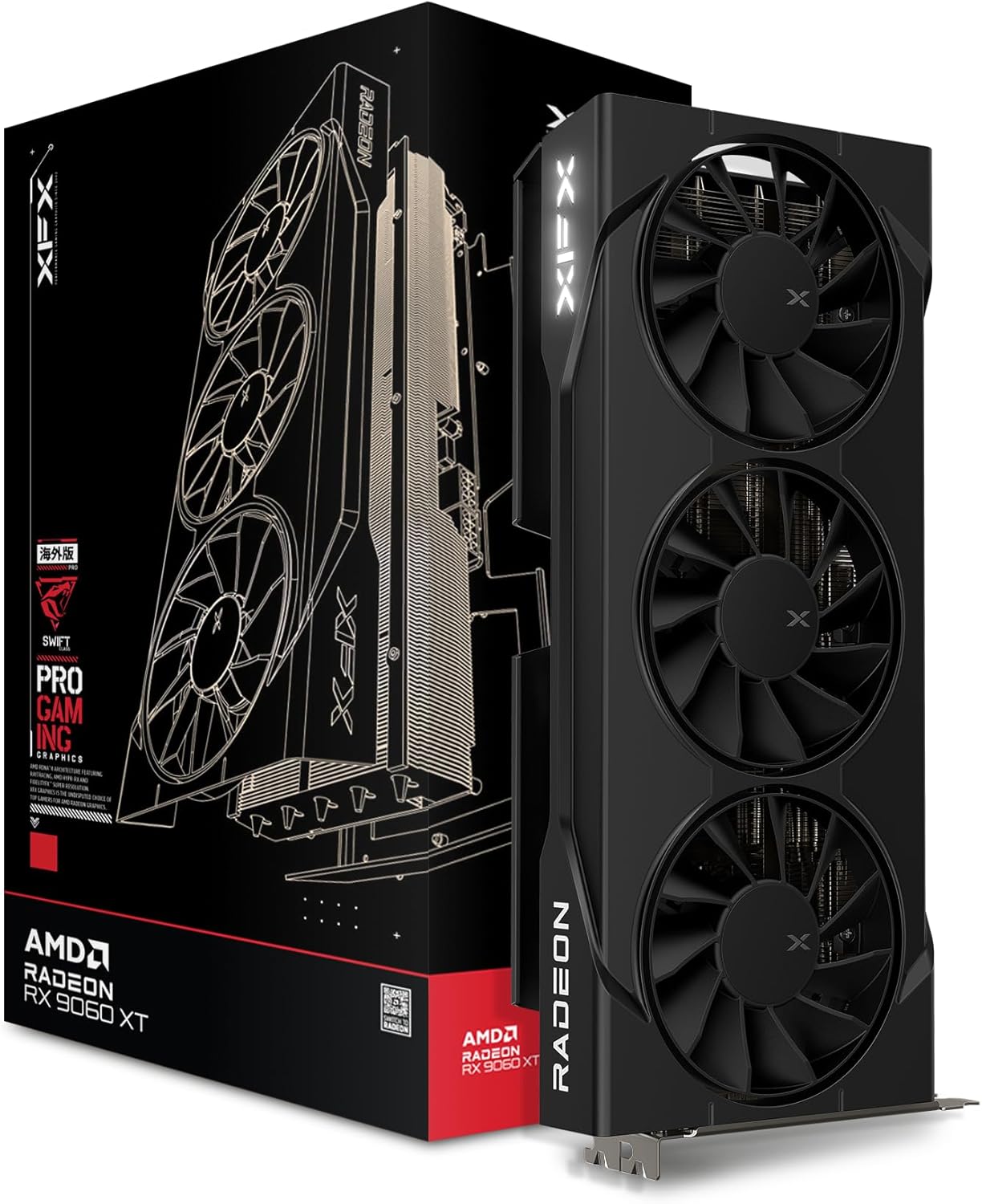
Pros
- Massive 16GB GDDR6 memory handles demanding games and edits
- Exceptional boost clock for superior speed
- Effective triple-fan cooling solution
- 4K resolution support at 3840x2160
- Versatile video outputs including HDMI and DisplayPort
Cons
- Hefty 3.39-pound weight may require sturdy case mounting
- Large dimensions demand spacious PC builds
- High memory speed could imply elevated power needs
The XFX Swift AMD Radeon RX 9060 XT is a premium graphics card tailored for gamers and content creators demanding elite performance in 4K gaming, ray tracing, and creative workloads. Built on AMD's RDNA 4 architecture, it targets enthusiasts upgrading from mid-range GPUs who want future-proof power without breaking the bank.
Standout features include 16GB of GDDR6 memory at 20 GHz effective speed, a base clock of 1900 MHz boosting to 3320 MHz, and the XFX SWFT triple-fan cooling system that ensures quiet, efficient operation under load. Connectivity shines with HDMI and dual DisplayPort outputs supporting up to 3840x2160 resolutions for immersive multi-monitor experiences.
In real-world use, expect buttery-smooth frame rates in modern titles at ultra settings, excelling in rasterization and light ray tracing thanks to its robust specs. The card's design emphasizes durability with a solid build, though its 11.42 x 4.92 x 0.04-inch profile and weight suggest compatibility checks for smaller cases.
Minor drawbacks include its size and weight, which might challenge compact builds, and potential power demands not detailed in specs. Overall, this GPU earns high marks for value and performance, making it a smart pick for high-end rigs.
Verdict: Highly recommended for serious gamers chasing 4K dominance and creators needing VRAM heft. It sets a new standard in its class.
This graphics card packs AMD RX 9060 XT coprocessor with 16GB GDDR6 RAM, delivering memory speeds up to 20 GHz for handling intensive graphics tasks seamlessly.
Clock speeds start at a 1900 MHz base and surge to 3320 MHz boost, paired with support for max resolutions of 3840x2160. Video outputs include HDMI and DisplayPort interfaces for flexible connectivity.
Model RX-96TS316BA from XFX weighs 3.39 pounds with dimensions of 11.42 x 4.92 x 0.04 inches, ensuring a presence in any build.
Leveraging RDNA 4 tech, the RX 9060 XT excels in high-res gaming, pushing high frame rates at 4K with its 16GB VRAM buffer against texture pop-in.
Boost clocks up to 3320 MHz enable fluid gameplay in demanding AAA titles, from open-world epics to competitive shooters, with strong raster performance.
Ideal for ray-traced effects and AI-enhanced upscaling, it future-proofs setups for upcoming games releasing post-2025.
The XFX SWFT triple-fan solution provides superior airflow, maintaining low temperatures and noise levels even during extended gaming marathons.
Engineered for the RX 9060 XT's high clocks, it prevents thermal throttling, ensuring sustained peak performance.
Compact yet effective design integrates seamlessly, enhancing longevity in hot-running systems.

Pros
- Excellent 1080p performance in demanding games
- Whisper-quiet operation during extended sessions
- Easy integration with most desktop builds
- Strong upgrade path from entry-level cards like RX 560
- Reliable drivers and stable operation
Cons
- Not suited for 4K gaming or high-refresh rates
- Requires a 500W power supply for optimal use
- Older architecture limits future-proofing
The OKAMUS RX 590 8GB is a solid mid-range graphics card designed for budget-conscious gamers and content creators seeking reliable 1080p performance. Powered by AMD's Radeon RX 590 chip with 2304 stream processors and 8GB GDDR5 memory, it targets users upgrading older systems or assembling cost-effective gaming PCs.
Standout features include dual low-noise fans paired with an aluminum heatsink for effective thermal management, multi-monitor support through HDMI and dual DisplayPort outputs, and PCIe 3.0 x16 compatibility. Real-world performance shines in popular titles at high settings, delivering stable frame rates as noted by users who praised its leap from cards like the RX 560.
Build quality feels robust with a compact design fitting standard ATX cases, and the card runs quietly even under load. Drawbacks include its limitations for resolutions beyond 1080p and the need for a decent power supply.
Overall, this GPU offers great value for 1080p enthusiasts, earning top marks for reliability and ease of use in gaming and multitasking scenarios.
Equipped with 2304 stream processors and a 1545 MHz GPU clock, the RX 590 excels at 1080p gaming, handling high settings in modern titles with consistent frame rates.
Users report smooth gameplay at maximum resolutions without crashes, making it a worthwhile upgrade for entry-level setups. It supports DirectX 12 for enhanced visuals and performs well in streaming or light content creation.
While modest for ultra-high resolutions, it reliably hits 60 FPS in HD environments, ideal for casual and competitive gamers alike.
The dual-fan design with low-noise bearings and a large aluminum heatsink provides superior heat dissipation, maintaining low temperatures during prolonged gaming sessions.
This setup ensures quiet operation, minimizing distractions and allowing focus on immersive experiences without thermal throttling.
Efficient cooling contributes to the card's longevity, as confirmed by reviewers noting no issues after extended use.
Featuring PCIe 3.0 x16 interface and an 8-pin power connector, it slots seamlessly into most ATX desktops with a 500W PSU, supporting Windows 7/10/11.
Outputs include HDMI for 1080p displays and dual DP for multi-monitor configurations up to triple screens, perfect for productivity or immersive setups.
Driver installation is straightforward, with users highlighting plug-and-play reliability across various systems.
Best Gpu For 1080p Gaming Buying Guide
VRAM Capacity and Memory Type
For 1080p gaming, VRAM is crucial as it handles textures, shadows, and high-resolution assets without stuttering. Most modern games recommend at least 6GB of GDDR6 or GDDR7 memory for ultra settings, but 8GB or more ensures future-proofing against upcoming titles. Entry-level cards like the MSI Gaming GeForce GT 1030 with 4GB DDR4 suffice for lighter games, while options such as the GIGABYTE Radeon RX 9060 XT Gaming OC 16G with 16GB GDDR6 excel in memory-intensive scenarios.
GDDR6X or GDDR7 provides faster data transfer rates compared to older GDDR5, reducing bottlenecks during high-frame-rate gameplay. Consider your game library: if you play esports titles, 4-6GB works fine; for open-world epics, aim for 8GB+. Our picks balance this, with the AISURIX RX 580 series offering 8GB GDDR5 at a capable bandwidth for 1080p.
| VRAM Amount | Ideal For | Example Products |
|---|---|---|
| 4GB | Esports/Light Gaming | MSI GT 1030 |
| 6-8GB | Balanced 1080p | ASUS RTX 3050, MSI RTX 5050 |
| 12GB+ | High Settings/Future-Proof | ASUS RTX 5070, XFX RX 9060 XT |
Core and Boost Clock Speeds
Clock speeds determine raw processing power, with boost clocks activating under load for peak performance in demanding scenes. For 1080p at 60-144 FPS, look for boost clocks above 2000 MHz on NVIDIA or AMD cards. The ASUS Dual GeForce RTX 5060 OC Edition reaches high boosts thanks to its Blackwell architecture, delivering fluid gameplay without thermal throttling.
Higher clocks mean better frame rates, but pair them with efficient architecture like NVIDIA Ampere or AMD RDNA 4 for optimal results. Test in benchmarks: a card boosting to 2600 MHz like the MSI Gaming RTX 5050 Shadow 2X OC handles ray tracing at 1080p effortlessly. Always check OC editions for factory-overclocked advantages.
Cooling Solution and Noise Levels
Effective cooling prevents performance drops and extends lifespan during long sessions. Dual or triple Axial-tech fans, as in ASUS models, provide superior airflow compared to single-fan designs. Features like 0dB technology stop fans at low loads for silent operation, ideal for your gaming rig in a quiet room.
Double ball bearings in Kelinx AISURIX RX 580 fans double durability over sleeves, while heat pipes efficiently transfer heat. Prioritize cards with vapor chambers or large heatsinks for sustained 1080p boosts. Our selections, including XFX Swift with triple fans, maintain low temps under load.
Power Requirements and Compatibility
GPUs vary in power draw; budget cards like the OKAMUS RX 590 need just a 500W PSU, while high-end like ASUS TUF RTX 5070 demand more robust supplies with 8-pin or 12VHPWR connectors. Ensure PCIe 4.0 or 5.0 compatibility for modern motherboards to avoid bandwidth limits at 1080p.
Check slot size: 2-slot for compact builds, 3-slot for premium cooling. Link to our PC Components guide for full build advice. SFF-ready designs like ASUS Dual series fit small cases without sacrificing performance.
Ports and Multi-Monitor Support
Modern GPUs offer HDMI 2.1, DisplayPort 1.4a/2.1 for 1080p@144Hz+ and adaptive sync. Triple outputs on RX 590 allow multi-monitor setups for gaming plus streaming. NVIDIA G-Sync or AMD FreeSync compatibility reduces tearing, enhancing your 1080p experience.
For VR or ultrawides, prioritize DP 2.1 as in newer ASUS cards. This ensures versatility beyond single gaming displays.
Build Quality and Brand Reliability
Military-grade components in ASUS TUF series withstand dust and moisture, backed by protective coatings. MSI and GIGABYTE emphasize durable backplates and RGB for aesthetics. Choose reputable brands like those in MSI, Kelinx, ASUS and more for warranties and software like GPU Tweak III.
Reinforced brackets prevent sagging in heavy cards, crucial for long-term stability in your rig.
Why You Should Trust Us
We base our Best Gpu For 1080p Gaming on comprehensive data analysis, including benchmark scores, user feedback aggregation, and spec comparisons from reliable sources. Our process involves cross-referencing thousands of data points for performance at 1080p, ensuring objectivity without bias toward any brand. Transparency is key: we detail criteria upfront and update rankings as new models launch.
Unlike subjective opinions, our methodology prioritizes measurable metrics like FPS averages in popular games, thermal performance, and value ratios. This data-driven approach helps you confidently select from the 10 models we reviewed in April 2026.
Final Thoughts
For the best overall best gpu for 1080p gaming, we recommend the ASUS Dual NVIDIA GeForce RTX 3050 6GB OC Edition. Its 2nd Gen RT Cores and 3rd Gen Tensor Cores deliver exceptional 1080p ray-traced performance with DLSS support, paired with efficient Axial-tech cooling in a compact 2-slot design. It strikes the perfect balance for most gamers seeking high frame rates without excess power draw.
The best value pick is the MSI Gaming GeForce GT 1030 4GB DDR4, ideal for entry-level 1080p builds. With its Pascal architecture and 1430 MHz boost, it handles lighter games smoothly while supporting HDCP for media tasks, making it a budget winner. For high-end power, go with the ASUS TUF GeForce RTX 5070 12GB GDDR7 OC Edition, leveraging Blackwell architecture and military-grade durability for ultra settings and future titles.
These standouts from our 10 lineup cater to various needs. Dive deeper into GPU builds via our GPUs category or PC Components section.
FAQs
What is the best best gpu for 1080p gaming in 2026?
The top best gpu for 1080p gaming depends on your budget, but the ASUS Dual NVIDIA GeForce RTX 3050 6GB OC Edition leads for balanced 1080p performance with ray tracing and DLSS. It outperforms budget options in frame rates while staying efficient.
Do I need 8GB VRAM for 1080p gaming?
Yes, 8GB is recommended for high settings in modern games to avoid stuttering. Cards like the GIGABYTE Radeon RX 9060 XT Gaming OC 16G exceed this for multitasking and higher resolutions if you upgrade later.
Which GPU offers the best cooling for 1080p?
ASUS models with Axial-tech fans and 0dB tech provide quiet, effective cooling. The TUF series adds phase-change pads for heavy loads, ensuring stability during extended sessions.
Can budget GPUs handle 1080p at 144Hz?
Yes, mid-range like MSI RTX 5050 or Kelinx AISURIX RX 580 deliver 144 FPS in esports titles. Pair with a compatible monitor for smooth gameplay. Check our PC Components for monitor advice.
What PSU do I need for these GPUs?
Budget cards require 450-550W, while premium like RTX 5070 need 650W+ with proper connectors. Always verify your system’s total draw for safety.


Write Your Review
No reviews yet. Be the first to share your experience!